Profit-Maximizing Behavior in Competitive Factor Markets · 完全竞争要素市场中的利润最大化行为
| English | 中文 | Pinyin · 拼音 |
|---|---|---|
| perfectly competitive factor market/ˈpɜːfektlɪ kəmˈpetɪtɪv ˈfæktə ˈmɑːkɪt/ | 完全竞争要素市场 | wán quán jìng zhēng yào sù shì chǎng |
| wage taker/weɪdʒ ˈteɪkə/ | 工资接受者 | gōng zī jiē shòu zhě |
| cost-minimizing rule/kɒst ˈmɪnɪmaɪzɪŋ ruːl/ | 成本最小化法则 | chéng běn zuì xiǎo huà fǎ zé |
Hiring when you're one of many
- Imagine thousands of firms all hiring the same kind of worker.
- No single firm is big enough to change the going wage.
- Each simply pays the market wage and decides how many to hire.
- This is a perfectly competitive factor market 完全竞争要素市场.
当你只是众多雇主之一
- 想象成千上万家企业都在雇同一种工人。
- 没有哪一家大到能改变通行的工资。
- 每家只是照市场工资付钱,再决定雇多少。
- 这就是完全竞争要素市场(perfectly competitive factor market)。
A wage taker hires where MRP = W
- Each firm is a wage taker 工资接受者 — it can hire all it wants at the market wage.
- So its marginal factor cost is constant and equal to the wage, $W$.
- The hiring rule simplifies to $MRP = W$.
工资接受者雇到 MRP = W
- 每家企业都是工资接受者(wage taker)——按市场工资想雇多少雇多少。
- 所以它的边际要素成本是恒定的,等于工资 $W$。
- 雇佣法则简化为 $MRP = W$。
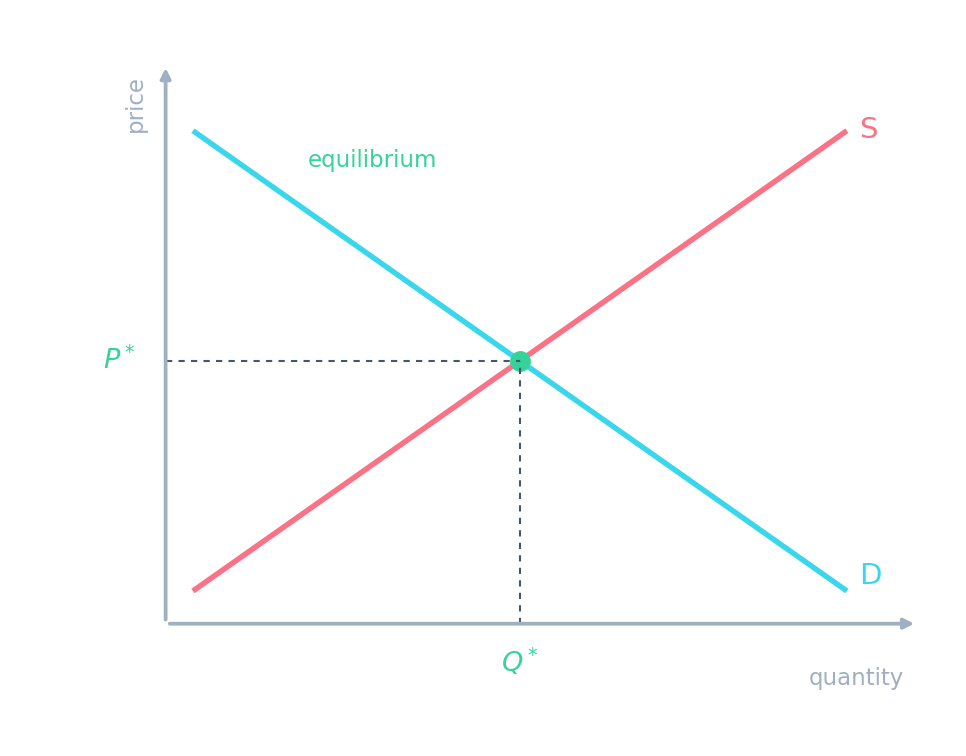
The labour market · 劳动力市场
In a competitive factor market the wage is set by market supply and demand; each firm takes that wage and hires where its MRP meets it. · 在完全竞争要素市场,工资由市场供求决定;每家企业接受这个工资,在自己的 MRP 与它相遇处雇人。
A firm in a competitive factor market is a wage taker, so its marginal factor cost is: · 完全竞争要素市场中的企业是工资接受者,所以它的边际要素成本是:
It can hire any number at the market wage, so each extra worker costs exactly that wage. · 它按市场工资能雇任意数量,所以每多一个工人的成本恰好是那个工资。
In a competitive factor market the hiring rule simplifies to MRP = ______. · 在完全竞争要素市场,雇佣法则简化为 MRP = ______。
Since MFC equals the wage W, the firm hires where MRP = W. · 因为 MFC 等于工资 W,企业在 MRP = W 处雇人。
A single wage-taking firm can lower the market wage by hiring fewer workers. · 单个工资接受型企业可以通过少雇工人来压低市场工资。
It is too small to affect the market wage — it simply takes the going wage. · 它太小,无法影响市场工资——只能接受通行工资。
The cost-minimizing rule
- When a firm uses several inputs, it should spend its budget so the last dollar on each brings the same extra output.
- The cost-minimizing rule 成本最小化法则: $\dfrac{MP_L}{P_L} = \dfrac{MP_K}{P_K}$.
- If one input gives more output per dollar, shift spending toward it until the ratios equalise.
成本最小化法则
- 当企业使用多种投入时,应让花在每种投入上的最后一元带来相同的额外产出。
- 成本最小化法则(cost-minimizing rule):$\dfrac{MP_L}{P_L} = \dfrac{MP_K}{P_K}$。
- 如果某种投入每元带来的产出更多,就把支出向它倾斜,直到各比值相等。
The cost-minimizing combination of inputs sets: · 成本最小化的投入组合满足:
Equalising MP/P across inputs means the last dollar buys the same extra output everywhere. · 让各投入的 MP/P 相等,意味着最后一元在每处买到相同的额外产出。
A worked case
- Labour costs 20 with a marginal product of 40, so $MP_L/P_L = 40/20 = 2$ units per dollar.
- Capital costs 10 with a marginal product of 30, so $MP_K/P_K = 30/10 = 3$ units per dollar.
- Capital gives more output per dollar, so use more capital and less labour until the ratios meet.
- That balance gives the chosen output at the lowest total cost.
一个例子
- 劳动成本为 20、边际产量为 40,所以 $MP_L/P_L = 40/20 = 2$ 单位每元。
- 资本成本为 10、边际产量为 30,所以 $MP_K/P_K = 30/10 = 3$ 单位每元。
- 资本每元带来的产出更多,所以多用资本、少用劳动,直到两个比值相等。
- 这种平衡让既定产出的总成本最低。
Capital costs 10 with a marginal product of 30. What is its marginal product per dollar (MP/P)? · 资本成本为 10,边际产量为 30。它每元的边际产量(MP/P)是多少?
MP_K/P_K = 30/10 = 3 units per dollar — more than labour's 2, so use more capital. · MP_K/P_K = 30/10 = 3 单位每元——高于劳动的 2,所以多用资本。
Labour gives 2 units per dollar and capital gives 3. To cut costs, the firm should use: · 劳动每元 2 单位,资本每元 3 单位。为降低成本,企业应该:
Capital gives more output per dollar, so shift toward it until MP/P equalises. · 资本每元产出更多,所以向它倾斜,直到 MP/P 相等。
In a perfectly competitive factor market each firm is a wage taker and hires where $MRP = W$. With several inputs, follow the cost-minimizing rule $\dfrac{MP_L}{P_L} = \dfrac{MP_K}{P_K}$ — shift toward whichever input gives more output per dollar.
在完全竞争要素市场里,每家企业都是工资接受者,在 $MRP = W$ 处雇人。使用多种投入时,遵循成本最小化法则 $\dfrac{MP_L}{P_L} = \dfrac{MP_K}{P_K}$——把支出向每元产出更多的那种投入倾斜。