Monopsonistic Markets · 买方垄断市场
| English | 中文 | Pinyin · 拼音 |
|---|---|---|
| monopsony/ˈmɒnəʊpsəni/ | 买方垄断 | mǎi fāng lǒng duàn |
| marginal factor cost/ˈmɑːdʒɪnl ˈfæktə kɒst/ | 边际要素成本 | biān jì yào sù chéng běn |
| supply curve/səˈplaɪ kɜːv/ | 供给曲线 | gōng jǐ qū xiàn |
| minimum wage/ˈmɪnɪməm weɪdʒ/ | 最低工资 | zuì dī gōng zī |
The only employer in town
- One factory in a small town, and it is the only place hiring.
- Workers have nowhere else to go — so who holds the power now?
- This is the mirror image of a monopoly: a single buyer of labour.
- It is called a monopsony 买方垄断.
镇上唯一的雇主
- 小镇上只有一家工厂,而且是唯一招人的地方。
- 工人无处可去——那么现在权力在谁手里?
- 这是垄断的镜像:劳动的单一买家。
- 它叫做买方垄断(monopsony)。
A monopsony is a factor market with: · 买方垄断是这样一种要素市场:
It is the mirror image of a monopoly — one buyer instead of one seller. · 它是垄断的镜像——一个买家而非一个卖家。
Marginal factor cost above the wage
- Because the monopsonist is the whole market, to hire more it must raise the wage — and pay it to every worker, not just the last.
- So the marginal factor cost 边际要素成本 of one more worker is above the wage on the supply curve.
- This mirrors a monopolist, whose marginal revenue is below its price.
边际要素成本高于工资
- 因为买方垄断者就是整个市场,想多雇就必须涨工资——而且要付给每一个工人,不只是最后一个。
- 所以多雇一个工人的边际要素成本(marginal factor cost)高于供给曲线上的工资。
- 这与垄断者相映成趣——垄断者的边际收入低于其价格。
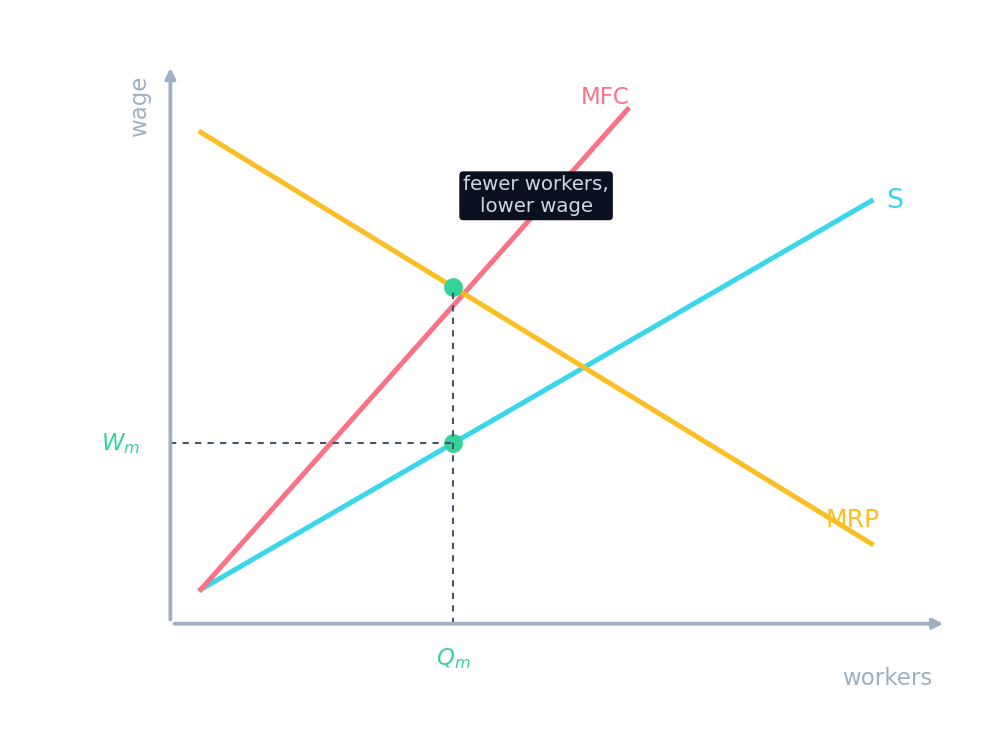
For a monopsony, the marginal factor cost of one more worker is above the wage on the supply curve. · 对买方垄断,多雇一个工人的边际要素成本高于供给曲线上的工资。
To hire one more it must raise the wage for every worker, so MFC exceeds the wage. · 多雇一个就要给每个工人涨工资,所以 MFC 超过工资。
Fewer workers, lower wage
- The monopsonist still hires where $MRP = MFC$, then reads the wage off the supply curve 供给曲线 at that quantity.
- The result: it hires fewer workers than a competitive market, and pays a lower wage.
- That is why a monopsony is inefficient — workers are paid less than the value they add.
更少的工人,更低的工资
- 买方垄断者仍在 $MRP = MFC$ 处雇人,再在那个数量从供给曲线(supply curve)读出工资。
- 结果:它雇的工人比竞争市场更少,付的工资更低。
- 这就是为什么买方垄断是无效率的——工人得到的报酬少于他们创造的价值。
Competitive vs monopsony · 竞争与买方垄断
A monopsony's marginal factor cost lies above the supply wage, so it hires fewer workers at a lower wage than a competitive market would. · 买方垄断的边际要素成本高于供给工资,所以它比竞争市场雇更少的工人、付更低的工资。
Compared with a competitive factor market, a monopsony: · 与完全竞争要素市场相比,买方垄断:
It hires where MRP = MFC but pays the lower wage off supply — fewer workers, lower pay. · 它在 MRP = MFC 处雇人,却付从供给读出的更低工资——更少工人、更低报酬。
A monopsonist chooses its quantity where MRP equals ______, then reads the wage off supply. · 买方垄断者在 MRP 等于______处选择数量,再从供给读出工资。
MRP = MFC gives the quantity; the wage comes from the supply curve, which is lower. · MRP = MFC 决定数量;工资来自供给曲线,更低。
Match each market to what it pays workers. · 把每种市场与它付给工人的报酬配对。
Competition pays the MRP; a monopsony pays less, which is why it is inefficient. · 竞争按 MRP 付酬;买方垄断付得更少,所以它无效率。
The minimum-wage twist
- In a competitive market, a minimum wage 最低工资 above equilibrium causes unemployment.
- But in a monopsony, a well-set minimum wage removes the employer's power to push the wage down.
- So it can raise both the wage and the number employed at the same time — a surprising result.
最低工资的意外转折
- 在竞争市场里,高于均衡的最低工资(minimum wage)会造成失业。
- 但在买方垄断里,设置得当的最低工资拿走了雇主压低工资的权力。
- 于是它能同时提高工资和就业人数——一个出人意料的结果。
In a monopsony, a well-set minimum wage can: · 在买方垄断里,设置得当的最低工资可以:
It removes the employer's power to hold the wage down, so wage and employment can both rise. · 它拿走雇主压低工资的权力,所以工资和就业都能上升。
A monopsony is a single buyer of labour, so its marginal factor cost lies above the supply-curve wage. It hires where $MRP = MFC$ but pays the lower wage off supply — fewer workers, lower wage. A well-set minimum wage can raise both wage and employment.
买方垄断是劳动的单一买家,所以其边际要素成本高于供给曲线上的工资。它在 $MRP = MFC$ 处雇人,却支付从供给读出的更低工资——更少工人、更低工资。设置得当的最低工资能同时提高工资和就业。