Introduction to Factor Markets · 要素市场导论
| English | 中文 | Pinyin · 拼音 |
|---|---|---|
| factor market/ˈfæktə ˈmɑːkɪt/ | 要素市场 | yào sù shì chǎng |
| factors of production/ˈfæktəz ɒv prəˈdʌkʃn/ | 生产要素 | shēng chǎn yào sù |
| derived demand/dɪˈraɪvd dɪˈmænd/ | 派生需求 | pài shēng xū qiú |
| marginal revenue product/ˈmɑːdʒɪnl ˈrevənjuː ˈprɒdʌkt/ | 边际收益产品 | biān jì shōu yì chǎn pǐn |
| marginal factor cost/ˈmɑːdʒɪnl ˈfæktə kɒst/ | 边际要素成本 | biān jì yào sù chéng běn |
| hiring rule/ˈhaɪərɪŋ ruːl/ | 雇佣法则 | gù yōng fǎ zé |
| factor demand curve/ˈfæktə dɪˈmænd kɜːv/ | 要素需求曲线 | yào sù xū qiú qū xiàn |
Now the firm is the buyer
- Until now, firms have been sellers of goods.
- But to make those goods, a firm must first buy workers, land, and machines.
- In a factor market 要素市场 the firm is on the buying side.
- Here it hires the factors of production 生产要素 it needs.
现在企业是买家
- 到目前为止,企业一直是商品的卖家。
- 但要生产这些商品,企业得先购买工人、土地和机器。
- 在要素市场(factor market)里,企业站在买的一边。
- 在这里,它雇用所需的生产要素(factors of production)。
Demand for a factor is derived
- No one wants a worker for their own sake — only for the goods that worker helps make.
- So factor demand is a derived demand 派生需求: it comes from the value of the product.
- When the product becomes more valuable, the demand for the workers who make it rises.
对要素的需求是派生的
- 没有人为了工人本身而要工人——只为那个工人帮忙生产的商品。
- 所以要素需求是一种派生需求(derived demand):它来自产品的价值。
- 当产品变得更有价值,生产它的工人的需求也随之上升。
Factor demand is a "derived demand" because it comes from: · 要素需求是"派生需求",因为它来自:
Firms want a factor only for the goods it produces, so demand is derived from the product. · 企业要一个要素只为它生产的商品,所以需求派生自产品。
Hire until MRP = MFC
- The marginal revenue product 边际收益产品 (MRP) is the extra revenue from one more unit of the factor: $MRP = MP \times P$.
- The marginal factor cost 边际要素成本 (MFC) is the extra cost of hiring one more unit.
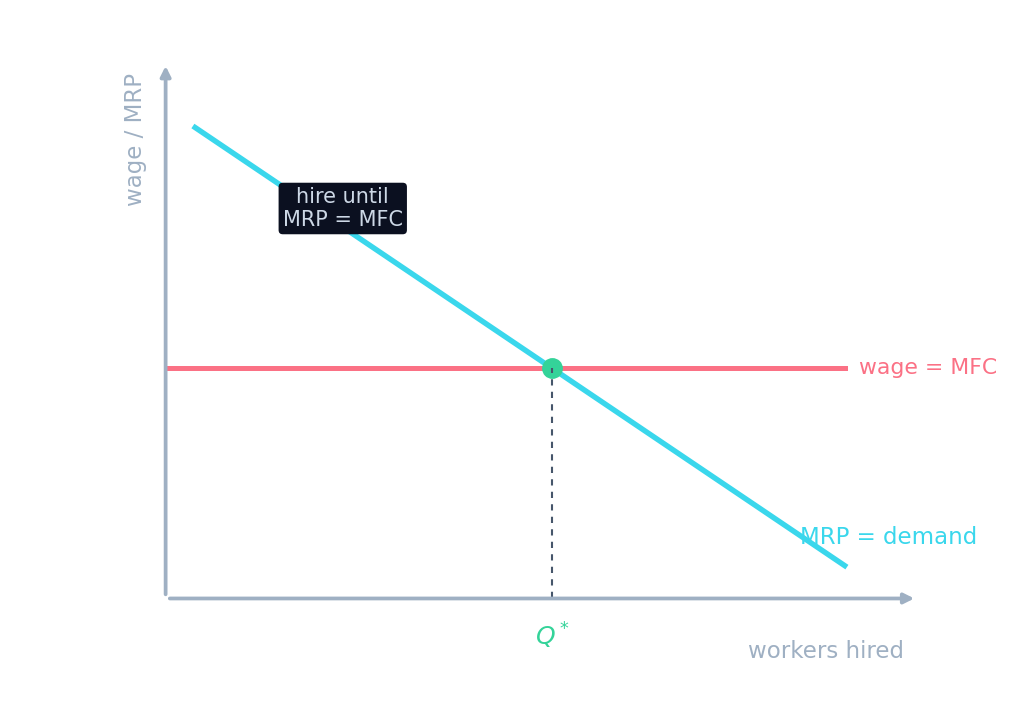
- The hiring rule 雇佣法则: keep hiring until $MRP = MFC$.
雇到 MRP = MFC 为止
- 边际收益产品(marginal revenue product,MRP)是多用一单位要素带来的额外收入:$MRP = MP \times P$。
- 边际要素成本(marginal factor cost,MFC)是多雇一单位的额外成本。
- 雇佣法则(hiring rule):一直雇到 $MRP = MFC$。
Hire, or don't? · 雇,还是不雇?
A firm hires a worker only if the extra revenue (MRP) is at least the extra cost (the wage). Hire while MRP ≥ wage; stop when MRP falls below it. · 只有当额外收入(MRP)不低于额外成本(工资)时,企业才雇一个工人。MRP ≥ 工资就雇;MRP 低于工资就停。
For a competitive seller, MRP equals marginal product times the product . · 对竞争性卖家,MRP 等于边际产量乘以产品。
MRP = MP × P — the extra output valued at the price it sells for. · MRP = MP × P——额外产出按其售价计价。
A worker adds 8 loaves a day, and each loaf sells for 5. What is this worker's marginal revenue product? · 一个工人每天多做 8 个面包,每个面包卖 5。这个工人的边际收益产品是多少?
MRP = MP × P = 8 × 5 = 40. · MRP = MP × P = 8 × 5 = 40。
A firm keeps hiring workers until: · 企业一直雇工人,直到:
At MRP = MFC the last worker just pays for themselves; beyond it they cost more than they bring. · 在 MRP = MFC 处最后一个工人刚好抵得上成本;再多则成本超过带来的收益。
A sixth worker adds revenue (MRP) of 30, but the wage is 40. The firm should: · 第六个工人带来 30 的收入(MRP),但工资是 40。企业应该:
MRP (30) is below MFC (40), so hiring that worker would shrink profit. · MRP(30)低于 MFC(40),所以雇这个工人会减少利润。
The MRP curve is factor demand
- As more workers are added, marginal product falls (diminishing returns).
- So the MRP curve slopes downward — and that curve is the firm's factor demand curve 要素需求曲线.
MRP 曲线就是要素需求
- 随着工人增加,边际产量(marginal product)下降(收益递减)。
- 所以 MRP 曲线向下倾斜——而这条曲线就是企业的要素需求曲线(factor demand curve)。
The MRP curve slopes downward because marginal product falls as more workers are added. · MRP 曲线向下倾斜,因为随着工人增加,边际产量下降。
Diminishing marginal product makes each extra worker's MRP smaller — a downward factor demand. · 边际产量递减使每个额外工人的 MRP 更小——一条向下的要素需求。
In a factor market the firm is a buyer, and its demand is derived from the product. Hire until $MRP = MFC$, where MRP $= MP \times P$. Because marginal product falls, the downward MRP curve is the firm's factor demand.
在要素市场里企业是买家,其需求派生自产品。一直雇到 $MRP = MFC$,其中 MRP $= MP \times P$。因为边际产量下降,向下的 MRP 曲线就是企业的要素需求。