Oligopoly and Game Theory · 寡头垄断与博弈论
| English | 中文 | Pinyin · 拼音 |
|---|---|---|
| oligopoly/ˌɒlɪˈɡɒpəli/ | 寡头垄断 | guǎ tóu lǒng duàn |
| cartel/kɑːˈtel/ | 卡特尔 | kǎ tè ěr |
| mutual interdependence/ˈmjuːtʃuːəl ˌɪntədɪˈpendəns/ | 相互依存 | xiāng hù yī cún |
| collusion/kəˈluːʒn/ | 合谋 | hé móu |
| game theory/ɡeɪm ˈθɪəri/ | 博弈论 | bó yì lùn |
| payoff matrix/ˈpeɪɒf ˈmeɪtrɪks/ | 收益矩阵 | shōu yì jǔ zhèn |
| dominant strategy/ˈdɒmɪnənt ˈstrætədʒi/ | 优势策略 | yōu shì cè lüè |
| Nash equilibrium/næʃ ˌiːkwɪˈlɪbrɪəm/ | 纳什均衡 | nà shén jūn héng |
| prisoner's dilemma/ˈprɪzənəz daɪˈlemə/ | 囚徒困境 | qiú tú kùn jìng |
When rivals watch each other
- Just a handful of phone networks. A few big airlines.
- Each one is large enough that its choices change the market.
- So before any firm acts, it asks: "what will my rivals do?"
- That strategic tension defines an oligopoly 寡头垄断.
当对手互相盯着彼此
- 只有屈指可数的几家手机运营商。几家大航空公司。
- 每一家都大到它的选择会改变市场。
- 所以任何一家在行动前都会问:"我的对手会怎么做?"
- 这种战略上的张力,定义了寡头垄断(oligopoly)。
Interdependence and cartels
- An oligopoly's defining feature is mutual interdependence 相互依存 — each firm's best move depends on its rivals'.
- Firms would love to act like one monopoly. Through collusion 合谋 they may form a cartel 卡特尔 to cut output and raise prices.
- But cartels are unstable: every member is tempted to cheat by secretly selling more.
相互依存与卡特尔
- 寡头垄断的定义特征是相互依存(mutual interdependence)——每家的最优行动取决于对手。
- 企业很想像一个垄断者那样行动。通过合谋(collusion),它们可能组成卡特尔(cartel),减产抬价。
- 但卡特尔不稳定:每个成员都想偷偷多卖来作弊。
The defining feature of an oligopoly is: · 寡头垄断的定义特征是:
With only a few firms, each must consider how rivals will react. · 只有几家企业,每家都必须考虑对手会如何反应。
When firms collude to restrict output and raise prices, they form a . · 当企业合谋限制产量、抬高价格时,它们组成一个。
A cartel acts like a monopoly, but cheating makes it unstable. · 卡特尔像垄断者一样行动,但作弊使它不稳定。
Game theory and the payoff matrix
- Game theory 博弈论 studies these strategic choices with a payoff matrix 收益矩阵.
- A dominant strategy 优势策略 is a choice that is best no matter what the rival does.
- A Nash equilibrium 纳什均衡 is an outcome where neither firm can do better by changing its own choice alone.
博弈论与收益矩阵
- 博弈论(game theory)用收益矩阵(payoff matrix)研究这些战略选择。
- 优势策略(dominant strategy)是无论对手怎么做都最好的选择。
- 纳什均衡(Nash equilibrium)是一种结果:任何一家单独改变自己的选择都无法变得更好。
Name the game-theory idea · 说出这个博弈论概念
A dominant strategy is best no matter what the rival does; a Nash equilibrium is where no one can improve alone; a cartel is a collusive agreement. · 优势策略无论对手怎么做都最好;纳什均衡是任何人单独都无法改善的地方;卡特尔是合谋协议。
A dominant strategy is a choice that is best: · 优势策略是这样一种选择,它最好的条件是:
It beats the alternatives regardless of the rival's choice. · 无论对手怎么选,它都胜过其他选项。
At a Nash equilibrium, no firm can improve its payoff by changing only its own choice. · 在纳什均衡处,没有企业能仅靠改变自己的选择来提高收益。
That is exactly what makes a Nash equilibrium stable. · 这正是纳什均衡稳定的原因。
The prisoner's dilemma
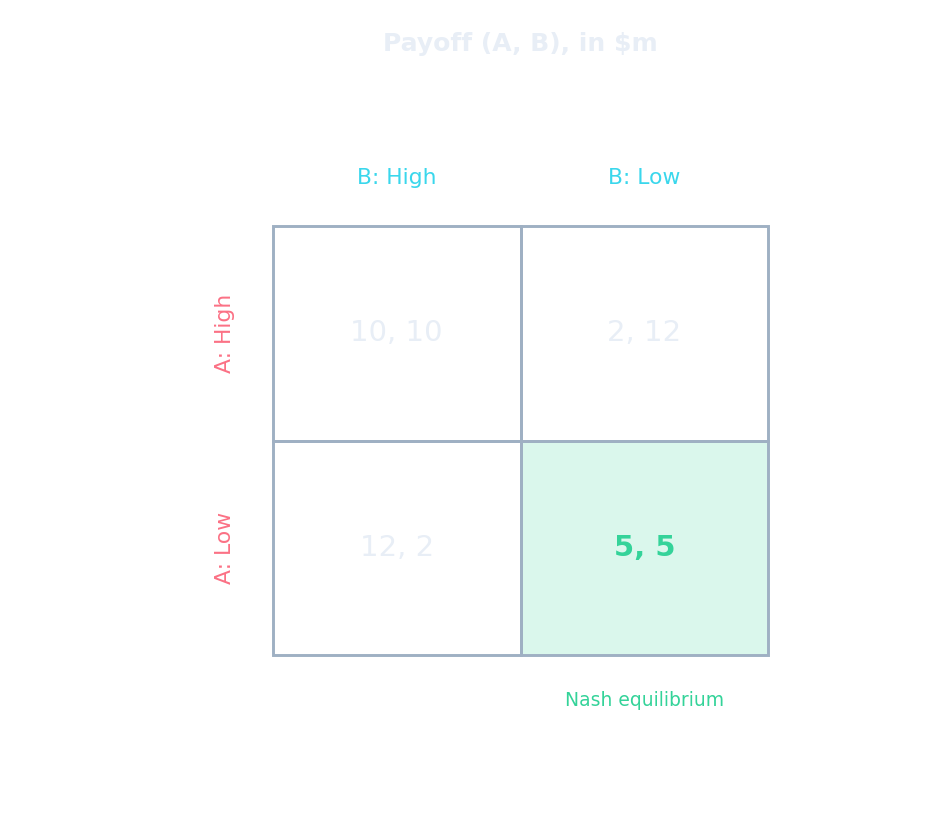
- In a prisoner's dilemma 囚徒困境, both firms have a dominant strategy to compete.
- So they reach a Nash equilibrium where both earn less than if they had cooperated.
- Rational self-interest blocks the better joint outcome — which is exactly why cartels keep collapsing.
囚徒困境
- 在囚徒困境(prisoner's dilemma)中,两家企业都有竞争的优势策略。
- 于是它们到达一个纳什均衡,在那里两家都比合作时赚得更少。
- 理性的自利挡住了更好的共同结果——这正是卡特尔不断瓦解的原因。
Both firms earn 10 if both keep prices high, 5 if both go low, but a lone undercutter earns 12 (rival gets 2). The Nash equilibrium is: · 两家都高价各赚 10,都低价各赚 5,单独降价者赚 12(对手得 2)。纳什均衡是:
"Low" is each firm's dominant strategy, so both pick it — earning 5 each, worse than the cooperative 10. · "低价"是每家的优势策略,所以两家都选它——各赚 5,不如合作的 10。
The result where both firms compete and end up worse off than cooperating is the prisoner's . · 两家都竞争、结果都不如合作的情形,叫做囚徒。
Rational self-interest leads to a worse joint outcome — the prisoner's dilemma. · 理性的自利导致更差的共同结果——囚徒困境。
An oligopoly has a few firms and mutual interdependence. They may collude into a cartel, but cheating makes it unstable. Game theory finds the dominant strategy and Nash equilibrium; the prisoner's dilemma shows why rivals compete even when cooperating would pay both more.
寡头垄断有少数几家企业和相互依存。它们可能合谋成卡特尔,但作弊使其不稳定。博弈论找出优势策略和纳什均衡;囚徒困境说明为什么对手会竞争,即使合作能让双方都赚得更多。