Perfect Competition · 完全竞争
| English | 中文 | Pinyin · 拼音 |
|---|---|---|
| perfect competition/ˈpɜːfekt ˌkɒmpəˈtɪʃn/ | 完全竞争 | wán quán jìng zhēng |
| free entry and exit/friː ˈentri ænd ˈeɡzɪt/ | 自由进出 | zì yóu jìn chū |
| price taker/praɪs ˈteɪkə/ | 价格接受者 | jià gé jiē shòu zhě |
| profit/ˈprɒfɪt/ | 利润 | lì rùn |
| loss/lɒs/ | 亏损 | kuī sǔn |
| productive efficiency/prəˈdʌktɪv ɪˈfɪʃənsi/ | 生产效率 | shēng chǎn xiào lǜ |
| allocative efficiency/ˈæləkətɪv ɪˈfɪʃənsi/ | 配置效率 | pèi zhì xiào lǜ |
When no one can set the price
- Picture a thousand wheat farms selling exactly the same grain.
- No single farm is big enough to nudge the market price.
- Each must simply accept whatever price the market gives.
- This extreme case, perfect competition 完全竞争, is the benchmark for every other market.
当没有人能定价
- 想象一千个麦农在卖一模一样的麦子。
- 没有任何一家大到能撬动市场价格。
- 每一家都只能接受市场给出的价格。
- 这个极端情形——完全竞争(perfect competition)——是所有其他市场的标尺。
The features of perfect competition
- Many tiny firms, selling identical products, with free entry and exit 自由进出 and perfect information.
- Because each firm is tiny and its product identical, it is a price taker 价格接受者 — it cannot set its own price.
- So the demand curve it faces is horizontal, and $P = AR = MR$.
完全竞争的特征
- 许多微小的企业,卖完全相同的产品,可以自由进出(free entry and exit),信息完全。
- 因为每家企业都很小、产品又一样,它是价格接受者(price taker)——无法自己定价。
- 所以它面对的需求曲线是水平的,且 $P = AR = MR$。
A perfectly competitive firm is a price taker, which means it: · 完全竞争企业是价格接受者,意思是它:
It is too small to influence the price, so it takes the market price as given. · 它太小,无法影响价格,所以把市场价格当作既定的。
For a competitive firm, price equals average revenue and also equals ______ revenue. · 对竞争企业,价格等于平均收入,也等于______收入。
Because every unit sells at the same price, P = AR = MR. · 因为每单位都以相同价格出售,P = AR = MR。
Select all · 所有 features of a perfectly competitive market. · 选出完全竞争市场的所有特征。
Many firms, identical products, and free entry/exit define perfect competition; one controlling firm is a monopoly. · 许多企业、相同产品、自由进出定义完全竞争;单一控制企业是垄断。
Short-run equilibrium
- The firm still produces where $MR = MC$; since $P = MR$, it produces where $P = MC$.
- Compare price with ATC at that quantity:
- $P > ATC$ → a profit 利润; $P = ATC$ → break-even; $P < ATC$ (but $\geq AVC$) → a loss 亏损, still producing.
短期均衡
- 企业仍在 $MR = MC$ 处生产;因为 $P = MR$,它在 $P = MC$ 处生产。
- 在那个数量把价格与 ATC 相比:
- $P > ATC$ → 利润(profit);$P = ATC$ → 盈亏平衡;$P < ATC$(但 $\geq AVC$)→ 亏损(loss),仍继续生产。
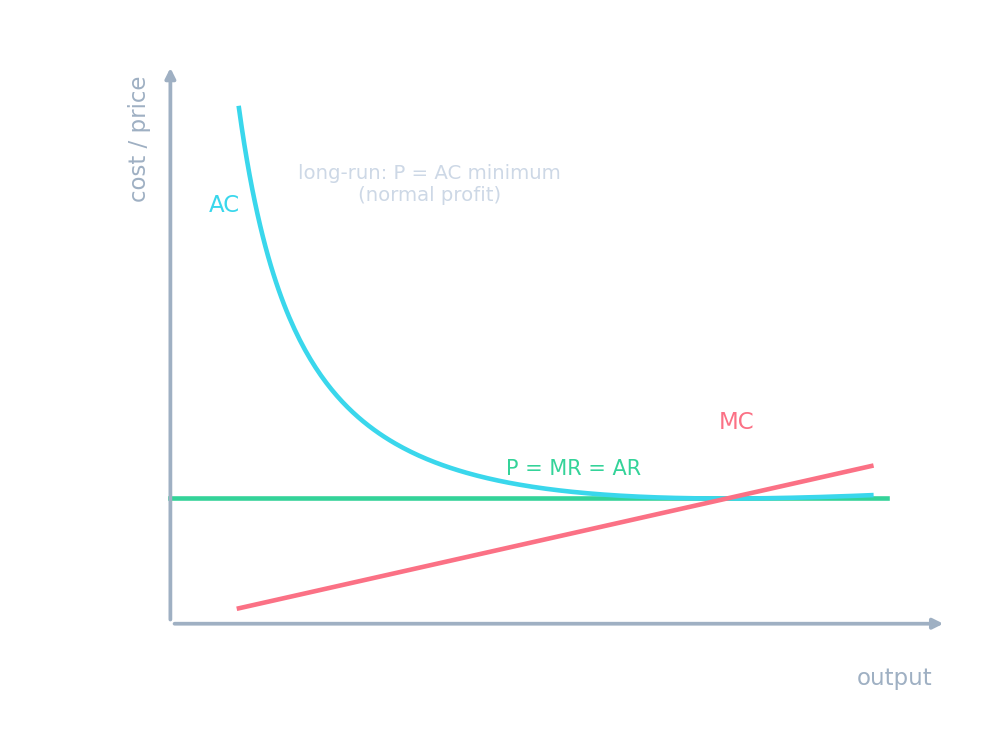
The competitive firm · 竞争企业
A price-taking firm faces a horizontal demand at the market price and produces where P = MC. In the long run, entry and exit push it to P = minimum ATC. · 价格接受者面对市场价格上的水平需求,在 P = MC 处生产。长期里,进入和退出把它推向 P = 最低 ATC。
A wheat farm sells at P = 5, produces Q = 1000 where MC = 5, and has ATC = 4. What is its short-run economic profit? · 一家麦农以 P = 5 出售,在 MC = 5 处生产 Q = 1000,ATC = 4。它的短期经济利润是多少?
Profit = (P − ATC) × Q = (5 − 4) × 1000 = 1000. That profit attracts new farms to enter. · 利润 = (P − ATC) × Q = (5 − 4) × 1000 = 1000。这利润吸引新麦农进入。
Long-run efficiency
- Free entry and exit erase any profit or loss, so the long run settles at $P = MC = \text{minimum } ATC$.
- Productive efficiency 生产效率: output is made at the lowest possible cost ($P = \text{minimum } ATC$).
- Allocative efficiency 配置效率: the right amount is made ($P = MC$).
- Achieving both at once is why perfect competition is the efficiency benchmark.
长期效率
- 自由进出抹平任何利润或亏损,所以长期停在 $P = MC = \text{minimum } ATC$。
- 生产效率(productive efficiency):产出以尽可能低的成本生产($P = \text{minimum } ATC$)。
- 配置效率(allocative efficiency):生产了恰当的数量($P = MC$)。
- 同时实现两者,正是完全竞争成为效率标尺的原因。
In long-run equilibrium, a perfectly competitive firm produces where: · 在长期均衡中,完全竞争企业在何处生产:
Entry and exit drive economic profit to zero at P = MC = minimum ATC. · 进入和退出把经济利润推到零,即 P = MC = 最低 ATC。
Match each type of efficiency to its condition. · 把每种效率与它的条件配对。
Perfect competition achieves both at once in the long run. · 完全竞争在长期同时实现两者。
A perfectly competitive firm is a price taker with $P = AR = MR$. It produces where $P = MC$, earning a profit, break-even, or loss short-run. Free entry and exit drive the long run to $P = MC = \text{minimum } ATC$ — both productive and allocative efficiency.
完全竞争企业是价格接受者,$P = AR = MR$。它在 $P = MC$ 处生产,短期可盈利、盈亏平衡或亏损。自由进出把长期推向 $P = MC = \text{minimum } ATC$——同时实现生产效率与配置效率。