Introduction to Imperfectly Competitive Markets · 不完全竞争市场导论
| English | 中文 | Pinyin · 拼音 |
|---|---|---|
| market power/ˈmɑːkɪt ˈpaʊə/ | 市场势力 | shì chǎng shì lì |
| imperfectly competitive market/ɪmˈpɜːfektlɪ kəmˈpetɪtɪv ˈmɑːkɪt/ | 不完全竞争市场 | bù wán quán jìng zhēng shì chǎng |
| price taker/praɪs ˈteɪkə/ | 价格接受者 | jià gé jiē shòu zhě |
| downward-sloping demand curve/ˈdaʊnwəd ˈsləʊpɪŋ dɪˈmænd kɜːv/ | 向下倾斜的需求曲线 | xiàng xià qīng xié de xū qiú qū xiàn |
| monopoly/məˈnɒpəli/ | 垄断 | lǒng duàn |
| monopolistic competition/məˈnɒpəlɪstɪk ˌkɒmpəˈtɪʃn/ | 垄断竞争 | lǒng duàn jìng zhēng |
| oligopoly/ˌɒlɪˈɡɒpəli/ | 寡头垄断 | guǎ tóu lǒng duàn |
| monopsony/ˈmɒnəʊpsəni/ | 买方垄断 | mǎi fāng lǒng duàn |
| barriers to entry/ˈbærɪəz tʊ ˈentri/ | 进入壁垒 | jìn rù bì lěi |
| economic profit/ˌiːkəˈnɒmɪk ˈprɒfɪt/ | 经济利润 | jīng jì lì rùn |
Most markets aren't "perfect"
- Perfect competition is a useful benchmark — but almost no real market matches it.
- Your phone network, favourite cafe, and local cinema all set their own prices.
- Any firm that can nudge its price has some market power 市场势力.
- The markets where this happens are called imperfectly competitive markets 不完全竞争市场.
大多数市场并不"完美"
- 完全竞争是个有用的标尺——但几乎没有真实市场符合它。
- 你的手机运营商、爱去的咖啡馆、附近的电影院,都自己定价。
- 任何能撬动自己价格的企业,都有一些市场势力(market power)。
- 出现这种情况的市场,被称为不完全竞争市场(imperfectly competitive market)。
Market power means a downward demand curve
- A price taker 价格接受者 faces a flat demand curve — it sells all it wants at the market price.
- An imperfect competitor faces a downward-sloping demand curve 向下倾斜的需求曲线 — to sell more, it must lower its price.
- That is exactly what market power is: the ability to set price above marginal cost.
市场势力意味着向下倾斜的需求曲线
- 价格接受者(price taker)面对一条水平的需求曲线——按市场价格能卖多少卖多少。
- 不完全竞争者面对向下倾斜的需求曲线(downward-sloping demand curve)——想多卖,就得降价。
- 这正是市场势力的含义:把价格定在边际成本之上的能力。
A firm with market power faces a demand curve that is: · 拥有市场势力的企业面对的需求曲线是:
To sell more it must lower its price — a downward-sloping demand curve. · 想多卖就得降价——一条向下倾斜的需求曲线。
A price taker can raise its price above the market price and still sell everything. · 价格接受者可以把价格提到市场价格之上,还能全部卖出。
A price taker must accept the market price; charging more loses all its buyers. · 价格接受者必须接受市场价格;收得更高就失去所有买家。
Four imperfect structures
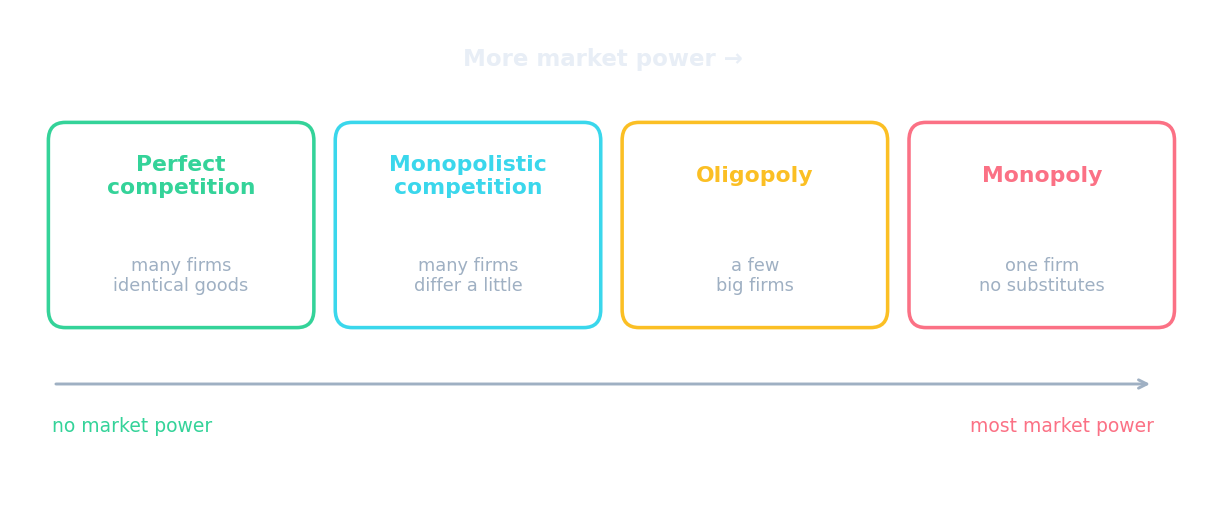
- Monopoly 垄断: one firm, no close substitutes.
- Oligopoly 寡头垄断: a few large firms that watch each other.
- Monopolistic competition 垄断竞争: many firms selling slightly different products.
- Monopsony 买方垄断: one big buyer — the mirror image of monopoly.
四种不完全结构
- 垄断(monopoly):一家企业,没有相近替代品。
- 寡头垄断(oligopoly):少数几家大企业,彼此盯着对方。
- 垄断竞争(monopolistic competition):许多企业,卖略有不同的产品。
- 买方垄断(monopsony):一个大买家——垄断的镜像。
Which market structure? · 哪种市场结构?
Structures differ by how many firms there are and how similar their products are — from perfect competition to monopoly. · 各种结构因企业数量和产品相似度而不同——从完全竞争到垄断。
Match each structure to its defining feature. · 把每种结构与它的定义特征配对。
They differ by number of firms, product similarity, and (for monopsony) being a buyer. · 它们的区别在于企业数量、产品相似度,以及(买方垄断)是买家。
Barriers to entry
- What lets these firms keep economic profit 经济利润 even in the long run is barriers to entry 进入壁垒.
- A barrier is anything that stops new firms coming in to compete the profit away.
- Common barriers: large start-up costs, control of a key resource, patents, and government licences.
进入壁垒
- 让这些企业即使在长期也能保住经济利润(economic profit)的,是进入壁垒(barriers to entry)。
- 壁垒是任何阻止新企业进来、把利润竞争掉的东西。
- 常见壁垒:高昂的启动成本、控制关键资源、专利,以及政府牌照。
Anything that stops new firms from entering a market is a ______ to entry. · 任何阻止新企业进入市场的东西,都是进入______。
Barriers to entry protect economic profit in the long run. · 进入壁垒在长期保护经济利润。
Select all · 所有 that are barriers to entry. · 选出所有属于进入壁垒的项目。
Patents, key resources and high start-up costs block entry; many competitors is the opposite. · 专利、关键资源和高启动成本阻挡进入;许多竞争者则恰恰相反。
An imperfectly competitive firm has market power — a downward-sloping demand curve and price above marginal cost. The four structures are monopoly, oligopoly, monopolistic competition, and monopsony. Barriers to entry protect their long-run profit.
不完全竞争企业拥有市场势力——一条向下倾斜的需求曲线、价格高于边际成本。四种结构是垄断、寡头垄断、垄断竞争和买方垄断。进入壁垒保护它们的长期利润。