Economic Systems · 经济体制
| English | 中文 | Pinyin · 拼音 |
|---|---|---|
| economic system/ˌiːkəˈnɒmɪk ˈsɪstəm/ | 经济体制 | jīng jì tǐ zhì |
| market economy/ˈmɑːkɪt ɪˈkɒnəmi/ | 市场经济 | shì chǎng jīng jì |
| command economy/kəˈmænd ɪˈkɒnəmi/ | 计划经济 | jì huà jīng jì |
| mixed economy/mɪkst ɪˈkɒnəmi/ | 混合经济 | hùn hé jīng jì |
| signal/ˈsɪɡnl/ | 信号 | xìn hào |
| incentive/ɪnˈsentɪv/ | 激励 | jī lì |
| invisible hand/ɪnˈvɪzɪbl hænd/ | 看不见的手 | kàn bú jiàn de shǒu |
| efficient/ɪˈfɪʃənt/ | 有效率 | yǒu xiào lǜ |
Who decides what gets made?
- No one orders a baker to make bread, yet every morning the shelves are full.
- No official assigns you a job, yet almost every job somehow gets done.
- So who answers the big questions — what to make, how to make it, and for whom?
- The answer depends on a country's economic system 经济体制.
谁来决定生产什么?
- 没有人命令面包师去做面包,可每天早上货架上都摆满了面包。
- 没有官员给你分配工作,可几乎每一份活儿都有人干。
- 那么,到底是谁回答了那几个大问题——生产什么、怎么生产、为谁生产?
- 答案取决于一个国家的经济体制(economic system)。
Every economic system must answer three questions. Which set is correct? · 每个经济体制都要回答三个问题。哪一组是正确的?
Scarcity forces every economy to decide what · 什么 goods, how · 如何 they are made, and for whom. · 稀缺迫使每个经济体决定生产什么、怎么生产、以及为谁生产。
Three ways to allocate resources
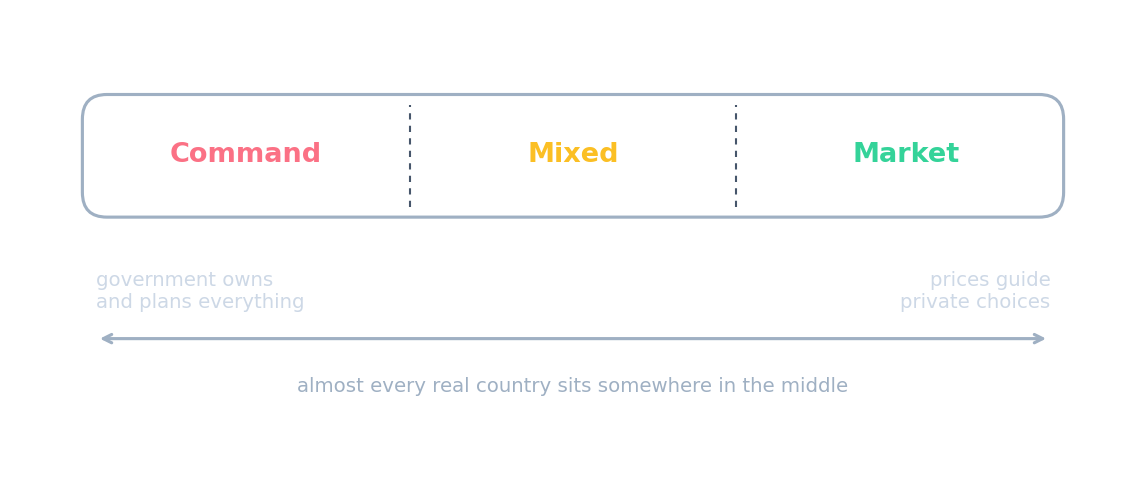
- A market economy 市场经济: private buyers and sellers decide, guided by prices — no central planner.
- A command economy 计划经济: a central government owns the resources and makes the decisions.
- A mixed economy 混合经济: markets set most prices, but government provides some goods and fixes some problems.
- The pure types are just the two ends of a scale — almost every real country is mixed.
配置资源的三种方式
- 市场经济(market economy):由私人买者和卖者做决定,靠价格来引导——没有中央计划者。
- 计划经济(command economy):中央政府拥有资源,并做出所有决定。
- 混合经济(mixed economy):市场决定大多数价格,但政府提供一些商品、纠正一些问题。
- 纯粹的两种类型只是一条刻度的两端——几乎所有真实国家都是混合的。
Market, command, or mixed? · 市场、计划,还是混合?
Each feature belongs to a way of allocating resources. Markets use prices; command uses a central plan; mixed blends the two. · 每个特征都对应一种配置资源的方式。市场靠价格,计划靠中央规划,混合把两者结合。
Which is a feature of a command economy? · 下面哪一项是计划经济的特征?
In a command economy the state owns resources and plans production centrally. · 在计划经济中,国家拥有资源并集中计划生产。
How prices coordinate a market
- In a market, prices do the coordinating — nobody is in charge.
- A price is a signal 信号: a high price says "this is scarce or strongly wanted."
- A price is also an incentive 激励: it rewards producers who make more of it.
- Adam Smith called this self-organising order the invisible hand 看不见的手 — resources flow toward what people value most, with no one planning it.
价格如何协调一个市场
- 在市场里,是价格在做协调——没有谁在指挥。
- 价格是一个信号(signal):高价格说明"这东西稀缺,或者很多人想要"。
- 价格也是一种激励(incentive):它奖励那些生产更多的人。
- 亚当·斯密把这种自我组织的秩序叫做看不见的手(invisible hand)——资源流向人们最看重的地方,却没有任何人在计划。
In a pure market economy, a central planner sets the prices. · 在纯市场经济中,由中央计划者制定价格。
No one sets them — prices emerge from buyers and sellers. That is the invisible hand. · 没有人制定它们——价格从买卖双方中产生。这就是看不见的手。
A price does two jobs: it is a signal and an . · 价格有两个作用:它是一个信号,和一个。
The signal carries information; the incentive rewards producers who respond. · 信号传递信息;激励奖励做出回应的生产者。
Every system has a trade-off
- Markets are usually efficient 有效率, but can leave some people behind and under-provide things like clean air.
- Command systems aim for fairness and can chase national goals, but without price signals they often waste resources and slow innovation.
- That is exactly why most countries are mixed — they try to keep the efficiency of markets while filling the gaps.
每种体制都有取舍
- 市场通常有效率(efficient),但可能把一些人抛在后面,也会少提供像清洁空气这样的东西。
- 计划体制追求公平,能集中力量办国家大事,但缺少价格信号,常常浪费资源、拖慢创新。
- 这正是为什么大多数国家是混合的——既想保留市场的效率,又想补上它的缺口。
Match each economy to what it is best known for. · 把每种经济与它最出名的特点配对。
Each system trades something off; the mixed economy tries to get the best of both. · 每种体制都有取舍;混合经济试图兼得两者之长。
Select all · 所有 common drawbacks of a command economy. · 选出计划经济的所有常见缺点。
Without prices to signal value, command systems often waste resources and slow innovation. · 没有价格来传递价值信号,计划体制常常浪费资源、拖慢创新。
Who grows the coffee you drink? No government agency planned it.
- A high coffee price signals that people want more, and rewards the farmers who grow it.
- Farmers, shippers, and cafés each just follow the prices — and the coffee appears on your table.
- That is the invisible hand: private choices, coordinated by price, not by a planner.
你喝的咖啡是谁种的?没有任何政府机构计划过这件事。
- 高咖啡价格发出信号:人们想要更多;它也奖励种咖啡的农民。
- 农民、货运商、咖啡馆各自只是跟着价格走——咖啡就出现在了你的桌上。
- 这就是看不见的手:由价格协调的私人选择,而不是某个计划者。
An economic system decides what, how, and for whom. A market economy uses prices — a signal and an incentive, the invisible hand. A command economy uses a central plan. A mixed economy blends both — and almost every real country is mixed.
经济体制决定生产什么、怎么生产、为谁生产。市场经济用价格——一个信号加一个激励,即看不见的手;计划经济用中央计划;混合经济把两者结合——几乎每个真实国家都是混合的。