The Production Possibilities Curve · 生产可能性曲线
| English | 中文 | Pinyin · 拼音 |
|---|---|---|
| production possibilities curve/prəˈdʌkʃn ˌpɒsəˈbɪlɪtiz kɜːv/ | 生产可能性曲线 | shēng chǎn kě néng xìng qū xiàn |
| efficient/ɪˈfɪʃənt/ | 有效率 | yǒu xiào lǜ |
| opportunity cost/ɒpəˈtjuːnɪti kɒst/ | 机会成本 | jī huì chéng běn |
| law of increasing opportunity cost/lɔː ɒv ɪnˈkriːsɪŋ ɒpəˈtjuːnɪti kɒst/ | 机会成本递增规律 | jī huì chéng běn dì zēng guī lǜ |
| economic growth/ˌiːkəˈnɒmɪk ɡrəʊθ/ | 经济增长 | jīng jì zēng zhǎng |
Draw the edge of the possible
- Give an economy just two goods to make — say food and phones.
- Draw every combination it could make when nothing is wasted.
- The outer boundary of those combinations is the production possibilities curve 生产可能性曲线 (PPC).
- It turns the whole idea of scarcity into one picture you can point at.
画出"可能"的边界
- 给一个经济体只安排两种商品——比如食物和手机。
- 把它在不浪费的前提下能够生产的每一种组合都画出来。
- 这些组合的外沿,就是生产可能性曲线(production possibilities curve,PPC)。
- 它把整个稀缺的概念,变成了一张你能指着看的图。
On, inside, or outside
- Points on the curve are efficient 有效率 — every resource is being used.
- Points inside are inefficient — some workers or factories sit idle.
- Points outside are currently unattainable — a direct picture of scarcity.
曲线上、曲线内,还是曲线外
- 曲线上的点是有效率(efficient)的——每一份资源都在被使用。
- 曲线内的点是无效率的——有些工人或工厂闲置着。
- 曲线外的点目前无法实现——这正是稀缺的直接写照。
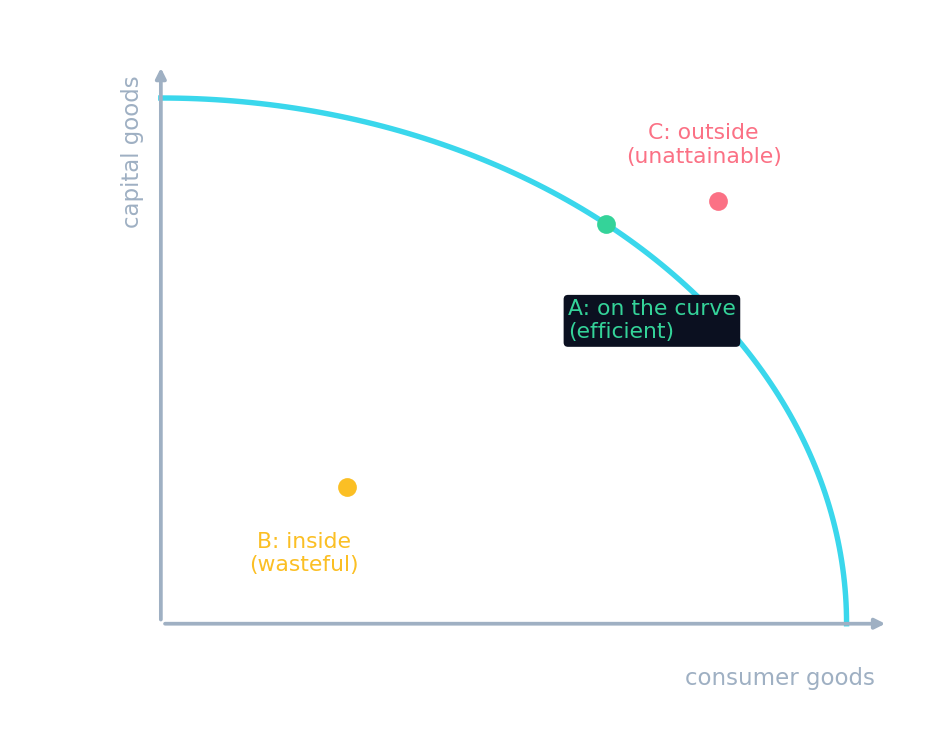
A country is producing at a point inside its PPC. This means: · 一个国家在它的 PPC 内部生产。这意味着:
Inside the curve, resources sit idle — the economy could make more of both goods. · 在曲线内部,资源闲置——经济体本可以两种商品都多生产一些。
With its current resources, an economy can produce at a point outside its PPC. · 用现有资源,一个经济体可以在它的 PPC 之外的点生产。
Points outside are unattainable now — reaching them needs economic growth. · 外部的点目前无法实现——要达到它们需要经济增长。
Why the curve bows outward
- Move along the curve to make more phones, and you must make less food — that sacrifice is the opportunity cost 机会成本.
- The curve usually bows outward, showing the law of increasing opportunity cost 机会成本递增规律.
- Resources are not equally good at both jobs, so each extra phone costs more and more food.
- A straight-line PPC would instead mean a constant opportunity cost.
曲线为什么向外凸
- 沿曲线移动去多造手机,你就必须少造食物——这个牺牲就是机会成本(opportunity cost)。
- 曲线通常向外凸,体现了机会成本递增规律(law of increasing opportunity cost)。
- 资源并非同样擅长两种工作,所以每多造一部手机,要付出越来越多的食物。
- 如果 PPC 是一条直线,那就意味着机会成本是恒定的。
Explore the production possibilities curve · 探索生产可能性曲线
Making more of one good means giving up some of the other — that trade-off is the opportunity cost, and the outward bow is the law of increasing opportunity cost. Drag along the curve, then grow the economy to push the whole frontier out. · 多生产一种商品意味着放弃一些另一种——这个取舍就是机会成本,向外的凸形就是机会成本递增规律。沿曲线拖动,再让经济增长,把整条边界向外推。
Why does a typical PPC bow outward (concave to the origin)? · 为什么典型的 PPC 向外凸(相对原点是凹的)?
As you pour more resources into one good, each extra unit costs ever more of the other — the law of increasing opportunity cost. · 当你把越来越多的资源投入一种商品,每多一单位都要付出更多的另一种——机会成本递增规律。
Read an opportunity cost off the curve
- Pick two points and compare them — the cost is what you gave up.
- Worked example. At point A the economy makes 100 food, 0 phones. At point B it makes 80 food, 30 phones.
- Moving A → B, it gains 30 phones by giving up 20 food.
- So the opportunity cost of one phone is $20 \div 30 = 0.67$ units of food.
从曲线上读出机会成本
- 选两个点作比较——成本就是你放弃的东西。
- 例题。 在 A 点,经济体生产 100 份食物、0 部手机;在 B 点,生产 80 份食物、30 部手机。
- 从 A 移到 B,放弃 20 份食物,换来 30 部手机。
- 所以一部手机的机会成本是 $20 \div 30 = 0.67$ 份食物。
At point A the economy makes 100 food and 0 phones; at B it makes 80 food and 30 phones. What is the opportunity cost of ONE phone, in units of food? · 在 A 点经济体生产 100 份食物、0 部手机;在 B 点生产 80 份食物、30 部手机。一部手机的机会成本(以食物计)是多少?
Give up 20 food to gain 30 phones, so each phone costs $20/30 = 0.67$ food. · 放弃 20 份食物换来 30 部手机,所以每部手机的成本是 $20/30 = 0.67$ 份食物。
Growth pushes the whole curve out
- Economic growth 经济增长 shifts the entire curve outward.
- It comes from more resources, better technology, or improved skills.
- Now combinations that were once impossible become reachable.
- Producing inside the curve is not growth — it is just using what you already have more fully.
增长把整条曲线向外推
- 经济增长(economic growth)让整条曲线向外移动。
- 它来自更多资源、更好的技术,或更高的技能。
- 于是,曾经不可能的组合变得可以实现了。
- 在曲线内生产并不是增长——那只是把已有的资源用得更充分。
Better technology shifts the whole curve ______ (which direction?). · 更好的技术使整条曲线向______移动(哪个方向?)。
Growth expands what is possible, moving the frontier outward. · 增长扩大了可能的范围,使边界向外移动。
Select all · 所有 that shift a PPC outward. · 选出所有能让 PPC 向外移动的因素。
Growth needs more or better resources. Moving onto the curve just removes waste — it is not growth. · 增长需要更多或更好的资源。移动到曲线上只是消除浪费——那不是增长。
The PPC shows the most an economy can make of two goods. On = efficient, inside = wasteful, outside = unattainable. Its outward bow is the law of increasing opportunity cost, and economic growth shifts the whole curve outward.
PPC 展示一个经济体最多能生产多少两种商品。曲线上=有效率,内=浪费,外=无法实现。它向外的凸形就是机会成本递增规律,而经济增长让整条曲线向外移动。