Scarcity · 稀缺性
| English | 中文 | Pinyin · 拼音 |
|---|---|---|
| economics/ˌiːkəˈnɒmɪks/ | 经济学 | jīng jì xué |
| scarcity/ˈskeəsɪti/ | 稀缺 | xī quē |
| trade-off/treɪd ɒf/ | 权衡取舍 | quán héng qǔ shě |
| production possibilities curve/prəˈdʌkʃn ˌpɒsəˈbɪlɪtiz kɜːv/ | 生产可能性曲线 | shēng chǎn kě néng xìng qū xiàn |
| efficient/ɪˈfɪʃənt/ | 有效率 | yǒu xiào lǜ |
| opportunity cost/ɒpəˈtjuːnɪti kɒst/ | 机会成本 | jī huì chéng běn |
| margin/ˈmɑːdʒɪn/ | 边际 | biān jì |
You can't have it all
- Imagine you have $20 and a food court full of things you want.
- Buy the noodles and you can't also buy the bubble tea and the dumplings.
- Every choice quietly closes off other choices.
- This simple fact — wanting more than you can have — is where all of economics starts.
你没法什么都要
- 想象你有 20 块钱,面对一整条美食街,样样都想吃。
- 买了面,你就不能同时再买奶茶和饺子。
- 每一个选择都悄悄关上了另一些选择的门。
- 这个简单的事实——想要的比能拥有的多——正是全部经济学的起点。
Scarcity: limited resources, unlimited wants
- Scarcity 稀缺 means our wants are unlimited but our resources are limited.
- It applies to money, time, land, workers, and raw materials.
- Because of scarcity, we cannot produce or buy everything — we must choose.
- Even the richest person and the largest country face scarcity of some resource (often time).
稀缺:资源有限,欲望无限
- 稀缺(scarcity)是指我们的欲望无限,而资源有限。
- 它适用于金钱、时间、土地、劳动力和原材料。
- 因为稀缺,我们无法生产或购买一切——必须做出选择。
- 即使最富有的人和最大的国家,也面临某种资源的稀缺(常常是时间)。
Scarcity exists because... · 稀缺性的存在是因为……
Scarcity · 稀缺性 is the gap between unlimited wants and the limited resources available to satisfy them. · 稀缺性是指无限欲望与满足这些欲望的有限资源之间的差距。
Only poor people and poor countries face scarcity. · 只有穷人和贫穷国家面临稀缺性。
Everyone faces scarcity of some resource — even the wealthy run short of time. · 每个人都面临某种资源的稀缺性——即使富人也会时间不足。
Scarcity forces a trade-off
- A country can use its resources to make different things — say food and phones.
- The production possibilities curve 生产可能性曲线 shows the most it can make of two goods.
- Points on the curve are efficient 有效率; points inside waste resources; points outside are impossible.
稀缺迫使我们权衡
- 一个国家可以用资源生产不同的东西——比如食物和手机。
- 生产可能性曲线(production possibilities curve)显示它最多能生产两种商品的多少。
- 曲线上的点是有效率(efficient)的;曲线内的点浪费了资源;曲线外的点无法实现。
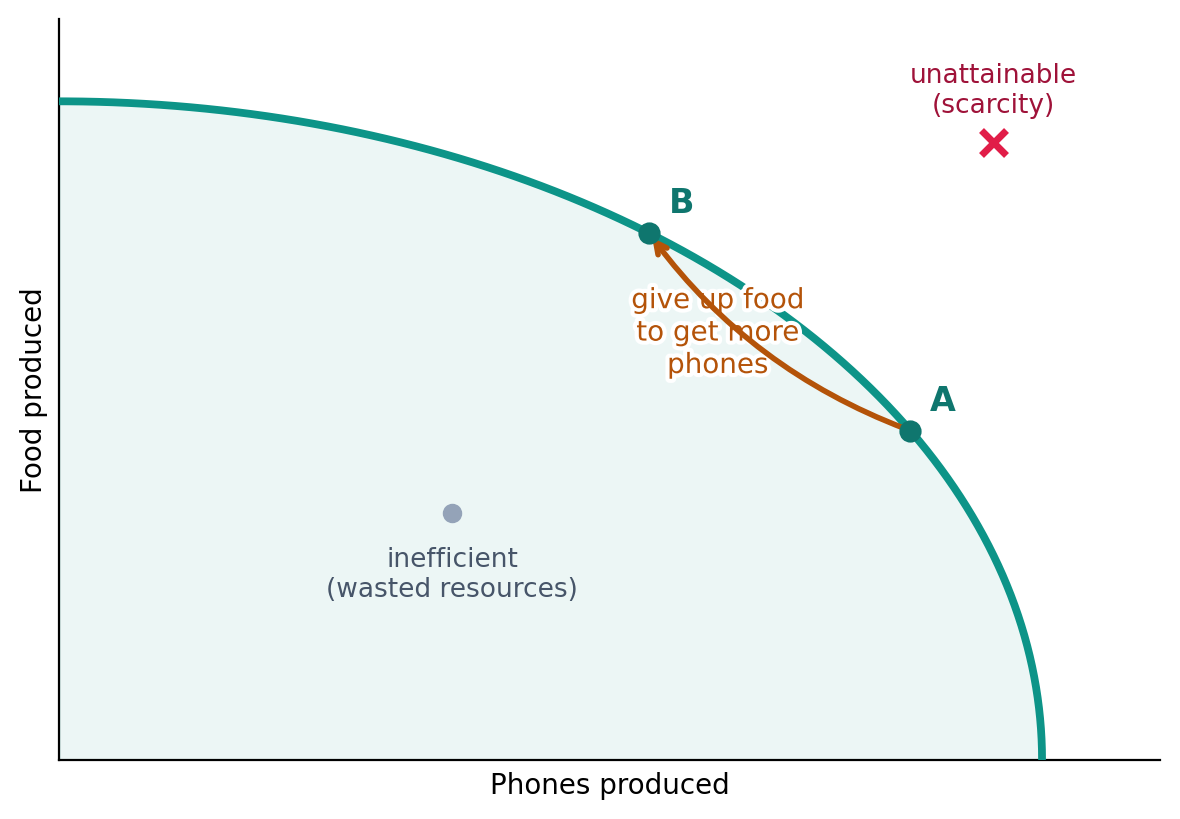
Where is each point? · 各点位于何处?
Sort production points as efficient, inefficient, or unattainable. · 将生产点分类为有效、无效或不可实现。
Select all · 所有 true statements about the production possibilities curve. · 选择关于生产可能性曲线的所有正确陈述。
On = efficient, inside = wasteful, outside = impossible. Moving along the curve always involves a trade-off. · 曲线上=有效,下方=浪费,上方=不可能。沿曲线移动总是涉及权衡取舍。
Opportunity cost
- To move along the curve and make more phones, you must give up some food.
- A trade-off 权衡取舍 is giving up one thing to get another.
- The opportunity cost 机会成本 of a choice is the value of the single best alternative you gave up.
- It is measured in what you sacrificed, not in dollars.
机会成本
- 要沿曲线移动、多造手机,你必须放弃一些食物。
- 权衡取舍(trade-off)就是放弃一样东西去换取另一样。
- 一个选择的机会成本(opportunity cost),是你放弃的那个最好的替代选项的价值。
- 它用你牺牲掉的东西来衡量,而不是用钱。
The value of the single best alternative you give up is the ____ cost. · 你放弃的最佳单一替代品的价值是______成本。
Opportunity cost · 机会成本 is what you sacrifice — the next-best choice — when you decide. · 机会成本是你做决定时所牺牲的东西——即次优选择。
A farm can grow 100 tonnes of wheat OR 40 tonnes of corn. What is the opportunity cost, in tonnes of wheat, of 1 tonne of corn? · 一个农场可以种植100吨小麦或40吨玉米。1吨玉米的机会成本是多少吨小麦?
Giving up all corn frees enough resources for 100 wheat, so each tonne of corn costs $100/40 = 2.5$ tonnes of wheat. · 放弃全部玉米可释放足够资源种植100吨小麦,因此每吨玉米花费$100/40 = 2.5$吨小麦。
Opportunity cost is only the next-best option you gave up — not everything you could have done. If you choose sleep over studying or a movie, the opportunity cost is whichever one you would have picked next, not both.
机会成本只是你放弃的次优选项——而不是你所有本可以做的事。如果你在睡觉、看电影之间选了学习,机会成本只是你下一个会选的那一个,而不是两个都算。
You rank your evening options: (1) study, (2) friends, (3) film — and choose to study. The opportunity cost is... · 你对晚间选项进行排名:(1)学习,(2)见朋友,(3)看电影——并选择学习。机会成本是……
Opportunity cost is only the next-best option you gave up — seeing friends. · 机会成本仅指你放弃的次优选项——见朋友。
What economists study
- Economics 经济学 is the study of how people and societies make choices under scarcity.
- Because resources are scarce, good decisions weigh costs against benefits.
- People tend to think at the margin 边际 — deciding one more unit at a time.
- The rest of this course is really about how these choices are made in markets.
经济学家研究什么
- 经济学(economics)研究人和社会在稀缺之下如何做选择。
- 因为资源稀缺,好的决策会权衡成本与收益。
- 人们往往在边际(marginal)上思考——一次多决定一个单位。
- 本课程接下来的内容,其实都是关于这些选择如何在市场中做出。
You have one free evening and three options you'd enjoy, ranked: (1) study, (2) see friends, (3) watch a film.
- You choose to study.
- The opportunity cost is seeing friends — your next-best option.
- Watching the film is not part of the cost: you would not have chosen it anyway.
你有一个空闲的晚上,以及三个你都喜欢、排好序的选项:(1) 学习,(2) 见朋友,(3) 看电影。
- 你选择了学习。
- 机会成本就是见朋友——你的次优选项。
- 看电影不算在成本里:反正你本来也不会选它。
Scarcity (unlimited wants, limited resources) forces every economy to choose. Each choice has an opportunity cost — the value of the single best alternative given up. The production possibilities curve shows these trade-offs, and economics is the study of how we make them.
稀缺(欲望无限、资源有限)迫使每个经济体做出选择。每个选择都有机会成本——放弃的那个最好替代选项的价值。生产可能性曲线展示这些权衡取舍,而经济学研究的正是我们如何做出这些选择。