Enzymes · 酶
| English | 中文 | Pinyin · 拼音 |
|---|---|---|
| enzyme/ˈenzaɪm/ | 酶 | méi |
| catalyst/ˈkætəlɪst/ | 催化剂 | cuī huà jì |
| active site/ˈæktɪv saɪt/ | 活性位点 | huó xìng wèi diǎn |
| substrate/ˈsʌbstreɪt/ | 底物 | dǐ wù |
| activation energy/ˌæktɪˈveɪʃn ˈenədʒi/ | 活化能 | huó huà néng |
Speeding up life's reactions
- Most reactions that keep you alive would happen far too slowly on their own.
- Digesting a meal could take years without help.
- Cells use special proteins to make these reactions fast enough.
- These proteins are enzymes — the catalysts of life.
加速生命的反应
- 让你活着的大多数反应,若靠它们自己会慢得不得了。
- 没有帮助,消化一顿饭可能要花好几年。
- 细胞用特殊的蛋白质让这些反应足够快。
- 这些蛋白质就是酶——生命的催化剂。
Enzymes are catalysts
- An enzyme 酶 is a biological catalyst 催化剂.
- A catalyst speeds up a reaction without being used up itself.
- One enzyme molecule can be reused thousands of times.
- Almost every reaction in a cell has its own enzyme.
酶是催化剂
- 酶(enzyme)是一种生物催化剂(catalyst)。
- 催化剂加速反应,而它自己不被消耗。
- 一个酶分子可以被重复使用几千次。
- 细胞里几乎每个反应都有它自己的酶。
An enzyme is a biological… · 酶是一种生物……
An enzyme is a biological catalyst · 催化剂 — it speeds up a reaction without being used up. · 酶是一种生物催化剂——它加速反应而自身不被消耗。
The active site
- Each enzyme has a pocket called the active site 活性位点.
- The substrate 底物 — the molecule it works on — fits into this pocket.
- The fit is specific, like a key in a lock.
- This is why each enzyme works on only one kind of substrate.
活性位点
- 每个酶都有一个叫做活性位点(active site)的口袋。
- 底物(substrate)——它作用的分子——嵌进这个口袋。
- 这种契合是特异的,就像钥匙插进锁。
- 这就是每个酶只作用于一种底物的原因。
The substrate · 底物 binds to which part of the enzyme? · 底物结合到酶的哪个部位?
The substrate · 底物 fits into the enzyme's active site, like a key in a lock. · 底物嵌进酶的活性位点,就像钥匙插进锁。
Lowering the activation energy
- Every reaction needs a starting push of energy — the activation energy 活化能.
- An enzyme lowers this energy barrier.
- With a smaller barrier, the reaction happens far faster.
- It can now run quickly at the gentle temperature of a living cell.
降低活化能
- 每个反应都需要一个起始的能量推动——活化能(activation energy)。
- 酶降低这个能量壁垒。
- 壁垒更小,反应就发生得快得多。
- 它现在能在活细胞温和的温度下快速进行。
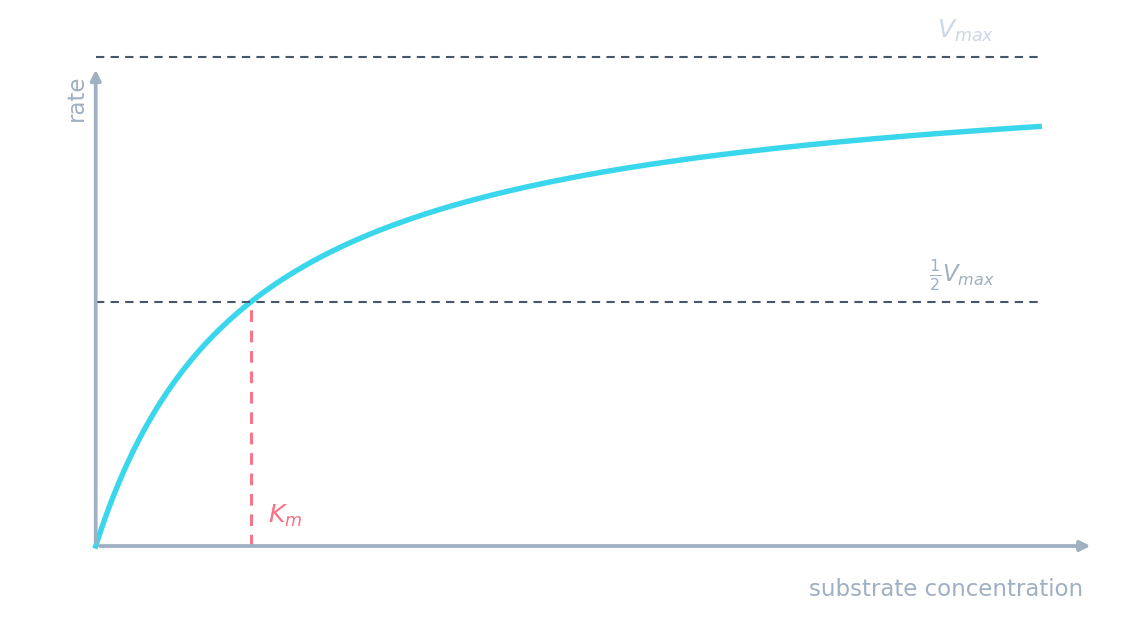
Enzyme rate and substrate · 酶的速率与底物
rate = Vmax·[S] / (Km + [S]) · 速率 = Vmax·[S] / (Km + [S])
Drag the substrate. The rate rises then levels off at Vmax as every active site becomes busy. · 拖动底物。随着每个活性位点都变忙,速率上升,然后在 Vmax 处趋平。
Enzymes speed up reactions by lowering the activation energy. · 酶通过降低活化能来加速反应。
By lowering the activation energy, an enzyme lets the reaction happen faster and at body temperature. · 通过降低活化能,酶让反应更快地、在体温下发生。
Select all · 所有 true statements about enzymes. · 选出关于酶的所有正确说法。
Enzymes are not · 不 used up — they are reused. The other three are correct. · 酶不被消耗——它们被重复使用。其余三条正确。
An enzyme is not used up in the reaction. It grabs the substrate, helps it react, then lets the product go — unchanged and ready to work again. This is why a cell needs only a tiny amount of each enzyme.
酶在反应中不被消耗。它抓住底物,帮它反应,然后放走产物——自己不变,准备再次工作。这就是细胞每种酶只需极少量的原因。
Because an enzyme is not used up, one enzyme molecule can be used over and ____. · 因为酶不被消耗,一个酶分子可以被一次又一____地使用。
A catalyst is reused, so a tiny amount of enzyme can process a huge number of substrate molecules. · 催化剂被反复使用,所以极少量的酶就能处理大量的底物分子。
Catalase, an incredibly fast enzyme:
- Your cells make hydrogen peroxide, a toxic waste.
- The enzyme catalase breaks it into harmless water and oxygen.
- A single catalase molecule can handle millions of peroxide molecules every second.
过氧化氢酶,一种快得惊人的酶:
- 你的细胞产生过氧化氢,一种有毒的废物。
- 过氧化氢酶把它分解成无害的水和氧气。
- 单个过氧化氢酶分子每秒能处理数百万个过氧化氢分子。
An enzyme is a biological catalyst that speeds up a reaction without being used up. The substrate binds to the enzyme's active site (a specific, lock-and-key fit), and the enzyme lowers the reaction's activation energy so it runs fast at body temperature.
酶是一种生物催化剂,它加速反应而自身不被消耗。底物结合到酶的活性位点(一种特异的锁钥契合),酶降低反应的活化能,让它在体温下快速进行。