Introduction to Macromolecules · 大分子导论
| English | 中文 | Pinyin · 拼音 |
|---|---|---|
| monomer/ˈmɒnəʊmə/ | 单体 | dān tǐ |
| polymer/ˈpɒlɪmə/ | 聚合物 | jù hé wù |
| condensation reaction/kɒndenˈseɪʃn rɪˈækʃn/ | 缩合反应 | suō hé fǎn yìng |
| hydrolysis/haɪˈdrɒləsɪs/ | 水解 | shuǐ jiě |
Big molecules from small parts
- The largest molecules in a cell are built like a train — many identical carriages linked in a row.
- Cells make these giants from small, repeating building blocks.
- The same trick — join small parts into a chain — builds most of what a cell is made of.
- Four families of these giant molecules run all of life.
由小部件组成的大分子
- 细胞里最大的分子像一列火车——许多相同的车厢连成一排。
- 细胞用小的、重复的构建单元来制造这些巨物。
- 同一个诀窍——把小部件连成一条链——构建了细胞大部分的组成。
- 这些巨型分子有四大家族,支撑着整个生命。
Monomers and polymers
- A monomer 单体 is a single small building-block molecule.
- A polymer 聚合物 is a long chain of many monomers linked together.
- Think beads (monomers) threaded into a necklace (polymer).
- Different monomers give polymers with completely different jobs.
单体与聚合物
- 单体(monomer)是单个的小构建单元分子。
- 聚合物(polymer)是由许多单体连在一起的长链。
- 想象一颗颗珠子(单体)被串成一条项链(聚合物)。
- 不同的单体给出功能完全不同的聚合物。
A polymer is best described as… · 聚合物最好被描述为……
A polymer is a large molecule made by linking many small monomer subunits into a chain. · 聚合物是通过把许多小的单体亚基连成一条链而形成的大分子。
Condensation joins them
- To link two monomers, the cell runs a condensation reaction 缩合反应.
- Each new bond releases one molecule of water.
- Do this many times and a short monomer becomes a long polymer.
- This is how the cell builds starch, proteins, and DNA.
缩合把它们连起来
- 要连接两个单体,细胞进行一个缩合反应(condensation reaction)。
- 每形成一个新键就释放一个水分子。
- 做许多次,一个短单体就变成一条长聚合物。
- 这就是细胞构建淀粉、蛋白质和 DNA 的方式。
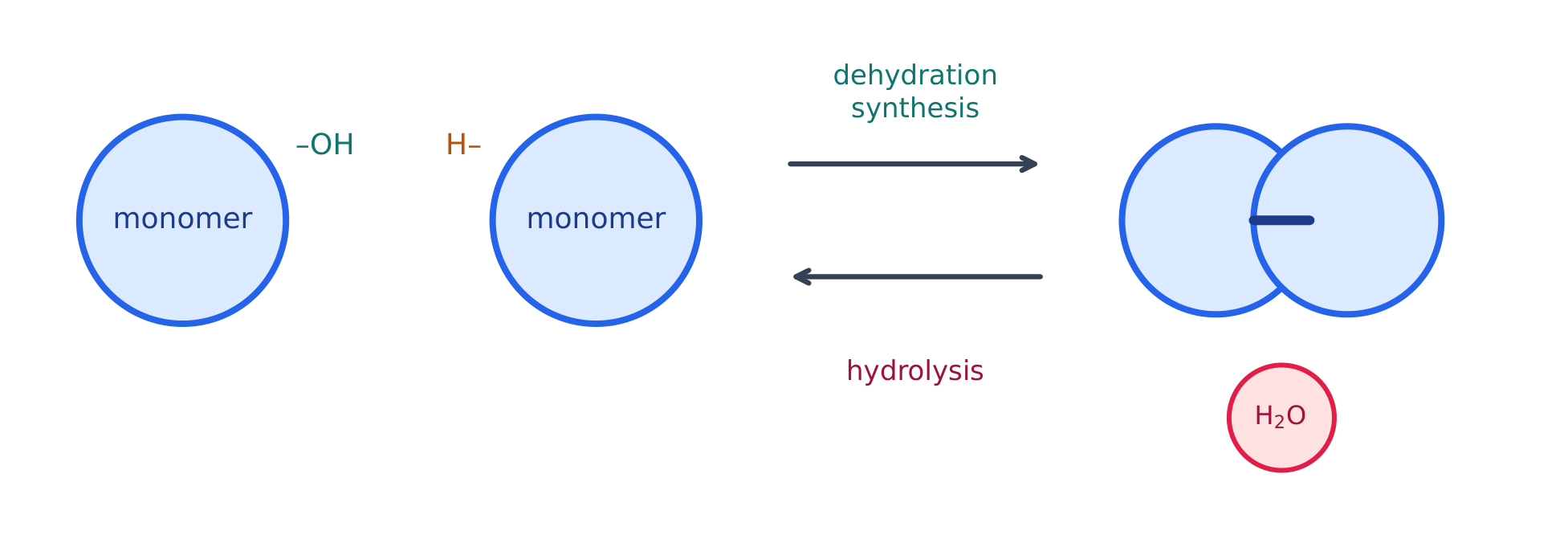
A condensation reaction releases a molecule of water each time it joins two monomers. · 缩合反应每次连接两个单体时都释放一个水分子。
Condensation joins monomers and removes one water molecule per bond formed. · 缩合把单体连接起来,每形成一个键就去掉一个水分子。
Hydrolysis breaks them
- The reverse reaction is hydrolysis 水解 — "splitting with water".
- Adding a water molecule breaks the bond between two monomers.
- This is how digestion breaks big food molecules into small ones.
- Condensation builds up; hydrolysis breaks down.
水解把它们断开
- 逆反应是水解(hydrolysis)——"用水分裂"。
- 加入一个水分子,断开两个单体之间的键。
- 这就是消化把大的食物分子分解成小分子的方式。
- 缩合是构建;水解是分解。
Breaking a polymer by adding water is called ____. · 通过加水来断开聚合物,叫做 ____。
Hydrolysis · 水解 ("water-splitting") adds water to break the bond — the reverse of condensation. · 水解("用水分裂")加水来断开键——缩合的逆过程。
The four families
- Carbohydrates: sugar monomers, for quick energy and structure.
- Proteins: amino-acid monomers, doing thousands of different jobs.
- Nucleic acids: nucleotide monomers, storing genetic information.
- Lipids: fats and oils — the odd one out, not built as a true polymer.
四大家族
- 碳水化合物:糖单体,用于快速能量和结构。
- 蛋白质:氨基酸单体,做着成千上万种不同的工作。
- 核酸:核苷酸单体,储存遗传信息。
- 脂质:脂肪和油——特殊的一类,不是作为真正的聚合物构建的。
Which macromolecule? · 哪一类大分子?
Sort each example into its macromolecule family by its building block and job. · 按照组成单元和功能,把每个例子归入它的大分子家族。
Which of these is not · 不 one of the four biological macromolecule families? · 下面哪个不是四大生物大分子家族之一?
The four families are carbohydrates, lipids, proteins, and nucleic acids — metals are not macromolecules. · 四大家族是碳水化合物、脂质、蛋白质和核酸——金属不是大分子。
Select all · 所有 true statements about macromolecules. · 选出关于大分子的所有正确说法。
Macromolecules are carbon-based, not metallic. The other three statements are correct. · 大分子以碳为基础,不是金属。其余三条正确。
Lipids are usually grouped with the macromolecules, but they are not true polymers — they are not long chains of one repeating monomer. Do not describe a fat as a "polymer of fatty acids" the way starch is a polymer of glucose.
脂质通常和大分子归在一起,但它们不是真正的聚合物——它们不是一种重复单体连成的长链。不要像淀粉是葡萄糖的聚合物那样,把脂肪描述成"脂肪酸的聚合物"。
Starch, step by step:
- One glucose monomer joins another by condensation, releasing water.
- Repeat hundreds of times to build a long starch polymer.
- To use it, the cell runs hydrolysis, adding water to release glucose again.
淀粉,一步一步来:
- 一个葡萄糖单体通过缩合连上另一个,释放水。
- 重复几百次,构建一条长长的淀粉聚合物。
- 要使用它,细胞进行水解,加水再次释放出葡萄糖。
Big biological molecules are polymers — chains of small monomers. A condensation reaction joins monomers and releases water; hydrolysis adds water to break them apart. The four families are carbohydrates, proteins, nucleic acids, and lipids (the odd one, not a true polymer).
大的生物分子是聚合物——小单体的链。缩合反应连接单体并释放水;水解加水把它们断开。四大家族是碳水化合物、蛋白质、核酸和脂质(特殊的一类,不是真正的聚合物)。