Diffraction · 衍射
| English | 中文 | Pinyin · 拼音 |
|---|---|---|
| gap/ɡæp/ | 缝 | fèng |
| diffraction/dɪˈfrækʃn/ | 衍射 | yǎn shè |
| obstacle/ˈɒbstəkl/ | 障碍物 | zhàng ài wù |
| wavelength/ˈweɪvleŋθ/ | 波长 | bō cháng |
| ripple tank/ˈrɪpl tæŋk/ | 水波槽 | shuǐ bō cáo |
| single slit/ˈsɪŋɡl slɪt/ | 单缝 | dān fèng |
| diffraction grating/dɪˈfrækʃn ˈɡreɪtɪŋ/ | 衍射光栅 | yǎn shè guāng shān |
Heard but not seen
- You can hear someone around a corner — but you can't see them.
- Both sound and light reach the gap 缝, yet only sound bends around it.
- The difference is diffraction 衍射.
听得见,看不见
- 你能 听见 拐角另一边的人——却 看不见 他们。
- 声音和光都到达了这个缝隙,但只有声音绕了过去。
- 区别在于 衍射(diffraction)。
What diffraction is
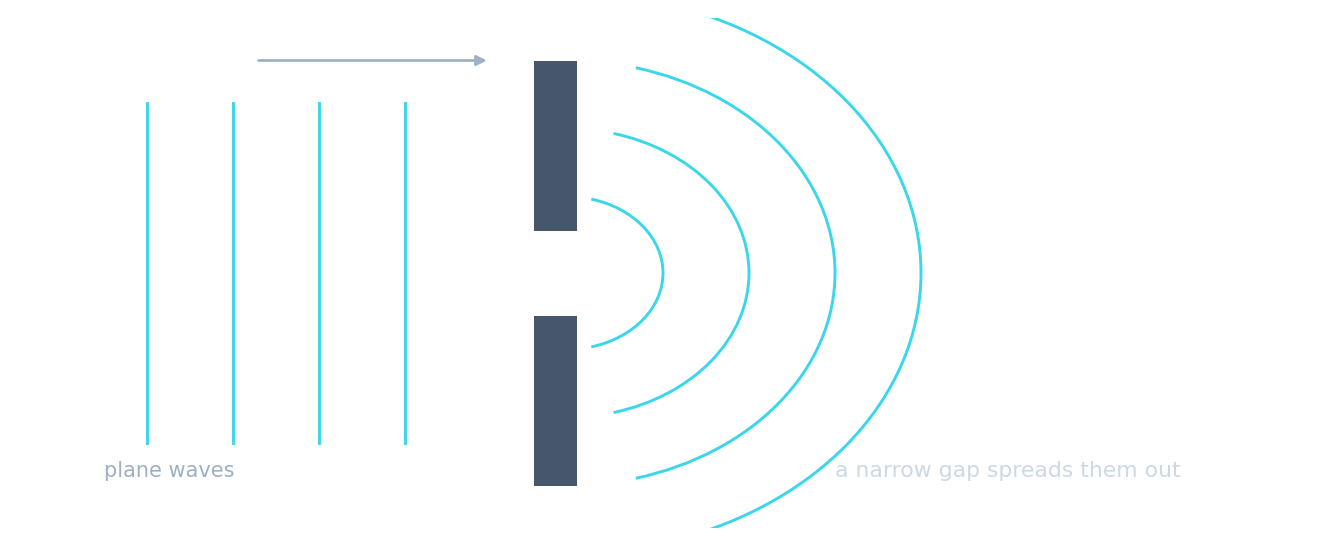
- Diffraction is the spreading of a wave as it passes through a gap or around the edge of an obstacle 障碍物.
- All waves do it — water, sound, light, microwaves. The speed, wavelength and frequency do not change; only the direction spreads.
什么是衍射
- 衍射 是波通过缝隙或绕过障碍物边缘时的散开。
- 所有 波都会衍射——水波、声音、光、微波。速率、波长和频率都不变;只有方向散开了。
Waves adding and cancelling · 波的相加与抵消
Two overlapping waves add where they are in phase and cancel where out of phase — change the phase to see the result. This is what makes diffraction patterns. · 两列重叠的波在同相处相加、反相处抵消——改变相位看结果。这正是衍射图样形成的原因。
Diffraction is the ____ of a wave as it passes through a gap. · 衍射是波经过缺口时的 ____。
Diffraction is the spreading (bending) of a wave at a gap or obstacle. · 衍射是波在缺口或障碍处的扩散(弯曲)。
All waves can diffract. · 所有波都能衍射。
Yes — water, sound, light and microwaves all spread at a gap or edge. · 是的——水、声音、光和微波都会在缺口或边缘处扩散。
Diffraction is the ____ of a wave as it passes through a gap or around an obstacle. · 衍射是波在通过缝隙或绕过障碍物时发生的____。
Spreading, not bending: refraction bends a wave at a boundary, and the two words are marked differently. · 是扩展,不是弯折:折射是波在界面处弯折,这两个词的评分是不同的。
How much it spreads
- Gap much wider than $\lambda$ → the wave passes nearly straight through.
- Gap about the size of $\lambda$ → it fans out strongly.
Diffraction in a ripple tank 水波槽 — a wide gap (a) spreads the waves little, a narrow gap (b) much more
散开多少
- 缝隙 远宽于 $\lambda$ → 波几乎直直地穿过。
- 缝隙 与 $\lambda$ 差不多大 → 波强烈地扇形散开。
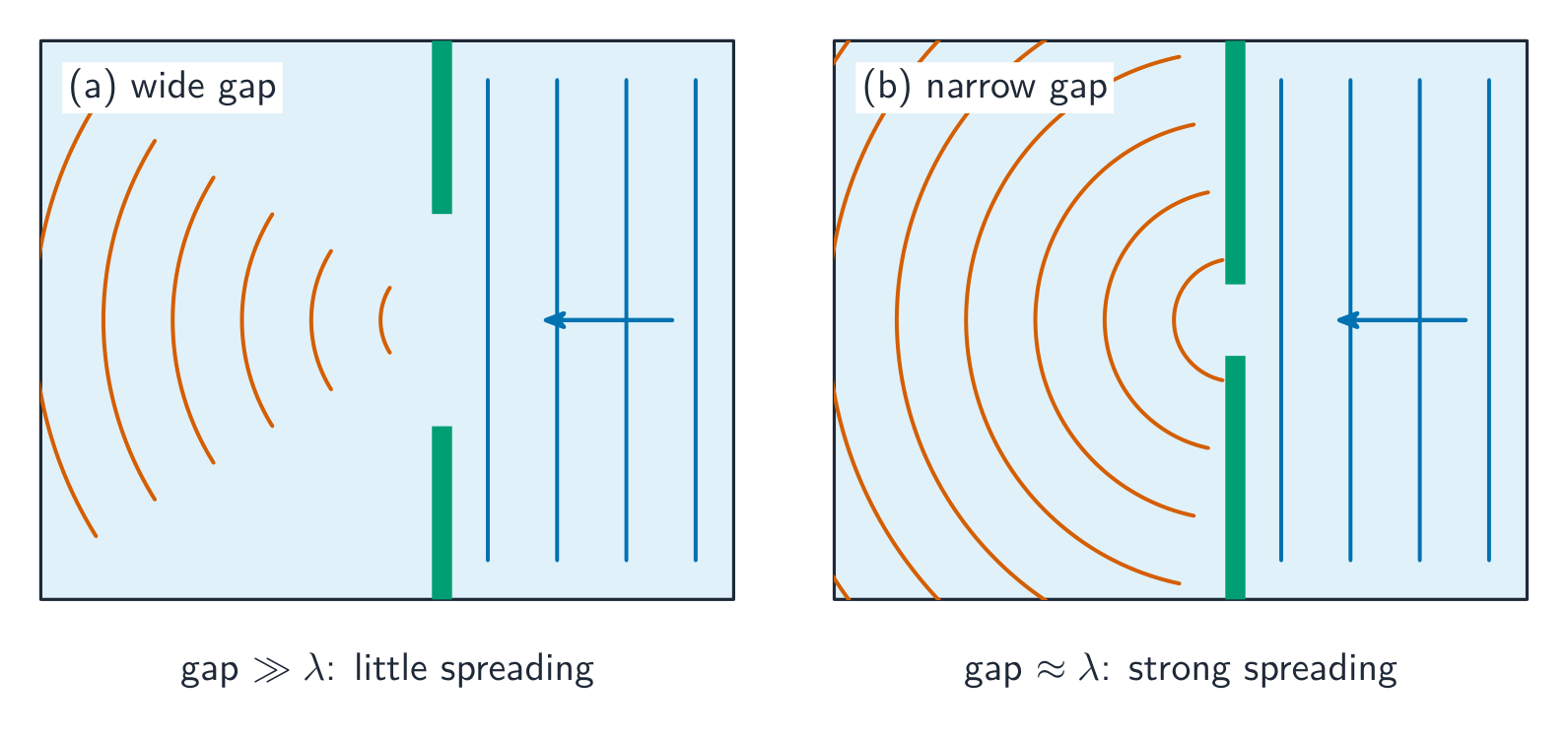
水波槽中的衍射——宽缝 (a) 让波散开很少,窄缝 (b) 散开得多
A wave spreads out the most when the gap is: · 当缺口满足以下哪种情况时,波扩散得最多:
When the gap ≈ the wavelength, the wave fans out strongly; a much wider gap lets it pass nearly straight. · 当缺口 ≈ 波长时,波强烈地散开;远宽得多的缺口让它几乎直直通过。
Making the gap narrower makes the waves spread out ____. · 把缺口变窄,会使波扩散得 ____。
A narrower gap (closer to one wavelength) gives stronger diffraction. · 更窄的缺口(更接近一个波长)给出更强的衍射。
Match each gap to how much the wave spreads out beyond it. · 把每种缝隙与波在它后面散开的程度配对。
Diffraction is greatest when the gap and the wavelength are about the same size, and fades as the gap gets much larger than the wavelength. · 缝隙和波长差不多大时衍射最强;缝隙远大于波长时衍射逐渐消失。
When does a wave diffract most through a gap? Select all · 所有 that apply. · 波通过缝隙时什么情况下衍射最明显?选出所有适用的。
This is why you hear round a doorway but cannot see round it: sound's wavelength is about a metre, light's is under a micrometre. · 这就是你能听见门外却看不见门外的原因:声音的波长约一米,光的波长不到一微米。
Why you hear but don't see
- Speech has $\lambda \approx 1\ \text{m}$ — close to a doorway's width, so it spreads round the corner.
- Light has $\lambda \approx 500\ \text{nm}$ — far smaller than the gap, so it barely spreads.
为什么听得见却看不见
- 说话声的 $\lambda \approx 1\ \text{m}$——接近门的宽度,所以它绕过拐角散开。
- 光的 $\lambda \approx 500\ \text{nm}$——远小于缝隙,所以它几乎不散开。
You can hear but not see around a corner because sound has a much larger wavelength than light. · 你能听见却看不见拐角处,是因为声音的波长比光大得多。
Sound's wavelength (~1 m) is near the gap size, so it diffracts; light's (~500 nm) is far smaller, so it barely does. · 声音的波长(约 1 m)接近缺口大小,所以它衍射;光的(约 500 nm)小得多,所以几乎不衍射。
What diffracted light looks like
- Laser light through a single slit 单缝 gives a wide, bright central band with fainter bands either side.
- Through a diffraction grating 衍射光栅 (many slits) the light concentrates into sharp, narrow lines at definite angles: a tall central maximum, then symmetrical peaks at $\pm\theta_1$, $\pm\theta_2$ that get weaker further out.
- The angles obey $d\sin\theta = n\lambda$ — the next lesson but one uses it in full.
衍射后的光是什么样
- 激光通过 单缝(single slit) 得到一条又宽又亮的中央条带,两侧是较暗的条带。
- 通过 衍射光栅(diffraction grating)(许多狭缝)时,光集中成 又细又亮的线,出现在确定的角度上:一个高高的中央极大,然后是 $\pm\theta_1$、$\pm\theta_2$ 处对称的峰,越往外越弱。
- 这些角度满足 $d\sin\theta = n\lambda$——再往后一课会完整使用它。
A grating has 500 lines per mm. What is the slit spacing d, in units of 1e-6 m? · 一个光栅每毫米 500 条线。缝间距 d 是多少(以 1e-6 m 为单位)?
d = 1e-3/500 = 2.0e-6 m. Putting the lines per millimetre straight into d sin(theta) = n lambda is the standard error; you must invert it first. · d = 1e-3/500 = 2.0e-6 m。把每毫米线数直接代进 d sin(theta) = n lambda 是标准错误;必须先取倒数。
Worked example: where the bright lines fall
Laser light of wavelength $600\ \text{nm}$ falls normally on a grating whose lines are $5.0 \times 10^{-6}\ \text{m}$ apart. Find the angle of the second-order line and describe the intensity graph from $-15^\circ$ to $+15^\circ$. A polarising filter is then placed in the beam.
- Second order: $\sin\theta = \dfrac{n\lambda}{d} = \dfrac{2 \times 600 \times 10^{-9}}{5.0 \times 10^{-6}} = 0.24$, so $\theta = 14^\circ$.
- First order: $\sin\theta = 0.12$, so $\theta = 6.9^\circ$.
- Graph: a tall narrow spike at $0^\circ$, smaller spikes at $\pm 6.9^\circ$, smaller again at $\pm 14^\circ$, and almost nothing in between.
- With the polarising filter: every spike is half as tall (unpolarised light through one filter), but the angles are unchanged — the filter does not alter the wavelength.
例题:亮线落在哪里
波长 $600\ \text{nm}$ 的激光垂直射到线间距为 $5.0 \times 10^{-6}\ \text{m}$ 的光栅上。求二级亮线的角度,并描述 $-15^\circ$ 到 $+15^\circ$ 之间的强度图。然后在光束中放入一片偏振片。
- 二级: $\sin\theta = \dfrac{n\lambda}{d} = \dfrac{2 \times 600 \times 10^{-9}}{5.0 \times 10^{-6}} = 0.24$,所以 $\theta = 14^\circ$。
- 一级: $\sin\theta = 0.12$,所以 $\theta = 6.9^\circ$。
- 图: 在 $0^\circ$ 处一个又高又窄的尖峰,$\pm 6.9^\circ$ 处较小的尖峰,$\pm 14^\circ$ 处更小,中间几乎没有。
- 放入偏振片后: 每个尖峰都变成 一半 高(非偏振光通过一片偏振片),但 角度不变——偏振片不改变波长。
Light of wavelength $500\ \text{nm}$ falls normally on a grating with lines $4.0 \times 10^{-6}\ \text{m}$ apart. At what angle, in degrees, is the second-order maximum? · 波长 $500\ \text{nm}$ 的光垂直射到线间距 $4.0 \times 10^{-6}\ \text{m}$ 的光栅上。二级极大在多少度的角度上?
$\sin\theta = \dfrac{n\lambda}{d} = \dfrac{2 \times 500 \times 10^{-9}}{4.0 \times 10^{-6}} = 0.25$, so $\theta = 14.5^\circ$. · $\sin\theta = \dfrac{n\lambda}{d} = \dfrac{2 \times 500 \times 10^{-9}}{4.0 \times 10^{-6}} = 0.25$,所以 $\theta = 14.5^\circ$。
Diffraction is not refraction and not reflection: the wave keeps the same speed, wavelength and frequency, and only its direction spreads. More spreading does not mean more energy — the same energy is shared over a wider region, so the wave beyond a narrow gap is weaker in any one direction.
衍射 不是 折射,也 不是 反射:波保持相同的速率、波长和频率,只有 方向 散开了。散开得更多并不意味着能量更多——同样的能量分摊到更宽的区域,所以窄缝后的波在任何一个方向上都 更弱。
A water wave passes through a narrow gap and spreads out. Which quantities stay the same? Select all that apply. · 一列水波通过一个窄缝并散开。哪些量保持不变?选出所有正确的。
Diffraction only changes the direction the energy travels in. Speed, wavelength and frequency are set by the medium and the source and do not change at a gap. · 衍射只改变能量传播的方向。速率、波长和频率由介质和波源决定,在缝隙处不变。
Seeing it in the lab
- Ripple tank: plane waves hit a barrier with a gap; narrow the gap (or lengthen $\lambda$ by slowing the paddle) and the curved wavefronts spread more.
- Laser and single slit: a pattern of bands on a distant screen; a narrower slit gives a wider central band.
- Laser and grating: a row of sharp dots; a finer grating (more lines per mm) pushes the dots further apart.
在实验室里看到它
- 水波槽: 平面波撞上带缝隙的挡板;把缝隙变窄(或放慢拨片使 $\lambda$ 变长),弯曲的波前散开得更多。
- 激光和单缝: 远处屏幕上出现一组条带;缝越窄,中央条带 越宽。
- 激光和光栅: 一排清晰的亮点;更密的光栅(每毫米线数更多)把亮点推得 更远。
You've got it
- diffraction = a wave spreading through a gap or around an obstacle (all waves do it; speed, $\lambda$ and $f$ unchanged)
- most spreading when the gap is about one wavelength 波长 wide
- sound diffracts round corners (big $\lambda$); light hardly does (tiny $\lambda$), so it needs a slit or a grating to show it
- a grating gives sharp maxima at $d\sin\theta = n\lambda$; a polarising filter halves them without moving them
你掌握了
- 衍射 = 波通过缝隙或绕过障碍物时散开(所有波都会;速率、$\lambda$ 和 $f$ 不变)
- 缝隙 约一个波长 宽时散开最多
- 声音绕过拐角(大 $\lambda$);光几乎不绕(小 $\lambda$),所以要用狭缝或光栅才能显示它
- 光栅在 $d\sin\theta = n\lambda$ 处给出清晰的极大;偏振片把它们减半但不移动它们