Interference · 干涉
| English | 中文 | Pinyin · 拼音 |
|---|---|---|
| interference/ˌɪntəˈfɪərəns/ | 干涉 | gān shè |
| coherent/kəʊˈhɪərənt/ | 相干 | xiāng gān |
| constructive/kənˈstrʌktɪv/ | 相长 | xiāng zhǎng |
| destructive/dɪˈstrʌktɪv/ | 相消 | xiāng xiāo |
| fringe/frɪndʒ/ | 条纹 | tiáo wén |
| path difference/pæθ ˈdɪfrəns/ | 路程差 | lù chéng chà |
| antiphase/ˌæntɪˈfeɪz/ | 反相 | fǎn xiāng |
| double slit/ˈdʌbl slɪt/ | 双缝 | shuāng fèng |
Two stones in a pond
- Drop two stones together and the ripples cross, making a steady criss-cross pattern.
- Some places churn; others stay almost still.
- This is interference 干涉 — superposition from two sources.
池塘里的两块石头
- 同时投下两块石头,涟漪交叉,形成稳定的交错图样。
- 有些地方翻腾;有些地方几乎静止。
- 这就是 干涉(interference)——来自两个波源的叠加。
What interference is
- Two coherent 相干 waves overlap to give a fixed pattern.
- Bright (constructive 相长) where they add; dark (destructive 相消) where they cancel.
Two-source interference in a ripple tank: circular waves overlap to give lines of cancellation
什么是干涉
- 两列 相干(coherent) 波重叠,形成固定的图样。
- 相加的地方 亮(相长);相消的地方 暗(相消)。

水波槽中的双源干涉:圆形波重叠,形成一条条相消的线
Interference · 干涉
y = y₁ + y₂
In phase → constructive · 建设性 (bright/loud); antiphase → destructive · 破坏性 (dark/quiet). · 同相 → 相长(亮/响);反相 → 相消(暗/静)。
Coherence
- Two sources are coherent if they keep a constant phase difference (same frequency).
- Two separate lamps are not coherent — their phases jump randomly, so any pattern flickers away.
The colours on a soap bubble come from interference of light
相干性
- 如果两个波源保持 恒定的相位差(频率相同),它们就是 相干 的。
- 两盏独立的灯不相干——它们的相位随机跳变,所以任何图样都会闪烁消失。

肥皂泡上的颜色来自光的干涉
Two coherent sources have: · 两个相干波源具有:
Coherence means a constant phase difference (and so the same frequency) — needed for a steady pattern. · 相干意味着恒定的相位差(因而频率相同)——稳定的图案需要它。
Two separate lamps make a steady, visible interference pattern. · 两盏单独的灯能产生稳定、可见的干涉图案。
No — their phase difference changes randomly, so any pattern flickers too fast to see. · 不——它们的相位差随机变化,所以任何图案都闪烁得太快而看不见。
Coherent sources have a ____ phase difference, and therefore the same frequency. · 相干光源之间有____的相位差,因而频率也相同。
Constant, not zero. Two sources permanently out of step by a quarter cycle are still coherent, and "in phase" is the wrong word here. · 是恒定,不是零。两个永远相差四分之一周期的光源仍然是相干的,而这里用"同相"是错的。
Path difference 路程差
- Constructive: path difference $= n\lambda$ (a whole number of wavelengths) — the waves arrive in phase.
- Destructive: path difference $= \left(n + \tfrac{1}{2}\right)\lambda$ — the waves arrive in antiphase 反相.
Two coherent sources give lines of maximum displacement where crests meet crests
路程差
- 相长:路程差 $= n\lambda$(整数个波长)——两波 同相 到达。
- 相消:路程差 $= \left(n + \tfrac{1}{2}\right)\lambda$——两波 反相(antiphase) 到达。
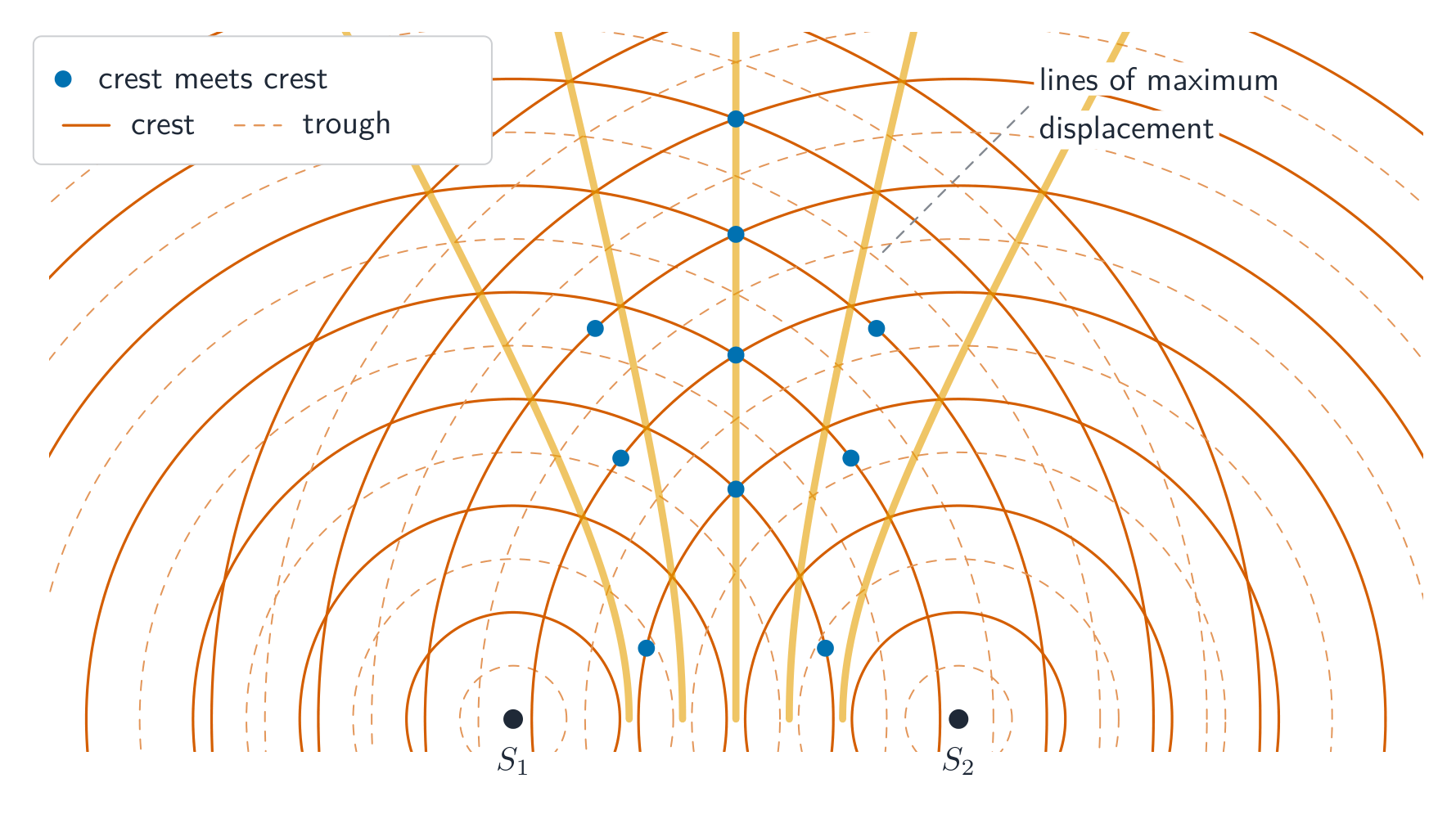
两个相干波源在波峰遇到波峰的地方给出位移最大的线
Constructive interference happens when the path difference is: · 当路程差满足以下哪种情况时发生相长干涉:
$\Delta x = n\lambda$ → crests arrive together → they add. $(n+\tfrac{1}{2})\lambda$ gives cancellation. · $\Delta x = n\lambda$ → 波峰一起到达 → 它们相加。$(n+\tfrac{1}{2})\lambda$ 给出抵消。
Destructive interference happens when the path difference is a whole number plus a ____ of a wavelength. · 当路程差是整数加 ____ 个波长时,发生相消干涉。
$\Delta x = \left(n + \tfrac{1}{2}\right)\lambda$ — a crest meets a trough, so they cancel. · $\Delta x = \left(n + \tfrac{1}{2}\right)\lambda$——波峰遇波谷,所以它们抵消。
Explaining the pattern in exam words
- Four marks, four sentences. 1. The two slits act as coherent sources (constant phase difference), because the same wave reaches both.
- 2. The waves from the two slits overlap and superpose.
- 3. Where the path difference is a whole number of wavelengths the waves arrive in phase → constructive interference → a bright fringe.
- 4. Where it is an odd number of half-wavelengths they arrive in antiphase → destructive → a dark fringe.
用考试语言解释图样
- 四分,四句话。1. 两条缝是 相干波源(恒定相位差),因为同一列波到达两条缝。
- 2. 来自两条缝的波 重叠并叠加。
- 3. 在 路程差 为整数个波长的地方,两波 同相 到达 → 相长 干涉 → 亮 条纹。
- 4. 在路程差为奇数个半波长的地方,两波 反相 到达 → 相消 → 暗 条纹。
Put the steps of the explanation of a double-slit pattern in order. · 把双缝图样的解释步骤按顺序排列。
Coherence first, then superposition, then the two path-difference conditions — each is a separate mark. · 先相干,再叠加,然后是两个路程差条件——每一条都是单独的一分。
Young's double slit 双缝
- One source lights two slits, so they act as coherent sources.
- Fringe 条纹 spacing $x = \dfrac{\lambda D}{a}$ ($a$ = slit gap, $D$ = distance to screen).
杨氏双缝
- 一个光源照亮两条缝,所以它们成为相干波源。
- 条纹间距 $x = \dfrac{\lambda D}{a}$($a$ = 缝间距,$D$ = 到屏的距离)。

Light of wavelength $600\ \text{nm}$ passes through slits $1.0\ \text{mm}$ apart onto a screen $2.0\ \text{m}$ away. Find the fringe spacing, in mm. · 波长 $600\ \text{nm}$ 的光穿过相距 $1.0\ \text{mm}$ 的狭缝,照到 $2.0\ \text{m}$ 外的屏上。求条纹间距(用 mm)。
$x = \dfrac{\lambda D}{a} = \dfrac{600 \times 10^{-9} \times 2.0}{1.0 \times 10^{-3}} = 1.2 \times 10^{-3}\ \text{m} = 1.2\ \text{mm}$. · $x = \dfrac{\lambda D}{a} = \dfrac{600 \times 10^{-9} \times 2.0}{1.0 \times 10^{-3}} = 1.2 \times 10^{-3}\ \text{m} = 1.2\ \text{mm}$。
Which changes increase the fringe spacing in a double-slit experiment? Select all · 所有 that apply. · 双缝实验中哪些改变会增大条纹间距?选出所有适用的。
x = lambda D / a has no brightness in it. A brighter source gives brighter fringes in the same places, which is a favourite distractor. · x = lambda D / a 里没有亮度。更亮的光源只是让同样位置的条纹更亮,这是常见的干扰项。
Changing the fringe spacing
- From $x = \dfrac{\lambda D}{a}$: closer fringes need bigger $a$, smaller $D$, or shorter $\lambda$.
- Bluer light gives tighter fringes than red.
改变条纹间距
- 由 $x = \dfrac{\lambda D}{a}$:要让条纹更密,需要 更大的 $a$、更小的 $D$ 或 更短的 $\lambda$。
- 偏蓝的光给出比红光更密的条纹。
Select all · 所有 the changes that make the fringes closer together. · 选出所有使条纹更靠近的改变。
From $x = \dfrac{\lambda D}{a}$: smaller $x$ needs a bigger $a$, a smaller $D$, or a shorter $\lambda$. · 由 $x = \dfrac{\lambda D}{a}$:更小的 $x$ 需要更大的 $a$、更小的 $D$,或更短的 $\lambda$。
Two slits 0.50 mm apart are lit by 600 nm light, with a screen 2.0 m away. What is the fringe spacing, in mm? · 相距 0.50 mm 的双缝用 600 nm 的光照射,屏幕在 2.0 m 外。条纹间距是多少 mm?
x = lambda D/a = (600e-9)(2.0)/(0.50e-3) = 2.4e-3 m. Convert both the wavelength and the slit separation to metres before dividing. · x = lambda D/a = (600e-9)(2.0)/(0.50e-3) = 2.4e-3 m。相除之前把波长和缝间距都换成米。
Worked example: from fringes to a frequency
A laser lights a double slit of separation $0.16\ \text{mm}$; the screen is $1.2\ \text{m}$ away. The distance from the centre of the first dark fringe to the centre of the ninth is $3.2\ \text{cm}$. Find the wavelength and the frequency of the light.
- Count the gaps: first to ninth is eight spacings, so $x = \dfrac{3.2}{8} = 0.40\ \text{cm} = 4.0 \times 10^{-3}\ \text{m}$.
- Wavelength: $\lambda = \dfrac{xa}{D} = \dfrac{(4.0 \times 10^{-3})(0.16 \times 10^{-3})}{1.2} = 5.3 \times 10^{-7}\ \text{m}$ — green light.
- Frequency: $f = \dfrac{c}{\lambda} = \dfrac{3.00 \times 10^{8}}{5.3 \times 10^{-7}} = 5.6 \times 10^{14}\ \text{Hz}$.
- Check: dark fringes are spaced the same as bright ones, so either kind gives $x$. Dividing by nine instead of eight is the usual slip.
例题:从条纹到频率
激光照射间距 $0.16\ \text{mm}$ 的双缝;屏在 $1.2\ \text{m}$ 外。从 第一条 暗条纹中心到 第九条 暗条纹中心的距离为 $3.2\ \text{cm}$。求光的波长和频率。
- 数间隔: 从第一到第九是 八 个间距,所以 $x = \dfrac{3.2}{8} = 0.40\ \text{cm} = 4.0 \times 10^{-3}\ \text{m}$。
- 波长: $\lambda = \dfrac{xa}{D} = \dfrac{(4.0 \times 10^{-3})(0.16 \times 10^{-3})}{1.2} = 5.3 \times 10^{-7}\ \text{m}$——绿光。
- 频率: $f = \dfrac{c}{\lambda} = \dfrac{3.00 \times 10^{8}}{5.3 \times 10^{-7}} = 5.6 \times 10^{14}\ \text{Hz}$。
- 检查: 暗条纹的间距与亮条纹相同,所以哪一种都能给出 $x$。除以九而不是八是常见的失误。
In a double-slit pattern the centres of the first and sixth dark fringes are $2.0\ \text{cm}$ apart. What is the fringe spacing, in mm? · 在双缝图样中,第一条和第六条暗条纹的中心相距 $2.0\ \text{cm}$。条纹间距是多少(单位 mm)?
First to sixth is five spacings: $x = \dfrac{2.0\ \text{cm}}{5} = 0.40\ \text{cm} = 4\ \text{mm}$. · 第一到第六是五个间距:$x = \dfrac{2.0\ \text{cm}}{5} = 0.40\ \text{cm} = 4\ \text{mm}$。
Worked example: two microwave sources
Two microwave transmitters emit in phase. A detector moved along a line finds the first minimum from the centre at a point where the two path lengths differ by $4.5\ \text{cm}$.
- First minimum: path difference $= \tfrac{1}{2}\lambda$, so $\lambda = 9.0\ \text{cm}$.
- Frequency: $f = \dfrac{c}{\lambda} = \dfrac{3.00 \times 10^{8}}{0.090} = 3.3 \times 10^{9}\ \text{Hz}$.
- Next maximum out from the centre: path difference $= \lambda = 9.0\ \text{cm}$.
- Check: the pattern is symmetrical about the centre line, so every point has a twin on the other side with the same intensity — that is the point an exam asks you to mark.
例题:两个微波源
两个微波发射器同相发射。探测器沿一条直线移动,在两条路径长度相差 $4.5\ \text{cm}$ 的点上找到离中心的 第一个极小。
- 第一个极小: 路程差 $= \tfrac{1}{2}\lambda$,所以 $\lambda = 9.0\ \text{cm}$。
- 频率: $f = \dfrac{c}{\lambda} = \dfrac{3.00 \times 10^{8}}{0.090} = 3.3 \times 10^{9}\ \text{Hz}$。
- 从中心向外的下一个极大: 路程差 $= \lambda = 9.0\ \text{cm}$。
- 检查: 图样关于中线 对称,所以每个点在另一侧都有一个强度相同的孪生点——那就是考题让你标出的点。
Coherent means a constant phase difference — not "in phase" and not merely "the same frequency". Two independent lamps of the same colour share a frequency but are not coherent, so no steady pattern forms. And fringe spacing is between adjacent fringes: the first-to-ninth distance is eight spacings, not nine.
相干 意味着 恒定的相位差——不是"同相",也不只是"频率相同"。两盏颜色相同的独立灯频率相同,却 不 相干,所以不会形成稳定图样。另外,条纹间距是 相邻 条纹之间的距离:第一到第九的距离是八个间距,不是九个。
You've got it
- interference needs coherent sources (constant phase difference)
- constructive: $\Delta x = n\lambda$ (in phase); destructive: $\Delta x = \left(n+\tfrac{1}{2}\right)\lambda$ (antiphase)
- double-slit fringe spacing $x = \dfrac{\lambda D}{a}$; count the gaps between fringes, not the fringes
你掌握了
- 干涉需要 相干 波源(恒定相位差)
- 相长:$\Delta x = n\lambda$(同相);相消:$\Delta x = \left(n+\tfrac{1}{2}\right)\lambda$(反相)
- 双缝条纹间距 $x = \dfrac{\lambda D}{a}$;数条纹之间的 间隔,而不是条纹的条数