Hooke's law · 胡克定律
| English | 中文 | Pinyin · 拼音 |
|---|---|---|
| elastic/ɪˈlæstɪk/ | 弹性 | tán xìng |
| Hooke's law/hʊks lɔː/ | 胡克定律 | hú kè dìng lǜ |
| extension/ekˈstenʃn/ | 伸长量 | shēn cháng liàng |
| tension/ˈtenʃn/ | 张力 | zhāng lì |
| natural length/ˈnætʃərəl leŋθ/ | 自然长度 | zì rán cháng dù |
| modulus of elasticity/ˈmɒdjʊləs ɒv ɪlæˈstɪsɪti/ | 弹性模量 | tán xìng mó liàng |
| elastic potential energy/ɪˈlæstɪk pəˈtenʃl ˈenədʒi/ | 弹性势能 | tán xìng shì néng |
| compress/kəmˈpres/ | 压缩 | yā suō |
The physics of a bungee jump
- Stretch an elastic 弹性 rope and it pulls back — harder the more you stretch it.
- That simple proportional law, Hooke's law 胡克定律, governs springs, bungee cords, and the energy they store and release.
蹦极的物理
- 拉伸一根弹性绳,它会拉回来——你拉得越多,拉得越用力。
- 那条简单的比例定律,胡克定律(Hooke's law),支配弹簧、蹦极绳,以及它们储存和释放的能量。
An elastic string of natural length 2 m and modulus 50 N is stretched by 0.5 m. Find the tension T = λx/L (N). · 一根自然长度 2 m、模量 50 N 的弹性弦被拉伸 0.5 m。求张力 T = λx/L(N)。
T = 50 × 0.5 / 2 = 12.5 N. · T = 50 × 0.5 / 2 = 12.5 N。
By Hooke's law, the tension is proportional to the extension. · 根据胡克定律,张力与伸长成正比。
T = (λ/L)x, so T ∝ x while the material stays elastic. · T = (λ/L)x,所以当材料保持弹性时 T ∝ x。
Hooke's law
- The tension 张力 in an elastic string or spring is proportional to its extension 伸长量 $x$:
- $L$ is the natural length 自然长度 and $\lambda$ the modulus of elasticity 弹性模量 (a property of the material).
Tension rises linearly with extension; the area under the line is the stored elastic energy.
胡克定律
- 一根弹性弦或弹簧中的张力与它的伸长(extension)$x$ 成正比:
- $L$ 是自然长度(natural length),$\lambda$ 是弹性模量(modulus of elasticity,材料的一个属性)。
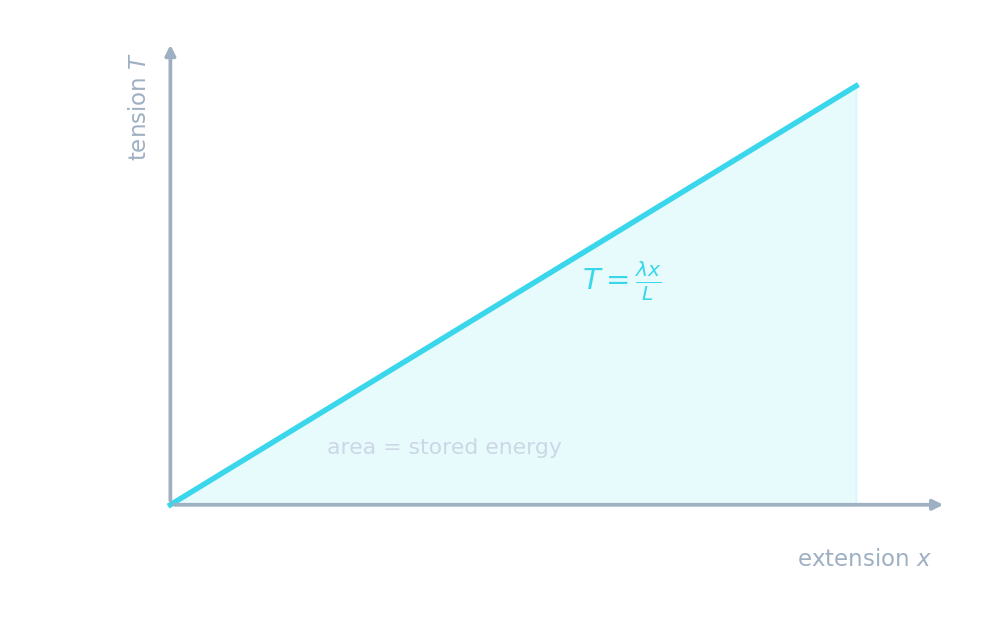
张力随伸长线性上升;线下面的面积是储存的弹性能量。
Hooke's law · 胡克定律
F = k·x
Force is proportional to extension — the gradient is the stiffness k. · 力与伸长成正比——梯度是劲度 k。
For the same string (λ = 50, x = 0.5, L = 2), find the stored elastic energy E = λx²/(2L) (J). · 对同一根弦(λ = 50,x = 0.5,L = 2),求储存的弹性能量 E = λx²/(2L)(J)。
E = 50 × 0.25 / 4 = 12.5/4 = 3.125 J. · E = 50 × 0.25 / 4 = 12.5/4 = 3.125 J。
The elastic energy equals the ______ under the force–extension graph. · 弹性能量等于力–伸长图下面的______。
Work done stretching = area under the T–x line = ½ × x × (λx/L) = λx²/(2L). · 拉伸做的功 = T–x 线下面的面积 = ½ × x × (λx/L) = λx²/(2L)。
Elastic potential energy 弹性势能
- Stretching does work, stored as elastic potential energy — the triangular area under the graph:
弹性势能
- 拉伸做功,储存为弹性势能(elastic potential energy)——图下面的三角形面积:
Worked example
- An elastic string of natural length $2$ m and modulus $50$ N is stretched by $0.5$ m.
- Tension $T = \dfrac{\lambda x}{L} = \dfrac{50 \times 0.5}{2} = 12.5$ N.
- Stored energy $E = \dfrac{\lambda x^2}{2L} = \dfrac{50 \times 0.25}{4} = 3.125$ J.
例题
- 一根自然长度 $2$ m、模量 $50$ N 的弹性弦被拉伸 $0.5$ m。
- 张力 $T = \dfrac{\lambda x}{L} = \dfrac{50 \times 0.5}{2} = 12.5$ N。
- 储存的能量 $E = \dfrac{\lambda x^2}{2L} = \dfrac{50 \times 0.25}{4} = 3.125$ J。
An elastic string (not a spring): · 一根弹性弦(不是弹簧):
A string only pulls; when slack its tension is zero. Only a spring pushes when compressed. · 一根弦只拉;松弛时它的张力为零。只有弹簧被压缩时推。
String vs spring
A string can't push. An elastic string only pulls (tension when stretched, nothing when slack). A spring also pushes when compressed 压缩 — so a spring's extension $x$ can be negative.
- A conical pendulum is a mass swung in a horizontal circle on a string.
弦对比弹簧
一根弦不能推。 一根弹性弦只拉(拉伸时有张力,松弛时没有)。一个弹簧被压缩时也推——所以一个弹簧的伸长 $x$ 可以是负的。
- 圆锥摆(conical pendulum)是用绳子在水平圆周上甩动的质量。
You've got it
- Hooke's law: $T = \dfrac{\lambda x}{L}$ (tension ∝ extension)
- stored elastic PE: $E = \dfrac{\lambda x^2}{2L}$ (area under the force–extension line)
- $\lambda$ = modulus, $L$ = natural length; a string only pulls, a spring also pushes
你掌握了
- 胡克定律:$T = \dfrac{\lambda x}{L}$(张力 ∝ 伸长)
- 储存的弹性势能:$E = \dfrac{\lambda x^2}{2L}$(力–伸长线下面的面积)
- $\lambda$ = 模量,$L$ = 自然长度;一根弦只拉,一个弹簧也推