Polar coordinates · 极坐标
| English | 中文 | Pinyin · 拼音 |
|---|---|---|
| Cartesian/kɑːˈtiːzɪən/ | 笛卡尔 | dí kǎ ěr |
| polar coordinates/ˈpəʊlə kəʊˈɔːdɪnəts/ | 极坐标 | jí zuò biāo |
| rotational symmetry/rəʊˈteɪʃənl ˈsɪmətri/ | 旋转对称 | xuán zhuǎn duì chèn |
| cardioid/ˈkɑːdɪəʊɪd/ | 心脏线 | xīn zàng xiàn |
| sector/ˈsektə/ | 扇形 | shàn xíng |
The coordinate system that simplifies circles
- Describing a spiral or a circle in Cartesian 笛卡尔 coordinates requires messy equations. In polar coordinates 极坐标, a circle is just $r = \text{constant}$.
- Polar coordinates are natural for anything with rotational symmetry 旋转对称 — from planetary orbits to radar screens.
简化圆的坐标系
- 用笛卡尔坐标描述一条螺线或一个圆需要凌乱的方程。在极坐标(polar coordinates)中,一个圆就是 $r = \text{constant}$。
- 极坐标对任何有旋转对称性的东西都很自然——从行星轨道到雷达屏幕。
Polar coordinates
- Polar coordinates give a point by distance $r$ from the origin and angle $\theta$.
- Links to Cartesian:
Worked example. The point $(r, \theta) = (5, 60°)$ in Cartesian: $x = 5\cos 60° = 2.5$, $y = 5\sin 60° = 4.33$. So the point is $(2.5, 4.33)$.
Polar coordinates $(r,\theta)$ convert to Cartesian by $x=r\cos\theta$ and $y=r\sin\theta$
A spiral staircase: spirals are described naturally in polar coordinates (r, theta)
极坐标
- 极坐标用到原点的距离 $r$ 和角 $\theta$ 给出一个点。
- 与笛卡尔坐标的联系:
算例。 点 $(r, \theta) = (5, 60°)$ 的笛卡尔坐标:$x = 5\cos 60° = 2.5$,$y = 5\sin 60° = 4.33$。所以这个点是 $(2.5, 4.33)$。
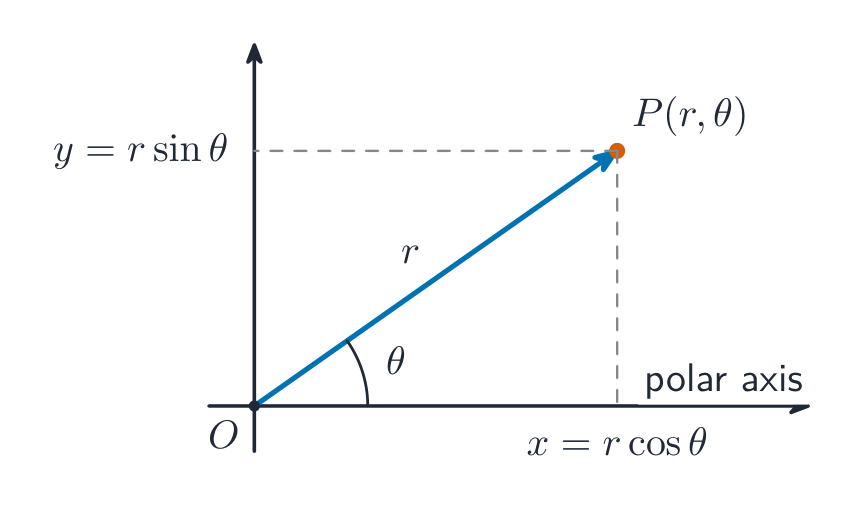
极坐标 $(r,\theta)$ 通过 $x=r\cos\theta$ 和 $y=r\sin\theta$ 转换为笛卡尔坐标

一个旋转楼梯:螺线在极坐标 (r, theta) 中被自然地描述
Polar coordinates · 极坐标
r = f(θ)
In polar form a point is (r, θ). Beautiful curves — roses, cardioids, spirals — come from r = f(θ). · 在极坐标形式中一个点是 (r, θ)。美丽的曲线——玫瑰线、心形线、螺线——来自 r = f(θ)。
In polar coordinates, the x-coordinate is given by: · 在极坐标中,x 坐标由以下给出:
x = r cos θ and y = r sin θ. · x = r cos θ 而 y = r sin θ。
Convert (r, θ) = (5, 60°) to Cartesian. What is x = r cos 60°? · 把 (r, θ) = (5, 60°) 转成笛卡尔坐标。x = r cos 60° 是多少?
x = 5 cos 60° = 5 × 0.5 = 2.5. · x = 5 cos 60° = 5 × 0.5 = 2.5。
For the point (3, 4) in Cartesian, r² = x² + y². Find r². · 对笛卡尔坐标中的点 (3, 4),r² = x² + y²。求 r²。
r² = 3² + 4² = 9 + 16 = 25. · r² = 3² + 4² = 9 + 16 = 25。
Polar curves
- Common polar curves:
r = 4cos θ is a circle of radius 2 centred at (2, 0) — polar form makes it a one-line equation.
- $r = a$ — a circle of radius $a$ centred at the origin.
- $r = a\cos\theta$ — a circle of radius $\dfrac{a}{2}$ centred at $\left(\dfrac{a}{2}, 0\right)$.
- $r = a(1 + \cos\theta)$ — a cardioid 心脏线 (heart shape).
极坐标曲线
- 常见的极坐标曲线:
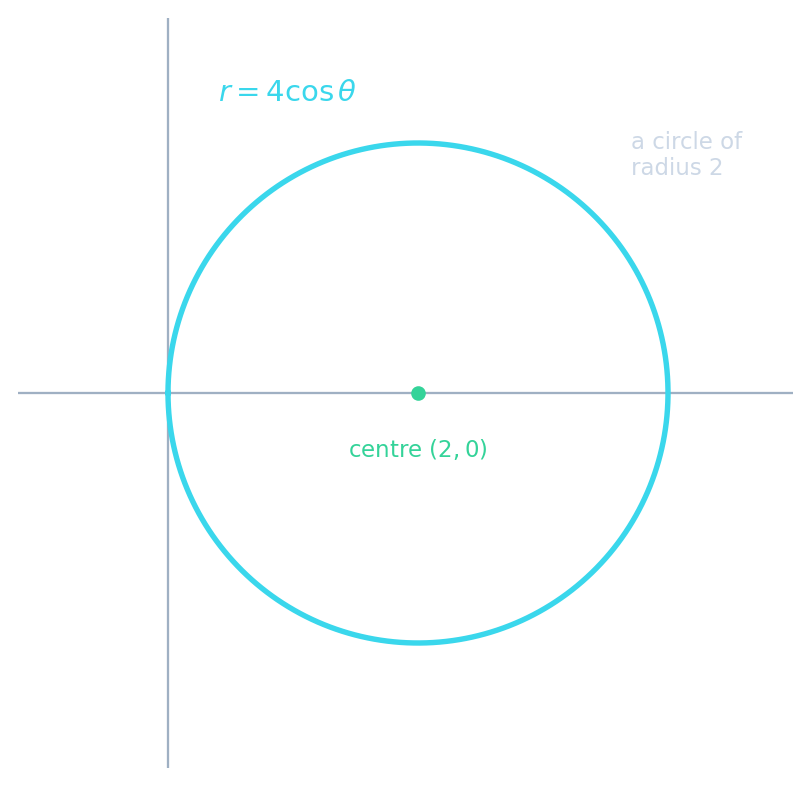
r = 4cos θ 是一个圆心在 (2, 0)、半径 2 的圆——极坐标形式使它成为一行的方程。
- $r = a$——一个圆心在原点、半径 $a$ 的圆。
- $r = a\cos\theta$——一个圆心在 $\left(\dfrac{a}{2}, 0\right)$、半径 $\dfrac{a}{2}$ 的圆。
- $r = a(1 + \cos\theta)$——一条心形线(cardioid,心的形状)。
The polar curve r = 4cos θ is a circle. What is its radius? · 极坐标曲线 r = 4cos θ 是一个圆。它的半径是多少?
r = 4cos θ gives x² + y² = 4x, i.e. (x−2)² + y² = 4 — a circle of radius 2. · r = 4cos θ 给出 x² + y² = 4x,即 (x−2)² + y² = 4——一个半径 2 的圆。
The polar curve r = a(1 + cos θ) is called a: · 极坐标曲线 r = a(1 + cos θ) 被称为一条:
r = a(1 + cos θ) traces a heart-shaped curve called a cardioid. · r = a(1 + cos θ) 描出一条心形的曲线,叫心形线。
Polar area
- Sector 扇形 area: $\text{area} = \tfrac12\displaystyle\int_{\alpha}^{\beta} r^2\,d\theta$.
Don't forget the $\dfrac{1}{2}$. The polar area formula has a factor of $\dfrac{1}{2}$ that's easy to miss. It comes from the area of a thin triangular sector: $\dfrac{1}{2}r^2\,d\theta$.
A cardioid r = 1 + cos theta, a curve sketched directly in polar form
极坐标面积
- 扇形面积:$\text{area} = \tfrac12\displaystyle\int_{\alpha}^{\beta} r^2\,d\theta$。
不要忘记 $\dfrac{1}{2}$。 极坐标面积公式有一个容易漏掉的 $\dfrac{1}{2}$ 因子。它来自一个细三角形扇形的面积:$\dfrac{1}{2}r^2\,d\theta$。
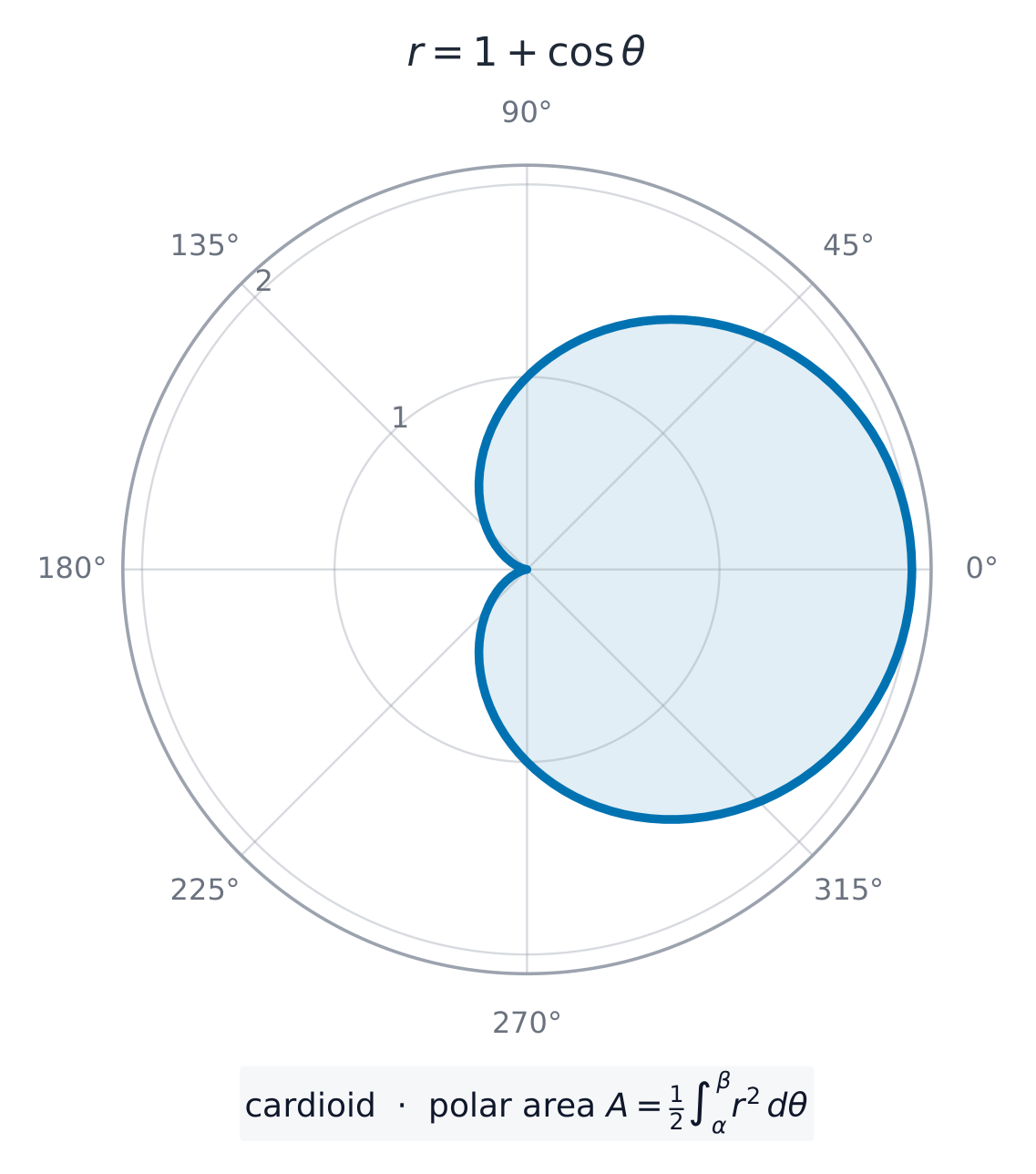
一条心形线 r = 1 + cos theta,一条直接以极坐标形式画出的曲线
The area of a polar sector is ½∫r² dθ. · 一个极坐标扇形的面积是 ½∫r² dθ。
This is the standard polar area formula. · 这是标准的极坐标面积公式。
Converting curves
- Example: $r = 4\cos\theta$ → multiply by $r$: $r^2 = 4r\cos\theta$ → $x^2 + y^2 = 4x$ → $(x-2)^2 + y^2 = 4$, a circle radius $2$.
转换曲线
- 例子:$r = 4\cos\theta$ → 乘以 $r$:$r^2 = 4r\cos\theta$ → $x^2 + y^2 = 4x$ → $(x-2)^2 + y^2 = 4$,一个半径 $2$ 的圆。
You've got it
- $x = r\cos\theta$, $y = r\sin\theta$, $r^2 = x^2 + y^2$
- polar sector area $= \tfrac12\int r^2\,d\theta$
- $r = 4\cos\theta$ is a circle of radius 2 centred at $(2, 0)$
你掌握了
- $x = r\cos\theta$,$y = r\sin\theta$,$r^2 = x^2 + y^2$
- 极坐标扇形面积 $= \tfrac12\int r^2\,d\theta$
- $r = 4\cos\theta$ 是一个圆心在 $(2, 0)$、半径 2 的圆