Vectors (Further Pure 1) · 向量(Further Pure 1)
| English | 中文 | Pinyin · 拼音 |
|---|---|---|
| plane/pleɪn/ | 平面 | píng miàn |
| skew/skjuː/ | 异面 | yì miàn |
| vector product/ˈvektə ˈprɒdʌkt/ | 向量积 | xiàng liàng jī |
| normal vector/ˈnɔːml ˈvektə/ | 法向量 | fǎ xiàng liàng |
| perpendicular/ˌpɜːpənˈdɪkjʊlə/ | 垂直 | chuí zhí |
| parallelogram/ˌpærəˈleləɡræm/ | 平行四边形 | píng xíng sì biān xíng |
| anti-commutative/ˈænti ˈkɒmjuːtətɪv/ | 反交换 | fǎn jiāo huàn |
The mathematics of 3D space
- How do you find the distance from a point to a plane 平面? The angle between two surfaces? The shortest path between two skew 异面 lines?
- Planes and the vector product 向量积 give you the tools to solve all these problems — essential for engineering, architecture, and computer graphics.
3D 空间的数学
- 你如何求一个点到一个平面的距离?两个表面之间的角?两条异面直线之间的最短路径?
- 平面与向量积(planes and the vector product)给你解决所有这些问题的工具——对工程、建筑和计算机图形必不可少。
Equations of planes
- A plane can be written in several forms:
The normal vector 法向量 n is perpendicular 垂直 to the plane; the scalar-product form is n·r = d.
- Cartesian: $ax + by + cz = d$
- Vector: $\mathbf{r}\cdot\mathbf{n} = p$ (where $\mathbf{n}$ is the normal vector)
- Parametric: $\mathbf{r} = \mathbf{a} + \lambda\mathbf{b} + \mu\mathbf{c}$
Worked example. A plane has normal $\mathbf{n} = \begin{pmatrix} 2 \\ -1 \\ 3 \end{pmatrix}$ and passes through $(1, 0, 2)$. Equation: $2x - y + 3z = 2(1) - 0 + 3(2) = 8$.
平面的方程
- 一个平面(plane)能写成几种形式:

法向量 n 垂直于平面;数量积形式是 n·r = d。
- 笛卡尔:$ax + by + cz = d$
- 向量:$\mathbf{r}\cdot\mathbf{n} = p$(其中 $\mathbf{n}$ 是法向量)
- 参数:$\mathbf{r} = \mathbf{a} + \lambda\mathbf{b} + \mu\mathbf{c}$
算例。 一个平面有法向量 $\mathbf{n} = \begin{pmatrix} 2 \\ -1 \\ 3 \end{pmatrix}$ 并过 $(1, 0, 2)$。方程:$2x - y + 3z = 2(1) - 0 + 3(2) = 8$。
Vectors · 向量
a · b = |a||b|cos θ
The dot product is zero exactly when two vectors are perpendicular. · 点积恰好在两个向量垂直时为零。
Scalar and vector products can find the shortest distance between two skew lines. · 数量积和向量积能求两条异面直线之间的最短距离。
These products let you compute distances, angles and intersections in 3D, including skew-line distances. · 这些积让你在 3D 中计算距离、角和交点,包括异面直线的距离。
A plane has equation 2x − y + 3z = 8. The normal vector has components (2, −1, ?). Find the missing component. · 一个平面有方程 2x − y + 3z = 8。法向量有分量 (2, −1, ?)。求缺的分量。
The coefficients of x, y, z in ax + by + cz = d give the normal vector (a, b, c) = (2, −1, 3). · ax + by + cz = d 中 x、y、z 的系数给出法向量 (a, b, c) = (2, −1, 3)。
The vector (cross) product
- The vector product $\mathbf{a}\times\mathbf{b} = |\mathbf{a}||\mathbf{b}|\sin\theta\,\hat{\mathbf{n}}$ gives a vector perpendicular to both.
- Its length equals the area of the parallelogram 平行四边形 spanned by $\mathbf{a}$ and $\mathbf{b}$.
Order matters. $\mathbf{a}\times\mathbf{b} = -\mathbf{b}\times\mathbf{a}$. The vector product is anti-commutative 反交换 — swapping the order reverses the direction.
Forces like wind and water are vectors, with both size and direction
向量(叉)积
- 向量积(vector product)$\mathbf{a}\times\mathbf{b} = |\mathbf{a}||\mathbf{b}|\sin\theta\,\hat{\mathbf{n}}$ 给出一个垂直于两者的向量。
- 它的长度等于 $\mathbf{a}$ 和 $\mathbf{b}$ 张成的平行四边形的面积。
顺序重要。 $\mathbf{a}\times\mathbf{b} = -\mathbf{b}\times\mathbf{a}$。向量积是反交换的(anti-commutative)——交换顺序反转方向。

像风和水这样的力是向量,既有大小又有方向
The vector product a × b gives a vector that is: · 向量积 a × b 给出一个向量,它:
a × b is perpendicular to both vectors; its length is |a||b|sin θ. · a × b 垂直于两个向量;它的长度是 |a||b|sin θ。
The magnitude |a × b| equals the: · 大小 |a × b| 等于:
|a × b| = |a||b|sin θ, which is the parallelogram's area. · |a × b| = |a||b|sin θ,这是平行四边形的面积。
The vector product is commutative: a × b = b × a. · 向量积是交换的:a × b = b × a。
The vector product is anti-commutative: a × b = −(b × a). Swapping the order reverses the direction. · 向量积是反交换的:a × b = −(b × a)。交换顺序反转方向。
If |a| = 3, |b| = 4, and the angle between them is 30°, |a × b| = |a||b|sin θ. Find it. · 如果 |a| = 3,|b| = 4,它们之间的角是 30°,|a × b| = |a||b|sin θ。求它。
|a × b| = 3 × 4 × sin 30° = 12 × 0.5 = 6. · |a × b| = 3 × 4 × sin 30° = 12 × 0.5 = 6。
Applications
- With scalar and vector products: distances, angles, where lines and planes meet, and the shortest distance between skew lines.
- Distance from point to plane: $d = \dfrac{|ax_0 + by_0 + cz_0 - d|}{\sqrt{a^2 + b^2 + c^2}}$.
The vector product is perpendicular to both vectors; its length is the parallelogram area
应用
- 用数量积和向量积:距离、角、直线和平面在哪里相交,以及异面直线之间的最短距离。
- 点到平面的距离:$d = \dfrac{|ax_0 + by_0 + cz_0 - d|}{\sqrt{a^2 + b^2 + c^2}}$。
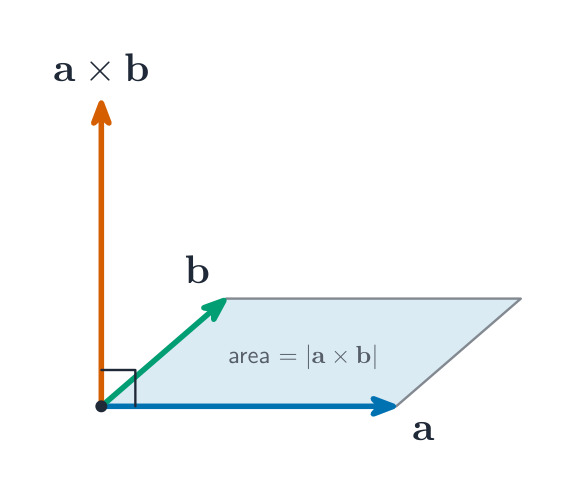
向量积垂直于两个向量;它的长度是平行四边形的面积
Finding the normal
- The normal to a plane containing two vectors $\mathbf{b}$ and $\mathbf{c}$ is $\mathbf{n} = \mathbf{b} \times \mathbf{c}$.
- This is the quickest way to find the Cartesian equation from a parametric form.
求法向量
- 包含两个向量 $\mathbf{b}$ 和 $\mathbf{c}$ 的平面的法向量是 $\mathbf{n} = \mathbf{b} \times \mathbf{c}$。
- 这是从参数形式求笛卡尔方程最快的方式。
You've got it
- a plane: $ax + by + cz = d$ or $\mathbf{r}\cdot\mathbf{n} = p$
- the vector product $\mathbf{a}\times\mathbf{b}$ is perpendicular to both; $|\mathbf{a}\times\mathbf{b}|$ = parallelogram area
- use it for distances, angles, intersections, and skew-line distances
你掌握了
- 一个平面:$ax + by + cz = d$ 或 $\mathbf{r}\cdot\mathbf{n} = p$
- 向量积 $\mathbf{a}\times\mathbf{b}$ 垂直于两者;$|\mathbf{a}\times\mathbf{b}|$ = 平行四边形面积
- 用它求距离、角、交点,和异面直线的距离