Rational functions and graphs · 有理函数与图
| English | 中文 | Pinyin · 拼音 |
|---|---|---|
| polynomial/ˌpɒlɪˈnəʊmɪəl/ | 多项式 | duō xiàng shì |
| vertical asymptote/ˈvɜːtɪkl ˈæsɪmptəʊt/ | 垂直渐近线 | chuí zhí jiàn jìn xiàn |
| oblique asymptote/əˈbliːk ˈæsɪmptəʊt/ | 斜渐近线 | xié jiàn jìn xiàn |
| denominator/dɪˈnɒmɪneɪtə/ | 分母 | fēn mǔ |
| rational function/ˈræʃənl ˈfʌŋkʃn/ | 有理函数 | yǒu lǐ hán shù |
| remainder/rɪˈmeɪndə/ | 余数 | yú shù |
| quotient/ˈkwəʊʃənt/ | 商 | shāng |
The graph that breaks the rules
- Most functions you've met are polynomials 多项式 — smooth, continuous, defined everywhere. But divide one polynomial by another and you get something wilder: vertical asymptotes 垂直渐近线, oblique asymptotes 斜渐近线, and behaviour that changes dramatically near the zeros of the denominator 分母.
- Rational functions 有理函数 are the gateway to understanding more complex curves.
打破规则的图
- 你遇到的大多数函数是多项式——光滑、连续、处处有定义。但把一个多项式除以另一个,你就得到更狂野的东西:垂直渐近线、斜渐近线,以及在分母的零点附近剧烈改变的行为。
- 有理函数(rational functions)是理解更复杂曲线的门户。
What is a rational function?
- A rational function is a fraction of two polynomials: $f(x) = \dfrac{P(x)}{Q(x)}$.
- The denominator's zeros give vertical asymptotes (where the function shoots to $\pm\infty$).
Worked example. $f(x) = \dfrac{x^2 - 1}{x - 2}$. Vertical asymptote at $x = 2$. Dividing: $f(x) = x + 2 + \dfrac{3}{x-2}$. The oblique asymptote is $y = x + 2$.
什么是有理函数?
- 一个有理函数是两个多项式的分数:$f(x) = \dfrac{P(x)}{Q(x)}$。
- 分母的零点给出垂直渐近线(vertical asymptotes,函数在那里冲向 $\pm\infty$)。
算例。 $f(x) = \dfrac{x^2 - 1}{x - 2}$。垂直渐近线在 $x = 2$。相除:$f(x) = x + 2 + \dfrac{3}{x-2}$。斜渐近线是 $y = x + 2$。
Rational functions · 有理函数
y = a/(x − b) + c
A rational function has asymptotes the curve approaches but never touches. · 一个有理函数有曲线接近但从不接触的渐近线。
A rational function is a fraction of two polynomials. · 一个有理函数是两个多项式的分数。
That is the definition — one polynomial over another. · 那就是定义——一个多项式除以另一个。
Oblique (slant) asymptotes
- When the top has higher degree than the bottom, the graph has an oblique (slant) asymptote — find it by polynomial long division.
- The remainder 余数 term vanishes as $x \to \infty$, leaving the quotient 商 as the asymptote.
The curve hugs the vertical asymptote x = 2 and the oblique asymptote y = x + 2 far from the origin.
Don't forget the remainder. When dividing, the function equals the quotient plus the remainder over the divisor. The asymptote is just the quotient — the remainder tells you which side of the asymptote the curve approaches from.
斜渐近线
- 当分子的次数比分母更高时,图有一条斜渐近线(oblique/slant asymptote)——用多项式长除法找到它。
- 余项随 $x \to \infty$ 消失,留下商作为渐近线。
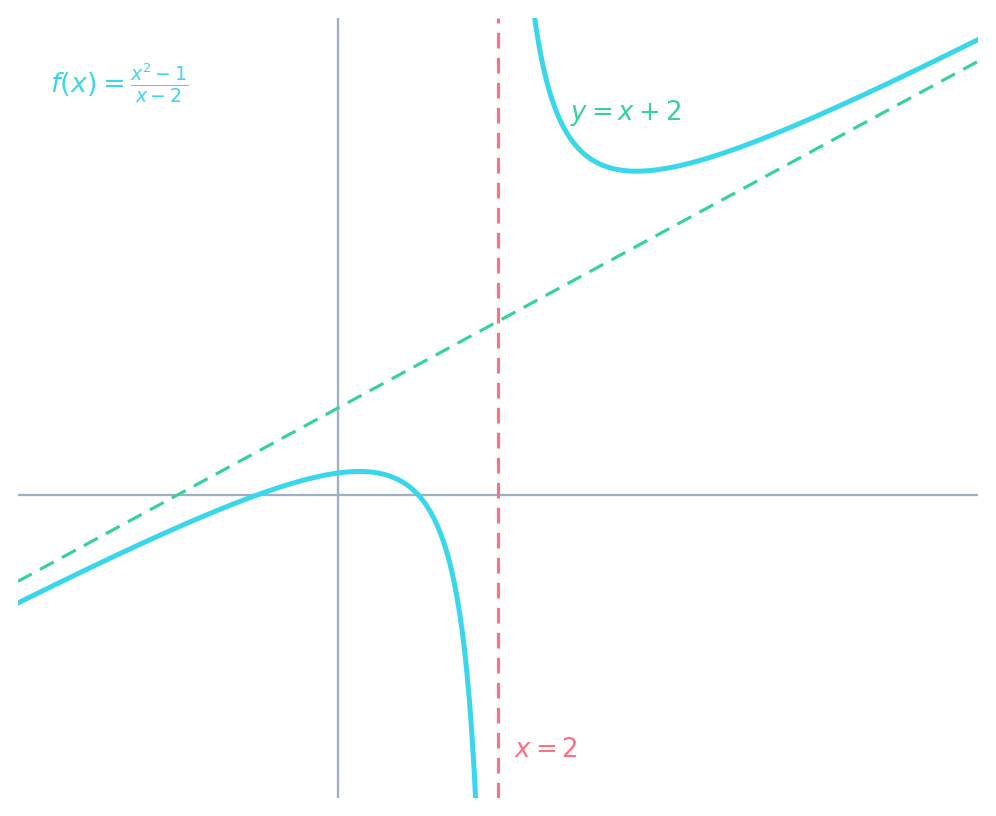
曲线紧贴垂直渐近线 x = 2,在远离原点处紧贴斜渐近线 y = x + 2。
不要忘记余项。 相除时,函数等于商加上余项除以除式。渐近线只是商——余项告诉你曲线从渐近线的哪一边接近。
A rational function has an oblique (slant) asymptote when the degree of the top is: · 一个有理函数有一条斜渐近线,当分子的次数:
When the numerator's degree exceeds the denominator's, dividing out leaves a slant line the curve approaches. · 当分子的次数超过分母的,除出来留下一条曲线接近的斜线。
You find an oblique asymptote by: · 你这样找一条斜渐近线:
Polynomial division gives the straight-line part the curve approaches far from the origin. · 多项式除法给出曲线在远离原点处接近的直线部分。
For f(x) = (x²−1)/(x−2), divide to get f(x) = x + 2 + 3/(x−2). The oblique asymptote is y = x + ? · 对 f(x) = (x²−1)/(x−2),相除得 f(x) = x + 2 + 3/(x−2)。斜渐近线是 y = x + ?
The quotient is x + 2, so the oblique asymptote is y = x + 2. · 商是 x + 2,所以斜渐近线是 y = x + 2。
Related graphs
- You should relate $y = f(x)$ to:
- $y^2 = f(x)$ — only exists where $f(x) \geq 0$, symmetric about the $x$-axis.
- $y = \dfrac{1}{f(x)}$ — zeros become asymptotes, asymptotes become zeros.
- $y = |f(x)|$ — reflects negative parts above the $x$-axis.
- $y = f(|x|)$ — reflects the right half to the left.
相关的图
- 你应该把 $y = f(x)$ 联系到:
- $y^2 = f(x)$——只在 $f(x) \geq 0$ 处存在,关于 $x$ 轴对称。
- $y = \dfrac{1}{f(x)}$——零点变成渐近线,渐近线变成零点。
- $y = |f(x)|$——把负的部分反射到 $x$ 轴上方。
- $y = f(|x|)$——把右半边反射到左边。
For y = 1/f(x), the zeros of f(x) become vertical asymptotes. · 对 y = 1/f(x),f(x) 的零点变成垂直渐近线。
Where f(x) = 0, 1/f(x) is undefined — giving a vertical asymptote. · 在 f(x) = 0 处,1/f(x) 无定义——给出一条垂直渐近线。
The graph of y = |f(x)| is obtained from y = f(x) by: · y = |f(x)| 的图这样从 y = f(x) 得到:
The modulus reflects any part of the graph below the x-axis to above it. · 模把图在 x 轴下方的任何部分反射到上方。
Worked example — sketching $y = \dfrac{1}{f(x)}$
- If $f(x) = x^2 - 4$ (roots at $\pm 2$, minimum at $(0, -4)$):
- $\dfrac{1}{f(x)}$ has vertical asymptotes at $x = \pm 2$.
- The minimum of $f$ at $-4$ becomes a local maximum of $\dfrac{1}{f}$ at $-\dfrac{1}{4}$.
- Find the set of values a rational function takes using the discriminant, and its turning points.
算例——画 $y = \dfrac{1}{f(x)}$
- 如果 $f(x) = x^2 - 4$(根在 $\pm 2$,最小值在 $(0, -4)$):
- $\dfrac{1}{f(x)}$ 在 $x = \pm 2$ 有垂直渐近线。
- $f$ 在 $-4$ 的最小值变成 $\dfrac{1}{f}$ 在 $-\dfrac{1}{4}$ 的一个局部最大值。
- 用判别式(discriminant)求有理函数的取值集合,以及它的驻点(turning points)。
You've got it
- a rational function = polynomial ÷ polynomial
- top degree > bottom degree → an oblique asymptote (found by division)
- learn the related graphs: $y^2 = f$, $1/f$, $|f|$, $f(|x|)$
你掌握了
- 一个有理函数 = 多项式 ÷ 多项式
- 分子次数 > 分母次数 → 一条斜渐近线(由除法找到)
- 学会相关的图:$y^2 = f$、$1/f$、$|f|$、$f(|x|)$