Summation of series · 级数求和
| English | 中文 | Pinyin · 拼音 |
|---|---|---|
| summation/sʌˈmeɪʃn/ | 求和 | qiú hé |
| method of differences/ˈmeθəd ɒv ˈdɪfrənsɪz/ | 差分法 | chā fēn fǎ |
| telescope/ˈtelɪskəʊp/ | 裂项相消 | liè xiàng xiāng xiāo |
| converge/kənˈvɜːdʒ/ | 收敛 | shōu liǎn |
| sum to infinity/sʌm tʊ ɪnˈfɪnɪti/ | 无穷和 | wú qióng hé |
| partial fractions/ˈpɑːʃl ˈfrækʃnz/ | 部分分式 | bù fèn fēn shì |
The sum that Gauss solved at age 10
- Young Gauss's teacher set the class the task of adding $1 + 2 + 3 + \cdots + 100$, expecting an hour's work. Gauss saw the pattern instantly: pair the first and last ($1 + 100 = 101$), the second and second-to-last ($2 + 99 = 101$), and so on — 50 pairs of 101 = 5050.
- Summation 求和 formulas turn long additions into simple algebra.
高斯 10 岁时解出的和
- 年轻的高斯的老师给全班布置了加 $1 + 2 + 3 + \cdots + 100$ 的任务,期待一小时的功夫。高斯立刻看出了模式:把第一个和最后一个配对($1 + 100 = 101$),第二个和倒数第二个($2 + 99 = 101$),依此类推——50 对 101 = 5050。
- 求和公式(summation formulas)把长的加法变成简单的代数。
Standard summation results
Worked example. $\sum_{r=1}^{10} r^2 = \dfrac{10 \times 11 \times 21}{6} = \dfrac{2310}{6} = 385$.
Summing 1 to n by pairing the ends: the total is n(n+1)/2
标准求和结果
算例。 $\sum_{r=1}^{10} r^2 = \dfrac{10 \times 11 \times 21}{6} = \dfrac{2310}{6} = 385$。
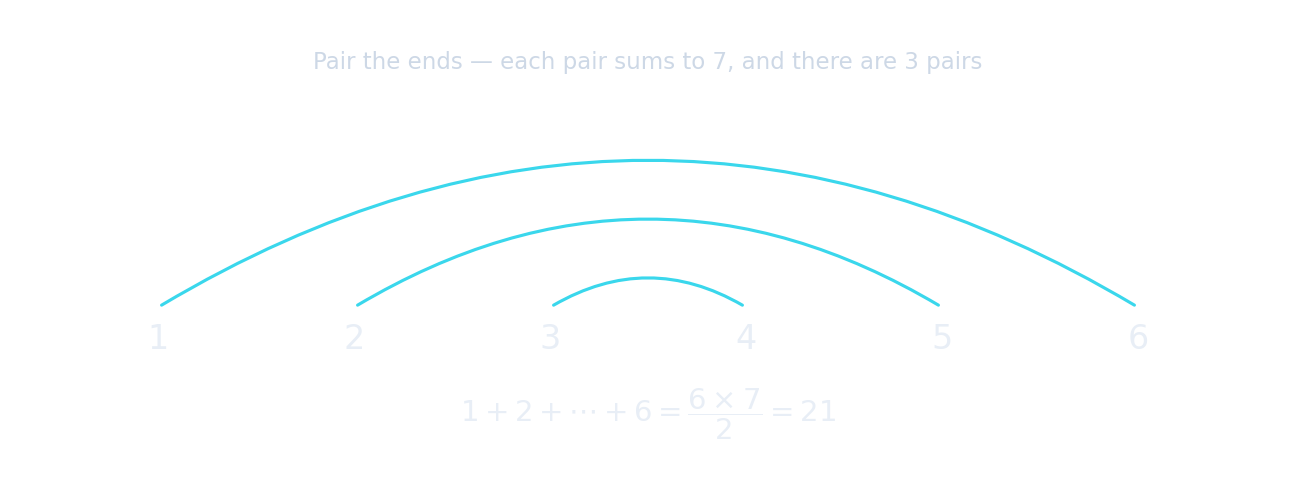
通过配对两端求 1 到 n 的和:总和是 n(n+1)/2
Summation of series · 级数求和
Sₙ = Σ uₖ
Add the terms one by one — the partial sum climbs toward its limit. · 把项一个一个地加起来——部分和向它的极限爬升。
Using Σr = ½n(n+1), what is the sum of the first 5 integers? · 用 Σr = ½n(n+1),前 5 个整数的和是多少?
½ × 5 × 6 = 15 (= 1+2+3+4+5). · ½ × 5 × 6 = 15(= 1+2+3+4+5)。
Using Σr² = (1/6)n(n+1)(2n+1), what is the sum of the first 3 squares? · 用 Σr² = (1/6)n(n+1)(2n+1),前 3 个平方数的和是多少?
(1/6)(3)(4)(7) = 84/6 = 14 (= 1+4+9). · (1/6)(3)(4)(7) = 84/6 = 14(= 1+4+9)。
Using Σr³ = ¼n²(n+1)², what is the sum of the first 3 cubes? · 用 Σr³ = ¼n²(n+1)²,前 3 个立方数的和是多少?
¼ × 9 × 16 = 36 (= 1+8+27). Note: 36 = 6² = (1+2+3)². · ¼ × 9 × 16 = 36(= 1+8+27)。注意:36 = 6² = (1+2+3)²。
Complete the standard result: Σr (from 1 to n) = ______ n(n+1). · 补全标准结果:Σr(从 1 到 n)= ______ n(n+1)。
The sum of the first n integers is ½n(n+1). · 前 n 个整数的和是 ½n(n+1)。
Splitting sums
- Split a sum into standard pieces:
- $\sum_{r=1}^{n}(2r+1) = 2\sum r + \sum 1 = 2 \times \dfrac{n(n+1)}{2} + n = n(n+1) + n = n(n+2)$.
$\sum r^3 = (\sum r)^2$. This beautiful identity means the sum of cubes equals the square of the sum of the first $n$ integers. It's easy to verify: $\sum_{r=1}^{3} r^3 = 1 + 8 + 27 = 36 = 6^2 = (1+2+3)^2$.
拆分求和
- 把一个和拆成标准的片段:
- $\sum_{r=1}^{n}(2r+1) = 2\sum r + \sum 1 = 2 \times \dfrac{n(n+1)}{2} + n = n(n+1) + n = n(n+2)$。
$\sum r^3 = (\sum r)^2$。 这个美丽的恒等式意味着立方的和等于前 $n$ 个整数的和的平方。容易验证:$\sum_{r=1}^{3} r^3 = 1 + 8 + 27 = 36 = 6^2 = (1+2+3)^2$。
Σ(2r+1) from r=1 to n = n(n+2). For n=4, find the sum. · Σ(2r+1) 从 r=1 到 n = n(n+2)。对 n=4,求这个和。
4 × 6 = 24. Check: 3+5+7+9 = 24. · 4 × 6 = 24。检查:3+5+7+9 = 24。
The method of differences 差分法
- If each term is $f(r) - f(r+1)$, almost everything cancels (telescopes 裂项相消).
- From the sum to $n$ terms you can see if a series converges 收敛 and find its sum to infinity 无穷和.
差分法
- 如果每一项是 $f(r) - f(r+1)$,几乎一切都消去(telescope,套叠)。
- 从前 $n$ 项的和你能看出一个级数是否收敛,并求它的无穷和。
In the method of differences, if each term is f(r) − f(r+1), most terms cancel (telescope). · 在差分法中,如果每一项是 f(r) − f(r+1),大多数项消去(套叠)。
Consecutive terms cancel, leaving only the first and last pieces. · 相邻的项消去,只留下第一块和最后一块。
Σ 1/(r(r+1)) from r=1 to ∞ telescopes to 1 − 1/(n+1). As n→∞, the sum to infinity is? · Σ 1/(r(r+1)) 从 r=1 到 ∞ 套叠成 1 − 1/(n+1)。当 n→∞,无穷和是多少?
As n→∞, 1/(n+1)→0, so the sum approaches 1. · 当 n→∞,1/(n+1)→0,所以和接近 1。
Worked example — method of differences
- Find $\sum_{r=1}^{n} \dfrac{1}{r(r+1)}$.
- Partial fractions 部分分式: $\dfrac{1}{r(r+1)} = \dfrac{1}{r} - \dfrac{1}{r+1}$.
- Sum telescopes: $\left(\dfrac{1}{1} - \dfrac{1}{2}\right) + \left(\dfrac{1}{2} - \dfrac{1}{3}\right) + \cdots = 1 - \dfrac{1}{n+1} = \dfrac{n}{n+1}$.
- As $n \to \infty$: sum to infinity $= 1$.
- A series is convergent when its sum to $n$ terms approaches a limit.
算例——差分法
- 求 $\sum_{r=1}^{n} \dfrac{1}{r(r+1)}$。
- 部分分式:$\dfrac{1}{r(r+1)} = \dfrac{1}{r} - \dfrac{1}{r+1}$。
- 求和套叠:$\left(\dfrac{1}{1} - \dfrac{1}{2}\right) + \left(\dfrac{1}{2} - \dfrac{1}{3}\right) + \cdots = 1 - \dfrac{1}{n+1} = \dfrac{n}{n+1}$。
- 当 $n \to \infty$:无穷和 $= 1$。
- 当部分和趋于极限时,级数是收敛的(convergent)。
You've got it
- $\sum r = \tfrac12 n(n+1)$, $\sum r^2 = \tfrac16 n(n+1)(2n+1)$, $\sum r^3 = \tfrac14 n^2(n+1)^2$
- split sums into standard pieces
- method of differences telescopes $f(r) - f(r+1)$
你掌握了
- $\sum r = \tfrac12 n(n+1)$,$\sum r^2 = \tfrac16 n(n+1)(2n+1)$,$\sum r^3 = \tfrac14 n^2(n+1)^2$
- 把求和拆成标准的片段
- 差分法套叠 $f(r) - f(r+1)$