Predicting the type of polymerisation · 预测聚合的类型
| English | 中文 | Pinyin · 拼音 |
|---|---|---|
| monomer/ˈmɒnəʊmə/ | 单体 | dān tǐ |
| addition polymerisation/əˈdɪʃn ˌpɒlɪməraɪˈzeɪʃn/ | 加成聚合 | jiā chéng jù hé |
| functional group/ˈfʌŋkʃənl ɡruːp/ | 官能团 | guān néng tuán |
| condensation polymerisation/kɒndenˈseɪʃn ˌpɒlɪməraɪˈzeɪʃn/ | 缩合聚合 | suō hé jù hé |
Which kind of polymer?
- Monomers 单体 can join in two very different ways.
- One clue — the monomer itself — tells you which.
- It comes down to whether a C=C opens up, or a small molecule is lost.
哪种聚合物?
- 单体可以以两种非常不同的方式连接。
- 一个线索——单体本身——告诉你哪一种。
- 它归结为一个 C=C 是否打开,或一个小分子是否失去。
Polymerisation type lab · 聚合类型实验室
Classify monomers by whether they form addition or condensation polymers. · 按单体形成加成还是缩合聚合物来分类它们。
Two monomers each with two functional groups will most likely form by: · 两个各有两个官能团的单体最可能通过以下形成:
Two reactive ends per monomer link with loss of a small molecule. · 每个单体的两个反应端连接并失去一个小分子。
Addition polymers form from monomers containing C=C double bonds. · 加成聚合物从含有 C=C 双键的单体形成。
No small molecule is lost. · 没有小分子失去。
The clues
| Clue | Type |
|---|---|
| monomer has a C=C and nothing is lost | addition polymerisation 加成聚合 |
| each monomer has two functional groups 官能团, a small molecule is lost, the chain has ester/amide links | condensation polymerisation 缩合聚合 |
Addition versus condensation polymerisation
线索
| 线索 | 类型 |
|---|---|
| 单体有一个 C=C 且什么都不失去 | 加成聚合 |
| 每个单体有两个官能团,一个小分子失去,链有酯/酰胺键 | 缩合聚合 |
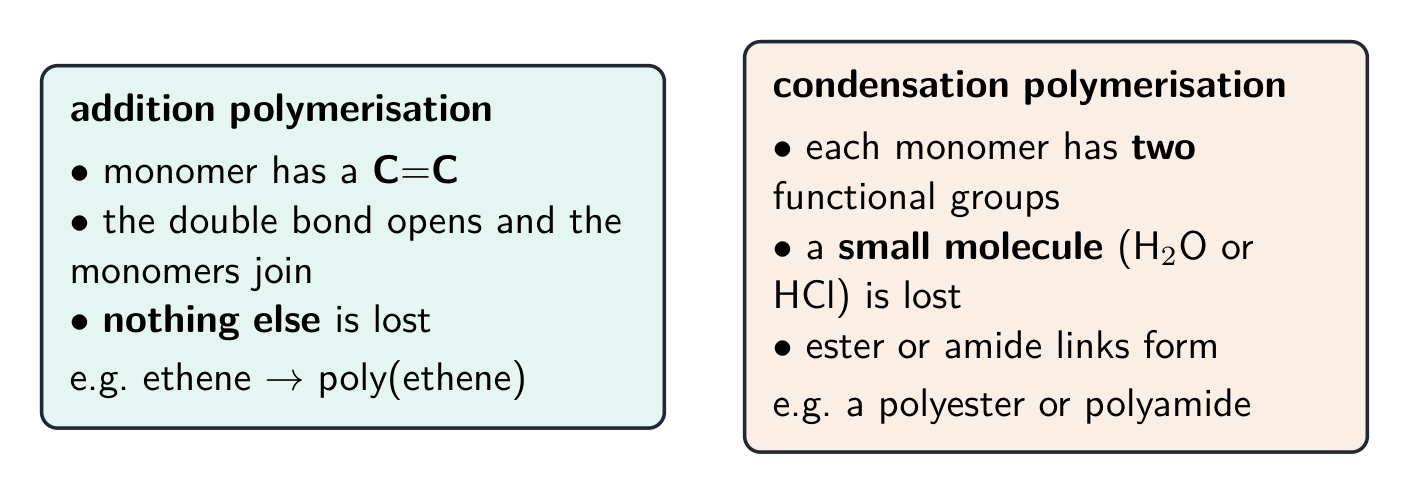
加成 vs 缩合聚合
A monomer with a C=C double bond, where nothing else is lost, undergoes: · 一个有 C=C 双键的单体,没有其他东西失去,进行:
Addition polymerisation opens the C=C and joins monomers with no other product. · 加成聚合打开 C=C 并连接单体,没有其他产物。
Monomers with two functional groups that lose a small molecule give: · 有两个官能团并失去一个小分子的单体给出:
Two-group monomers join with loss of a small molecule, forming ester/amide links — condensation. · 两基团单体连接并失去一个小分子,形成酯/酰胺键——缩合。
A polymer chain that contains ester or amide links was made by: · 一个含有酯或酰胺键的聚合物链是由以下制成的:
Ester/amide links are the signature of condensation polymers (addition polymers have a plain C–C backbone). · 酯/酰胺键是缩合聚合物的标志(加成聚合物有一个简单的 C–C 主链)。
Match each term to its meaning. · 匹配每个术语和它的含义。
Each item links the term to its correct meaning. · 每一项把术语链接到它正确的含义。
How to tell the type
- Look at the monomer, not just the polymer.
- One monomer with a C=C → addition. Two monomers each with two reactive groups → condensation.
- Condensation always loses a small molecule (water, or HCl from an acyl chloride).
- Addition: ethene CH₂=CH₂ → poly(ethene). The double bond opens; nothing is lost.
- Condensation (polyester): a diol + a dicarboxylic acid → PET + water (ester links).
- Condensation (polyamide): a diamine + a dicarboxylic acid → nylon + water (amide links).
A single C=C monomer is the give-away for addition; two double-ended monomers losing water/HCl is condensation.
如何判断类型
- 看单体,不只是聚合物。
- 一个有 C=C 的单体 → 加成。两个各有两个反应基团的单体 → 缩合。
- 缩合总是失去一个小分子(水,或来自一个酰氯的 HCl)。
- 加成: 乙烯 CH₂=CH₂ → 聚乙烯。双键打开;什么都不失去。
- 缩合(聚酯): 一个二醇 + 一个二羧酸 → PET + 水(酯键)。
- 缩合(聚酰胺): 一个二胺 + 一个二羧酸 → 尼龙 + 水(酰胺键)。
一个单一的 C=C 单体是加成的标志;两个双端单体失去水/HCl 是缩合。
Spotting the repeat unit
- Addition polymer: the backbone is all carbon — no links break it up.
- Condensation polymer: you can spot ester (–COO–) or amide (–CONH–) links repeating along the chain.
- Finding those links in a structure instantly tells you it was made by condensation.
找出重复单元
- 加成聚合物:主链全是碳——没有键把它分开。
- 缩合聚合物:你可以发现**酯(–COO–)或酰胺(–CONH–)**键沿链重复。
- 在一个结构中找到那些键立即告诉你它是由缩合制成的。
You've got it
- addition: a C=C monomer opens up, nothing else is lost (e.g. poly(ethene))
- condensation: two-group monomers join, a small molecule is lost (water/HCl), leaving ester/amide links (e.g. PET, nylon)
- to decide: look at the monomer and check for a lost small molecule
你掌握了
- 加成:一个 C=C 单体打开,没有其他东西失去(例如聚乙烯)
- 缩合:两基团单体连接,一个小分子失去(水/HCl),留下酯/酰胺键(例如 PET、尼龙)
- 要决定:看单体并检查是否有失去的小分子