Amino acids · 氨基酸
| English | 中文 | Pinyin · 拼音 |
|---|---|---|
| amino acid/əˈmiːnəʊ ˈæsɪd/ | 氨基酸 | ān jī suān |
| peptide bond/ˈpeptaɪd bɒnd/ | 肽键 | tài jiàn |
| zwitterion/zwɪˈtɪərɪən/ | 两性离子 | liǎng xìng lí zi |
| isoelectric point/ˌaɪsəʊˈlektrɪk pɔɪnt/ | 等电点 | děng diàn diǎn |
| electrophoresis/ɪˌlektrəʊfɔːˈriːsɪs/ | 电泳 | diàn yǒng |
The building blocks of proteins
- An amino acid 氨基酸 has both a basic –NH₂ group and an acidic –COOH group.
- Its charge depends on the pH.
- Amino acids join into proteins by peptide bonds 肽键.
蛋白质的构建块
- 一个氨基酸(amino acid)同时有一个碱性 –NH₂ 基团和一个酸性 –COOH 基团。
- 它的电荷取决于 pH。
- 氨基酸通过肽键连接成蛋白质。
Amino acid lab · 氨基酸实验室
Classify amino acid behaviour by the group that reacts. · 按反应的基团分类氨基酸的行为。
An amino acid contains: · 一个氨基酸含有:
Having both groups is what makes amino acids behave as they do (zwitterions, peptide bonds). · 同时有两个基团就是使氨基酸如此表现的原因(两性离子、肽键)。
Amino acids contain both an amino group and a carboxylic acid group. · 氨基酸同时含有一个氨基和一个羧酸基团。
They can act as both acid and base (zwitterions). · 它们可以同时作为酸和碱(两性离子)。
Zwitterions 两性离子 and the isoelectric point 等电点
- The –COOH can give its $\text{H}^+$ to the –NH₂ in the same molecule → a zwitterion ($\text{H}_3\text{N}^+\text{–CHR–COO}^-$): both ends charged, no overall charge.
- in acid (low pH): gains $\text{H}^+$ → positive.
- in alkali (high pH): loses $\text{H}^+$ → negative.
- at the isoelectric point: mostly the zwitterion, no net charge.
An amino acid is positive, zwitterionic or negative with pH
两性离子和等电点
- –COOH 可以把它的 $\text{H}^+$ 给同一分子中的 –NH₂ → 一个两性离子(zwitterion)($\text{H}_3\text{N}^+\text{–CHR–COO}^-$):两端都带电,无总电荷。
- 在酸中(低 pH):获得 $\text{H}^+$ → 带正电。
- 在碱中(高 pH):失去 $\text{H}^+$ → 带负电。
- 在等电点:大多是两性离子,无净电荷。

一个氨基酸随 pH 是正、两性或负的
A zwitterion is: · 一个两性离子是:
The –COOH gives H⁺ to the –NH₂, so both ends are charged but the molecule is overall neutral. · –COOH 把 H⁺ 给 –NH₂,所以两端都带电但分子总体中性。
In acidic solution (low pH), an amino acid is: · 在酸性溶液中(低 pH),一个氨基酸是:
In acid it gains H⁺ (positive); in alkali it loses H⁺ (negative); at the isoelectric point it is neutral. · 在酸中它获得 H⁺(正);在碱中它失去 H⁺(负);在等电点它是中性的。
Match each term to its meaning. · 匹配每个术语和它的含义。
Each item links the term to its correct meaning. · 每一项把术语链接到它正确的含义。
Peptide bonds
- Two amino acids join by condensation (lose water) forming a peptide bond (an amide link) → a dipeptide.
- Repeating this builds a polypeptide, and then a protein.
Two amino acids condense to form a peptide bond
肽键
- 两个氨基酸通过缩合(condensation)(失去水)连接,形成一个肽键(一个酰胺键)→ 一个二肽。
- 重复这个构建一个多肽,然后一个蛋白质。

两个氨基酸缩合形成一个肽键
Two amino acids join by a: · 两个氨基酸通过一个以下连接:
Condensation between –COOH and –NH₂ forms a peptide (amide) bond and releases water. · –COOH 和 –NH₂ 之间的缩合形成一个肽(酰胺)键并释放水。
Worked example: electrophoresis 电泳
- Electrophoresis separates amino acids by charge at a chosen pH.
Glycine has an isoelectric point of about pH 6.
- At pH 2 (below pI): it is positive → moves to the negative electrode (cathode).
- At pH 11 (above pI): it is negative → moves to the positive electrode (anode).
- At pH 6 (its pI): no net charge → it stays put.
So the direction and distance moved identify the amino acid.
Electrophoresis separates amino acids by charge
例题:电泳
- 电泳(electrophoresis)在一个选定的 pH 下按电荷分离氨基酸。
甘氨酸的等电点约为 pH 6。
- 在 pH 2(低于 pI):它是正的 → 移向负电极(阴极)。
- 在 pH 11(高于 pI):它是负的 → 移向正电极(阳极)。
- 在 pH 6(它的 pI):无净电荷 → 它待在原地。
所以移动的方向和距离识别氨基酸。
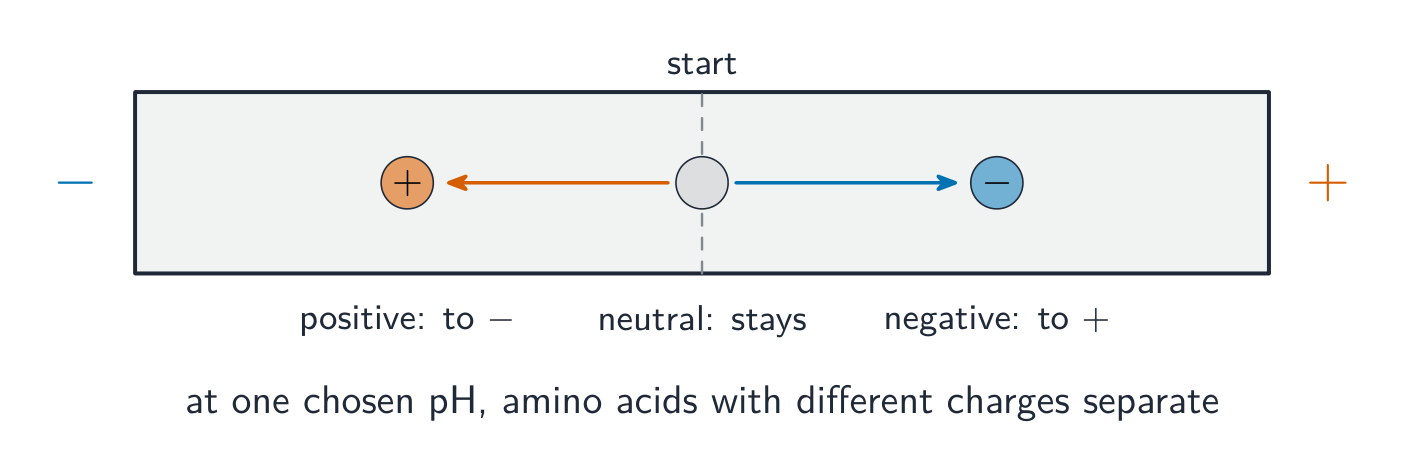
电泳按电荷分离氨基酸
You've got it
- an amino acid has –NH₂ (basic) and –COOH (acidic)
- zwitterion = no net charge; positive in acid, negative in alkali; neutral at the isoelectric point
- two amino acids condense to form a peptide bond (amide link), losing water
- electrophoresis: below pI → moves to cathode; above pI → anode; at pI → stays put
你掌握了
- 一个氨基酸有 –NH₂(碱性)和 –COOH(酸性)
- 两性离子 = 无净电荷;在酸中正,在碱中负;在等电点中性
- 两个氨基酸缩合形成一个肽键(酰胺键),失去水
- 电泳:低于 pI → 移向阴极;高于 pI → 阳极;在 pI → 待在原地