Primary and secondary amines · 伯胺和仲胺
| English | 中文 | Pinyin · 拼音 |
|---|---|---|
| amine/ˈæmaɪn/ | 胺 | àn |
| amino acid/əˈmiːnəʊ ˈæsɪd/ | 氨基酸 | ān jī suān |
| lone pair/ləʊn peə/ | 孤对电子 | gū duì diàn zi |
| basicity/beɪˈsɪsɪti/ | 碱性 | jiǎn xìng |
| phenylamine/ˌfiːˈnaɪləmiːn/ | 苯胺 | běn àn |
Nitrogen-based bases
- Amines 胺 are everywhere — in amino acids 氨基酸, proteins, medicines and dyes.
- An amine has an –NH₂ group (primary) or –NH– (secondary).
- The nitrogen keeps a lone pair 孤对电子, and that lone pair is what makes amines bases.
基于氮的碱
- 胺无处不在——在氨基酸、蛋白质、药物和染料中。
- 一个胺(amine)有一个 –NH₂ 基团(伯)或 –NH–(仲)。
- 氮保留一个孤对电子,那个孤对电子就是使胺成为碱的东西。
Amine type lab · 胺类型实验室
Classify amines by substitution at nitrogen and basic behaviour. · 按氮上的取代和碱性行为分类胺。
A primary amine has the group: · 一个伯胺有基团:
A primary amine has –NH₂; a secondary amine has –NH– between two carbons. · 一个伯胺有 –NH₂;一个仲胺在两个碳之间有 –NH–。
Amines act as bases because the nitrogen has a lone ______. · 胺作为碱,因为氮有一个孤 ______。
It accepts a proton. · 它接受一个质子。
Making amines
- a halogenoalkane + NH₃ (in ethanol, under pressure) → a primary amine.
- that primary amine + more halogenoalkane → a secondary, then tertiary amine.
- reduction of an amide or nitrile with $\text{LiAlH}_4$ → an amine.
- (and an amine or ammonia + an acyl chloride → an amide.)
Amine basicity 碱性 depends on the availability of the nitrogen lone pair
制造胺
- 一个卤代烷 + NH₃(在乙醇中,加压)→ 一个伯胺。
- 那个伯胺 + 更多卤代烷 → 一个仲胺,然后叔胺。
- 用 $\text{LiAlH}_4$ 还原一个酰胺或腈 → 一个胺。
- (而一个胺或氨 + 一个酰氯 → 一个酰胺。)
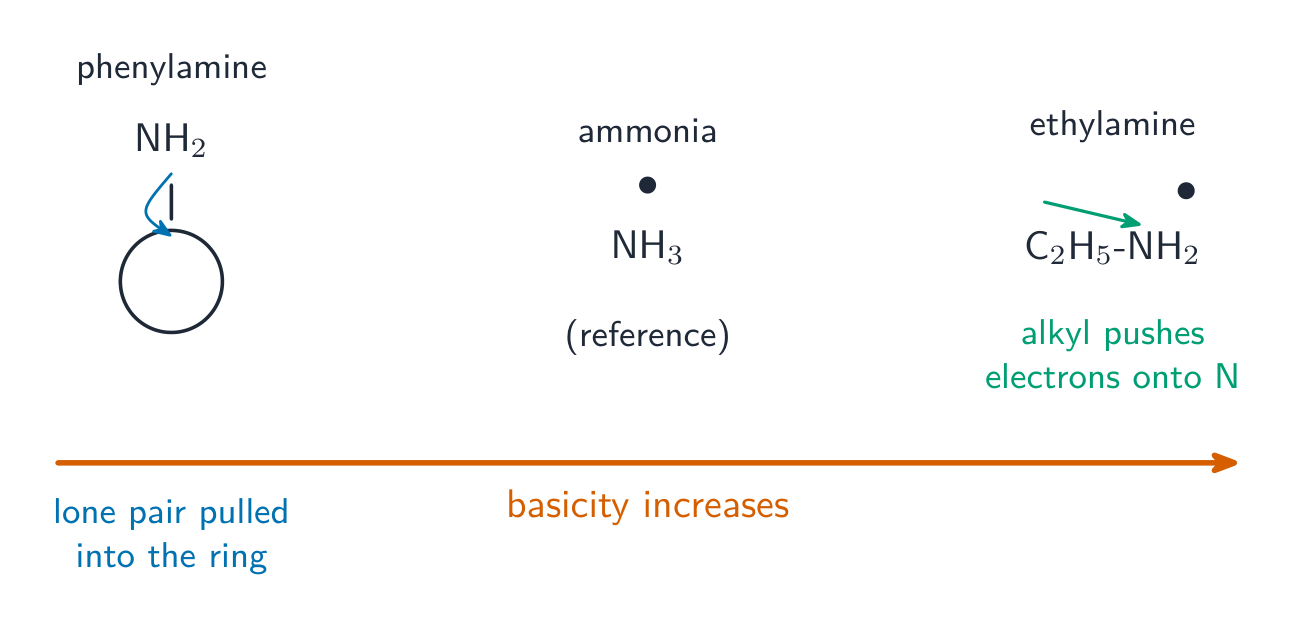
胺的碱性取决于氮孤对电子的可用性
A primary amine is made by heating a halogenoalkane with: · 一个伯胺通过把一个卤代烷与以下加热制造:
Ammonia substitutes the halogen to give the amine (excess NH₃ favours the primary amine). · 氨取代卤素给出胺(过量 NH₃ 有利于伯胺)。
Reducing a nitrile or amide with LiAlH₄ gives: · 用 LiAlH₄ 还原一个腈或酰胺给出:
LiAlH₄ reduces both nitriles and amides to amines. · LiAlH₄ 把腈和酰胺都还原成胺。
Match each term to its meaning. · 匹配每个术语和它的含义。
Each item links the term to its correct meaning. · 每一项把术语链接到它正确的含义。
Why amines are bases
- The nitrogen lone pair accepts an $\text{H}^+$ — so an amine is a base (a proton acceptor).
- The more available that lone pair, the stronger the base.
- Alkyl groups push electrons onto N, making the pair more available; a benzene ring pulls it away.
Basicity order: ethylamine > ammonia > phenylamine 苯胺.
- Ethylamine (CH₃CH₂NH₂): the ethyl group donates electrons, so the lone pair is more available — the strongest base here.
- Ammonia (NH₃): no help, no hindrance — the baseline.
- Phenylamine (C₆H₅NH₂): the lone pair is drawn into the benzene ring, so it is least available — the weakest base.
A primary amine has-NH2; a secondary amine has-NH-
为什么胺是碱
- 氮孤对电子接受一个 $\text{H}^+$——所以一个胺是一个碱(一个质子接受体)。
- 那个孤对电子越可用,碱越强。
- 烷基把电子推到 N 上,使孤对电子更可用;一个苯环把它拉走。
碱性顺序: 乙胺 > 氨 > 苯胺。
- 乙胺(CH₃CH₂NH₂):乙基给电子,所以孤对电子更可用——这里最强的碱。
- 氨(NH₃):无帮助,无阻碍——基线。
- 苯胺(C₆H₅NH₂):孤对电子被吸入苯环,所以它最不可用——最弱的碱。
Amines are bases because: · 胺是碱,因为:
The nitrogen lone pair accepts H⁺, making the amine a base. · 氮孤对电子接受 H⁺,使胺成为一个碱。
Primary, secondary, tertiary
- Amines are classed by how many carbon groups are attached to the nitrogen.
- 1° = one (e.g. CH₃NH₂); 2° = two (e.g. (CH₃)₂NH); 3° = three (e.g. (CH₃)₃N).
- All act as bases, because the nitrogen still keeps its lone pair in each case.
Two routes to an amine: from a halogenoalkane, or by reducing a nitrile
伯、仲、叔
- 胺按多少个碳基团连接到氮来分类。
- 1° = 一个(例如 CH₃NH₂);2° = 两个(例如 (CH₃)₂NH);3° = 三个(例如 (CH₃)₃N)。
- 全都作为碱,因为氮在每种情况下仍保留它的孤对电子。
You've got it
- amine = –NH₂ (1°), –NH– (2°), or three carbons on N (3°)
- made from halogenoalkane + NH₃, or by reducing a nitrile/amide ($\text{LiAlH}_4$)
- amines are bases — the nitrogen lone pair accepts $\text{H}^+$
- basicity: ethylamine > ammonia > phenylamine (alkyl donates to N; a ring pulls the pair away)
你掌握了
- 胺 = –NH₂(1°)、–NH–(2°),或 N 上三个碳(3°)
- 从卤代烷 + NH₃ 制造,或通过还原一个腈/酰胺($\text{LiAlH}_4$)
- 胺是碱——氮孤对电子接受 $\text{H}^+$
- 碱性:乙胺 > 氨 > 苯胺(烷基给 N;一个环把孤对电子拉走)