Acyl chlorides · 酰氯
| English | 中文 | Pinyin · 拼音 |
|---|---|---|
| acyl chloride/əˈkɪl ˈklɔːraɪd/ | 酰氯 | xiān lǜ |
| nucleophile/ˈnjuːklɪɒfaɪl/ | 亲核试剂 | qīn hé shì jì |
| addition–elimination/əˈdɪʃn ɪˌlɪmɪˈneɪʃn/ | 加成消去 | jiā chéng xiāo qù |
| amide/əˈmaɪd/ | 酰胺 | xiān àn |
| leaving group/ˈliːvɪŋ ɡruːp/ | 离去基团 | lí qù jī tuán |
The most reactive derivatives
- Acyl chlorides 酰氯 are made from carboxylic acids and are very reactive.
- They react with many nucleophiles 亲核试剂, always releasing HCl.
- They follow an addition–elimination 加成消去 mechanism.
最活泼的衍生物
- 酰氯从羧酸制造并且非常活泼。
- 它们与许多亲核试剂反应,总是释放 HCl。
- 它们遵循一个加成—消去机理。
Acyl chloride reaction map · 酰氯反应图谱
Follow why acyl chlorides are reactive acylating agents. · 跟随为什么酰氯是活泼的酰基化试剂。
Acyl chlorides react vigorously with water to give a carboxylic acid and ______ chloride gas. · 酰氯与水剧烈反应给出一个羧酸和氯化 ______ 气体。
Misty fumes of HCl form. · HCl 的雾状烟雾形成。
Reactions (all give HCl)
| Reactant | Product |
|---|---|
| water | the carboxylic acid |
| an alcohol | an ester |
| phenol | an ester |
| ammonia | an amide 酰胺 |
| a 1°/2° amine | an amide |
Addition-elimination mechanism of an acyl chloride
反应(全都给出 HCl)
| 反应物 | 产物 |
|---|---|
| 水 | 羧酸 |
| 一个醇 | 一个酯 |
| 苯酚 | 一个酯 |
| 氨 | 一个酰胺 |
| 一个 1°/2° 胺 | 一个酰胺 |
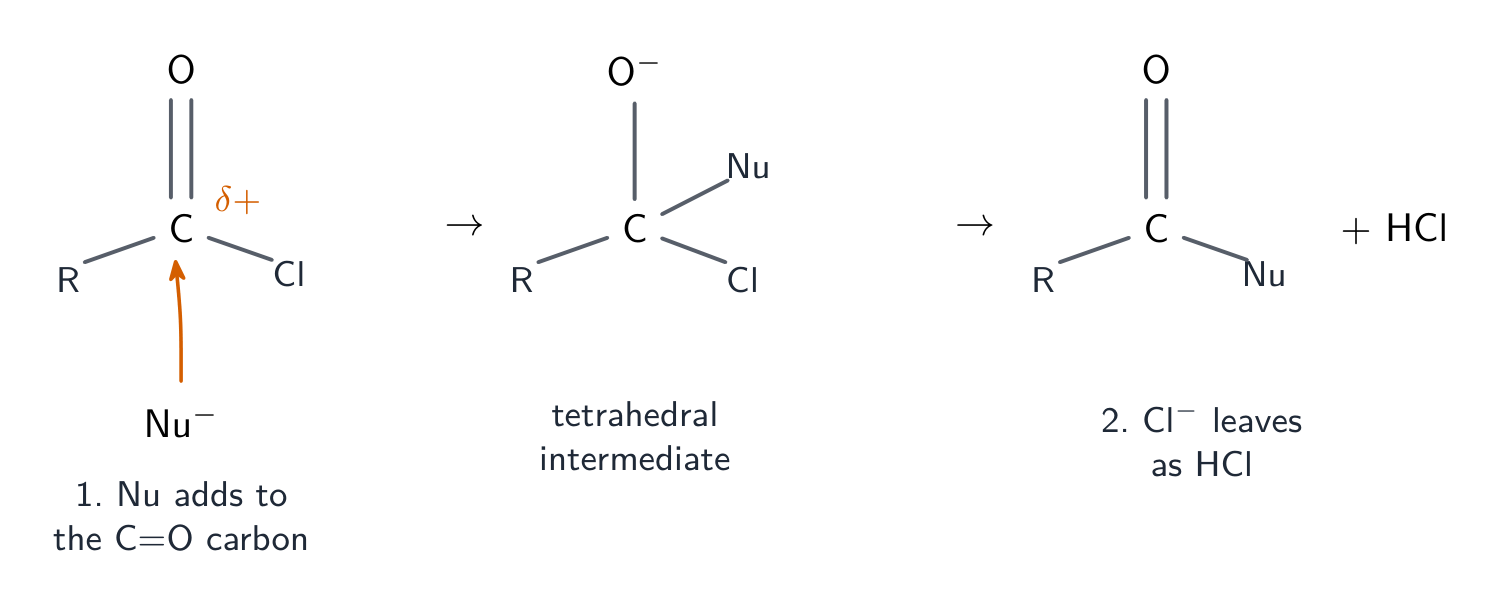
一个酰氯的加成—消去机理
An acyl chloride reacting with ammonia gives: · 一个酰氯与氨反应给出:
Ammonia (or a 1°/2° amine) reacts with an acyl chloride to give an amide. · 氨(或一个 1°/2° 胺)与一个酰氯反应给出一个酰胺。
An acyl chloride reacting with water gives: · 一个酰氯与水反应给出:
Hydrolysis of an acyl chloride regenerates the carboxylic acid (very vigorously). · 一个酰氯的水解再生羧酸(非常剧烈)。
Match each term to its meaning. · 匹配每个术语和它的含义。
Each item links the term to its correct meaning. · 每一项把术语链接到它正确的含义。
Addition–elimination
- A nucleophile adds to the slightly positive carbonyl carbon → a tetrahedral intermediate.
- Then the C=O reforms and $\text{Cl}^-$ leaves as HCl (elimination).
- Ease of hydrolysis: $\text{acyl chloride} \gg \text{alkyl chloride} \gg \text{aryl chloride}$ (the aryl C–Cl is strengthened by the ring).
Acyl chlorides react with many nucleophiles
加成—消去
- 一个亲核试剂加到略带正电的羰基碳 → 一个四面体中间体。
- 然后 C=O 重新形成,$\text{Cl}^-$ 作为 HCl 离开(消去)。
- 水解的容易程度:$\text{acyl chloride} \gg \text{alkyl chloride} \gg \text{aryl chloride}$(芳基 C–Cl 被环强化)。
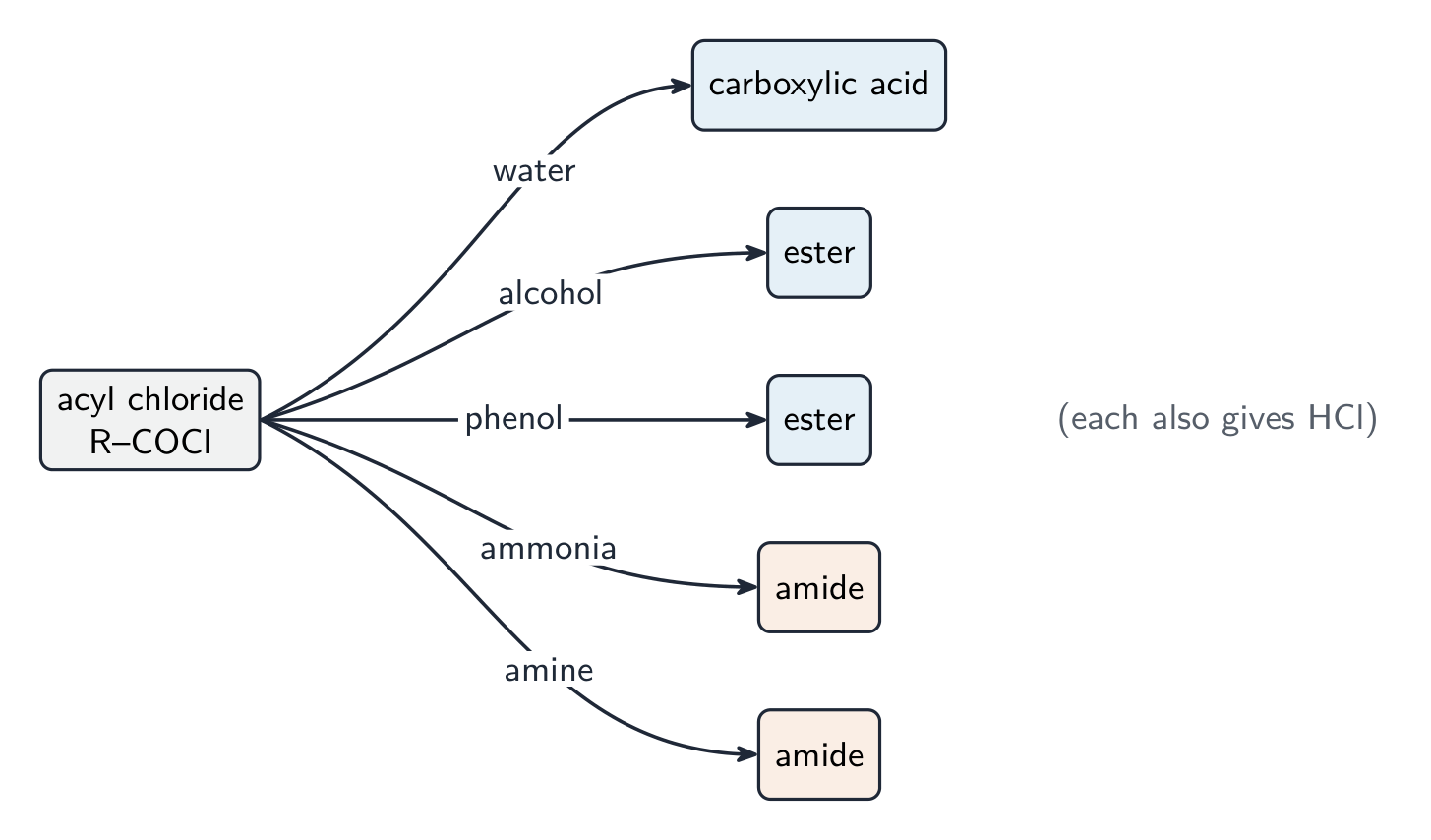
酰氯与许多亲核试剂反应
The reactions of acyl chlorides follow which mechanism? · 酰氯的反应遵循哪个机理?
A nucleophile adds to the carbonyl carbon; the C=O reforms and Cl⁻ leaves as HCl. · 一个亲核试剂加到羰基碳;C=O 重新形成,Cl⁻ 作为 HCl 离开。
The order of ease of hydrolysis is: · 水解的容易程度顺序是:
Acyl chlorides hydrolyse violently, alkyl slowly, and aryl chlorides not at all (ring-strengthened C–Cl). · 酰氯剧烈水解,烷基缓慢,芳基氯完全不(环强化的 C–Cl)。
The most reactive derivative
- Acyl chlorides react vigorously with water, alcohols, ammonia and amines.
- The chlorine is an excellent leaving group 离去基团, which is why they are so reactive.
最活泼的衍生物
- 酰氯与水、醇、氨和胺剧烈反应。
- 氯是一个极好的离去基团,这就是为什么它们如此活泼。
You've got it
- acyl chlorides are very reactive; with water → acid, alcohol/phenol → ester, ammonia/amine → amide (all + HCl)
- mechanism = addition–elimination (nucleophile adds to the carbonyl carbon, then HCl is eliminated)
- hydrolysis ease: acyl ≫ alkyl ≫ aryl chloride
你掌握了
- 酰氯非常活泼;与水 → 酸,醇/苯酚 → 酯,氨/胺 → 酰胺(全都 + HCl)
- 机理 = 加成—消去(亲核试剂加到羰基碳,然后 HCl 被消去)
- 水解容易程度:酰基 ≫ 烷基 ≫ 芳基氯