New organic mechanisms · 新的有机机理
| English | 中文 | Pinyin · 拼音 |
|---|---|---|
| electrophilic substitution/ɪˌlektrəʊˈfɪlɪk ˌsʌbstɪˈtjuːʃn/ | 亲电取代 | qīn diàn qǔ dài |
| electrophile/ɪˌlektrəʊˈfaɪl/ | 亲电试剂 | qīn diàn shì jì |
| delocalised/dɪˈlɒkəlaɪzd/ | 离域 | lí yù |
| nitration/naɪˈtreɪʃn/ | 硝化 | xiāo huà |
| nitrobenzene/ˌnaɪtrəʊˈbenziːn/ | 硝基苯 | xiāo jī běn |
Two new mechanisms
- A Level adds two reaction mechanisms to the ones you already know.
- Electrophilic substitution 亲电取代 is how benzene reacts.
- Addition–elimination appears with carbonyls and acyl chlorides.
两个新机理
- A Level 在你已经知道的机理上增加两个反应机理。
- 亲电取代(electrophilic substitution)是苯反应的方式。
- 加成—消去(addition–elimination)出现在羰基和酰氯中。
Electrophilic substitution is when: · 亲电取代是当:
Benzene reacts by electrophilic substitution, keeping its stable ring while swapping an H for the electrophile. · 苯通过亲电取代反应,保留它稳定的环,同时把一个 H 换成亲电试剂。
Benzene reacts mainly by: · 苯主要通过以下方式反应:
Substitution keeps the stable delocalised ring intact, unlike addition which would destroy it. · 取代保持稳定的离域环完好,不像加成会破坏它。
Benzene undergoes electrophilic ______ rather than addition. · 苯进行亲电 ______ 而不是加成。
This preserves the stable ring. · 这保留稳定的环。
Reduction adds hydrogen (or removes oxygen) to a molecule. · 还原给一个分子加氢(或移除氧)。
The opposite of oxidation. · 氧化的反面。
Electrophilic substitution
- An electrophile 亲电试剂 replaces a hydrogen atom on a benzene ring.
- This is the characteristic way benzene reacts — the stable delocalised 离域 ring is kept.
- Benzene won't do addition (that would destroy the ring), so it substitutes instead.
Benzene: sigma framework plus a delocalised pi system
亲电取代
- 一个亲电试剂(electrophile)替换一个苯环上的氢原子。
- 这是苯反应的特征方式——稳定的离域环被保留。
- 苯不会做加成(那会破坏环),所以它代之以取代。
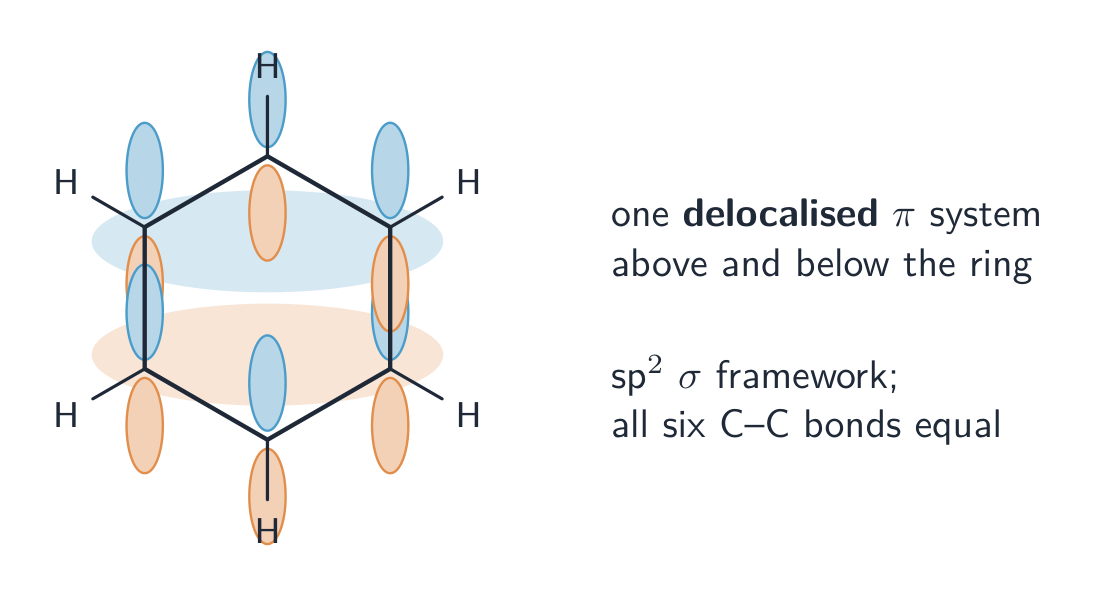
苯:σ 骨架加上一个离域的 π 系统
Electrophilic substitution on benzene · 苯上的亲电取代
Step through how benzene reacts. An electrophile swaps for a hydrogen — keeping the stable ring — instead of adding across it. · 逐步了解苯如何反应。一个亲电试剂换掉一个氢——保留稳定的环——而不是加成到它上面。
In an addition–elimination reaction: · 在一个加成—消去反应中:
Addition–elimination (e.g. with 2,4-DNPH or acyl chlorides) adds then eliminates a small molecule. · 加成—消去(例如与 2,4-DNPH 或酰氯)加成然后消去一个小分子。
Match each term to its meaning. · 匹配每个术语和它的含义。
Each item links the term to its correct meaning. · 每一项把术语链接到它正确的含义。
Addition–elimination
- A molecule first adds on, then a small molecule is removed.
- Seen with 2,4-DNPH (with carbonyls) and with acyl chlorides (which lose HCl).
Two aromatic mechanisms: electrophilic substitution and addition-elimination
加成—消去
- 一个分子先加上,然后一个小分子被移除。
- 在 2,4-DNPH(与羰基)和酰氯(它们失去 HCl)中可见。
Worked example: nitration 硝化
Nitrating benzene (concentrated HNO₃ + H₂SO₄, 50 °C) — an electrophilic substitution:
- The acids react to make the electrophile, NO₂⁺.
- NO₂⁺ takes two electrons from the ring → an unstable intermediate.
- The intermediate loses H⁺, restoring the stable ring.
- Product: nitrobenzene 硝基苯 — one H has been swapped for NO₂, ring intact.
- The same pattern (make electrophile → attack ring → lose H⁺) covers halogenation and Friedel–Crafts.
例题:硝化
硝化苯(浓 HNO₃ + H₂SO₄,50 °C)——一个亲电取代:
- 酸反应生成亲电试剂 NO₂⁺。
- NO₂⁺ 从环取两个电子 → 一个不稳定的中间体。
- 中间体失去 H⁺,恢复稳定的环。
- 产物:硝基苯——一个 H 被换成 NO₂,环完好。
- 同样的规律(生成亲电试剂 → 攻击环 → 失去 H⁺)涵盖卤化和傅瑞德—克拉夫茨(Friedel–Crafts)反应。
You've got it
- electrophilic substitution: an electrophile replaces an H on the benzene ring (how benzene reacts)
- it keeps the stable delocalised ring — benzene substitutes rather than adds
- worked: nitration → NO₂⁺ attacks, loses H⁺, gives nitrobenzene
- addition–elimination: a molecule adds on, then a small molecule is removed (2,4-DNPH, acyl chlorides)
你掌握了
- 亲电取代:一个亲电试剂替换苯环上的一个 H(苯反应的方式)
- 它保留稳定的离域环——苯取代而不是加成
- 例题:硝化 → NO₂⁺ 攻击,失去 H⁺,给出硝基苯
- 加成—消去:一个分子加上,然后一个小分子被移除(2,4-DNPH、酰氯)