The shape of benzene · 苯的形状
| English | 中文 | Pinyin · 拼音 |
|---|---|---|
| delocalised/dɪˈlɒkəlaɪzd/ | 离域 | lí yù |
| hybridised/ˈhaɪbrɪdaɪzd/ | 杂化 | zá huà |
| sigma bond/ˈsɪɡmə bɒnd/ | σ键 | σ jiàn |
| pi system/paɪ ˈsɪstəm/ | π体系 | π tǐ xì |
| hydrogenation/haɪˈdrɒdʒəneɪʃn/ | 氢化 | qīng huà |
The puzzle of benzene
- Benzene is a flat, regular hexagon.
- Its electrons are delocalised 离域 into one ring system.
- This makes benzene unusually stable.
苯的谜题
- 苯是一个平的、正的六边形。
- 它的电子离域(delocalised)成一个环系统。
- 这使苯异常稳定。
Benzene bonding lab · 苯成键实验室
Follow the evidence for a planar delocalised benzene ring. · 跟随一个平面离域苯环的证据。
Benzene is a flat, regular hexagon. · 苯是一个平的、正的六边形。
Its sp² σ framework and delocalised π system make it planar and symmetrical. · 它的 sp² σ 骨架和离域 π 系统使它平面且对称。
The electrons in benzene's ring are delocalised, making it unusually stable. · 苯环中的电子是离域的,使它异常稳定。
This is why benzene resists addition reactions. · 这是为什么苯抗拒加成反应。
The bonding
- Each carbon is sp² hybridised 杂化, making sigma bonds σ键 to two carbons and one hydrogen — the flat hexagon.
- Each carbon's leftover p-orbital electron overlaps sideways all the way round, making one delocalised pi system π体系 above and below the ring.
- Because the electrons are shared evenly, all six C–C bonds are the same length.
Benzene: sigma framework plus a delocalised pi system
成键
- 每个碳是 sp² 杂化(hybridised)的,与两个碳和一个氢形成 σ 键——平的六边形。
- 每个碳剩余的 p 轨道电子一路侧向重叠,在环的上方和下方形成一个离域的 π 系统。
- 因为电子被均匀共享,所有六个 C–C 键是相同的长度。
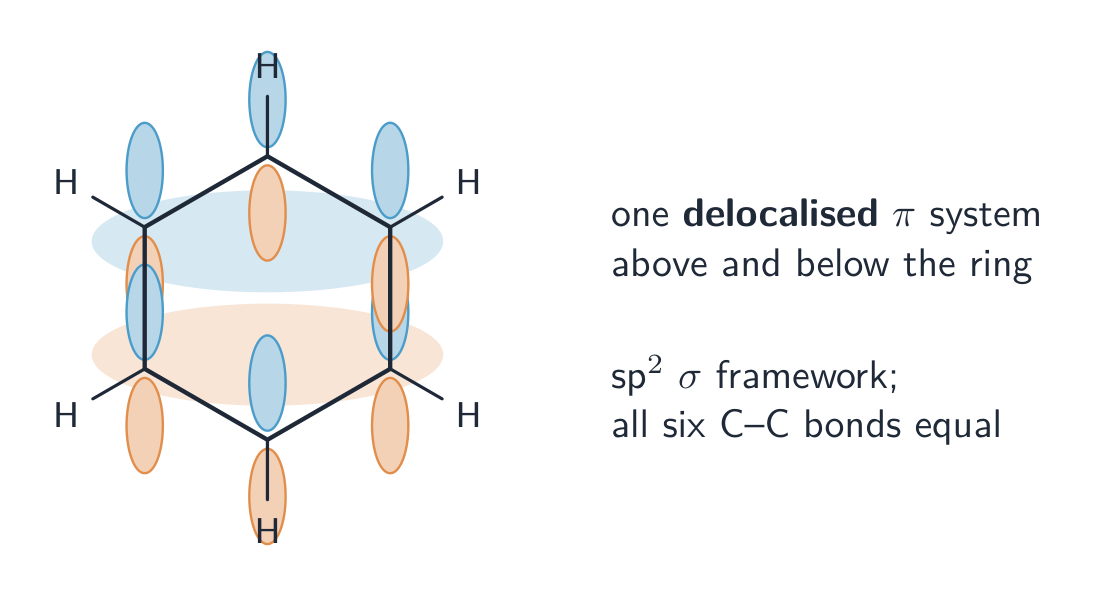
苯:σ 骨架加上一个离域的 π 系统
Each carbon in benzene is: · 苯中的每个碳是:
sp² carbons give the flat hexagon; the leftover p-orbitals form the delocalised π system. · sp² 碳给出平的六边形;剩余的 p 轨道形成离域的 π 系统。
In benzene, all six C–C bonds are the same length because: · 在苯中,所有六个 C–C 键是相同的长度,因为:
The single delocalised π system spreads the electrons evenly, so every C–C bond is identical. · 单个离域的 π 系统均匀地分散电子,所以每个 C–C 键都相同。
Match each term to its meaning. · 匹配每个术语和它的含义。
Each item links the term to its correct meaning. · 每一项把术语链接到它正确的含义。
Evidence: hydrogenation 氢化
- Adding $\text{H}_2$ to one C=C (cyclohexene) releases about $120\ \text{kJ}/\text{mol}$, so a Kekulé ring of three double bonds should release $\approx 360\ \text{kJ}/\text{mol}$.
- Real benzene releases only $208\ \text{kJ}/\text{mol}$ — about $152\ \text{kJ}/\text{mol}$ more stable than the model predicts. That extra stability is the delocalisation.
证据:氢化
- 给一个 C=C(环己烯)加 $\text{H}_2$ 释放约 $120\ \text{kJ}/\text{mol}$,所以一个三个双键的凯库勒(Kekulé)环应释放 $\approx 360\ \text{kJ}/\text{mol}$。
- 真实的苯只释放 $208\ \text{kJ}/\text{mol}$——比模型预测的更稳定约 $152\ \text{kJ}/\text{mol}$。那额外的稳定性就是离域。
The enthalpy of hydrogenation shows benzene is more stable than the Kekulé model because real benzene releases: · 氢化焓显示苯比凯库勒模型更稳定,因为真实的苯释放:
Real benzene releases only 208 kJ/mol, ~152 kJ/mol less than the 360 predicted — the extra stability of delocalisation. · 真实的苯只释放 208 kJ/mol,比预测的 360 少约 152 kJ/mol——离域的额外稳定性。
The evidence for delocalisation
- All six C–C bonds in benzene are the same length (between single and double).
- Benzene is more stable than the 'Kekulé' structure predicts — evidence for delocalised electrons.
离域的证据
- 苯中所有六个 C–C 键是相同的长度(在单键和双键之间)。
- 苯比 "凯库勒" 结构预测的更稳定——离域电子的证据。
You've got it
- benzene is a flat, regular hexagon of sp² carbons (a σ framework)
- the p-orbitals overlap into one delocalised π system, so all six C–C bonds are equal
- hydrogenation evidence: real benzene ($-208\ \text{kJ}/\text{mol}$) is far more stable than the Kekulé model ($-360$), by ≈ 152 kJ/mol
你掌握了
- 苯是一个 sp² 碳的平的、正的六边形(一个 σ 骨架)
- p 轨道重叠成一个离域的 π 系统,所以所有六个 C–C 键相等
- 氢化证据:真实的苯($-208\ \text{kJ}/\text{mol}$)远比凯库勒模型($-360$)稳定,约 152 kJ/mol