Solubility of Group 2 compounds · 第 2 族化合物的溶解度
| English | 中文 | Pinyin · 拼音 |
|---|---|---|
| enthalpy of solution/enˈθælpi ɒv səˈluːʃn/ | 溶解焓 | róng jiě hán |
| lattice energy/ˈlætɪs ˈenədʒi/ | 晶格能 | jīng gé néng |
| hydration/haɪˈdreɪʃn/ | 水合 | shuǐ hé |
| insoluble/ɪnˈsɒljuːbl/ | 不溶 | bù róng |
| antacid/ænˈtæsɪd/ | 抗酸药 | kàng suān yào |
Solubility (Group 2)
- When an ionic solid dissolves, two energy changes compete.
- Their balance is the enthalpy of solution 溶解焓.
- This explains why hydroxides and sulfates trend oppositely.
溶解度(第 2 族)
- 当一个离子固体溶解时,两个能量变化竞争。
- 它们的平衡是溶解焓(enthalpy of solution)。
- 这解释了为什么氢氧化物和硫酸盐相反地变化趋势。
Group 2 solubility lab · 第 2 族溶解度实验室
Classify Group 2 compounds by solubility trend. · 按溶解度趋势分类第 2 族化合物。
Group 2 hydroxides become more soluble down the group. · 第 2 族氢氧化物沿族向下变得更可溶。
While the sulfates become less soluble. · 而硫酸盐变得更不可溶。
The energy balance
- first pull the lattice apart (costs the lattice energy 晶格能), then hydrate the ions (releases hydration 水合 energy).
- If hydration roughly matches or beats the lattice energy, the solid dissolves easily.
Why the Group 2 solubility trends are opposite
能量平衡
- 先把晶格拉开(消耗晶格能),然后水合离子(释放水合能)。
- 如果水合大致匹配或超过晶格能,固体容易溶解。
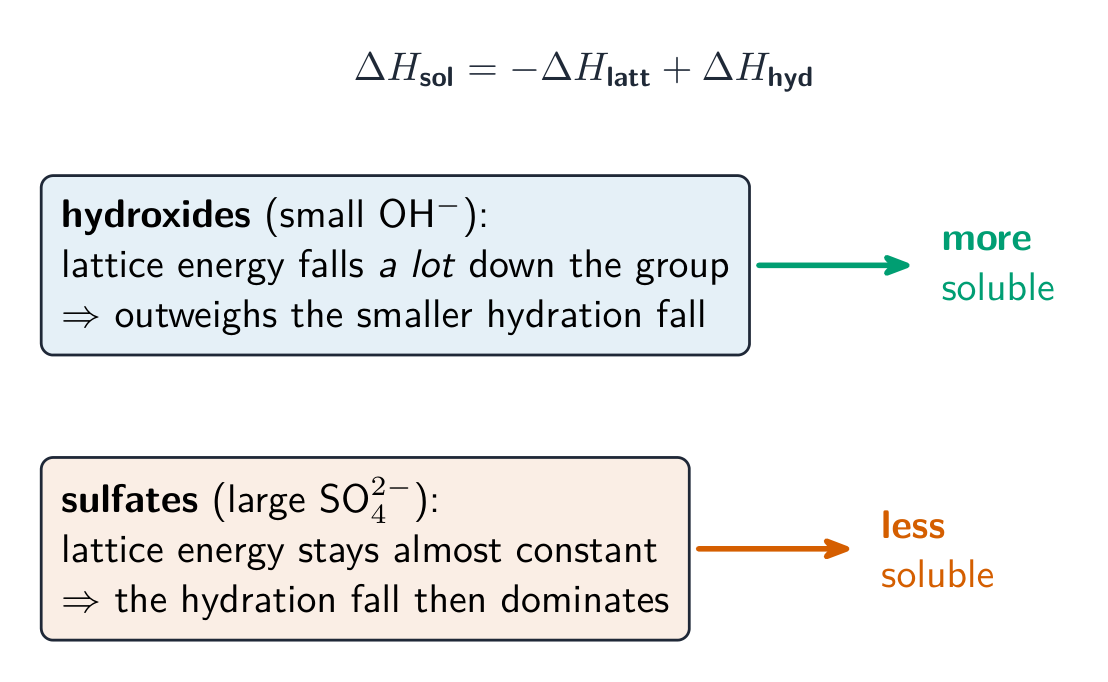
为什么第 2 族溶解度趋势相反
The enthalpy of solution is given by: · 溶解焓由以下给出:
You reverse the lattice energy (to break the lattice) and add the hydration enthalpy. · 你把晶格能反转(以断裂晶格)并加上水合焓。
A solid dissolves easily when the hydration energy: · 当水合能以下情况时,一个固体容易溶解:
If hydration releases about as much (or more) energy than is needed to break the lattice, dissolving is favourable. · 如果水合释放的能量大约等于(或多于)断裂晶格所需的能量,溶解是有利的。
Match each solubility trend. · 匹配每个溶解度趋势。
Each item links the term to its correct meaning. · 每一项把术语链接到它正确的含义。
Opposite trends
Down the group both energies get smaller, but at different rates:
- hydroxides: the small $\text{OH}^-$ means the lattice energy falls a lot → solubility increases.
- sulfates: the large $\text{SO}_4^{2-}$ means the lattice energy barely changes, so the fall in hydration energy dominates → solubility decreases.
Down Group 2 the hydroxides get more soluble but the sulfates less
相反的趋势
沿族向下两个能量都变小,但速率不同:
- 氢氧化物:小的 $\text{OH}^-$ 意味着晶格能下降很多 → 溶解度增加。
- 硫酸盐:大的 $\text{SO}_4^{2-}$ 意味着晶格能几乎不变,所以水合能的下降占主导 → 溶解度减小。
Group 2 hydroxides become MORE soluble down the group because: · 第 2 族氢氧化物沿族向下变得更可溶,因为:
With the small OH⁻ ion, the lattice energy drops sharply down the group, outweighing the hydration fall. · 有小的 OH⁻ 离子,晶格能沿族向下急剧下降,超过水合的下降。
Group 2 sulfates become LESS soluble down the group because: · 第 2 族硫酸盐沿族向下变得更不可溶,因为:
The big sulfate ion makes the lattice energy nearly constant, so the decreasing hydration energy controls the trend. · 大的硫酸根离子使晶格能几乎恒定,所以减小的水合能控制趋势。
What you see in practice
- Hydroxides (more soluble down the group): Mg(OH)₂ is nearly insoluble 不溶 — it's milk of magnesia, a mild antacid 抗酸药; but Ba(OH)₂ dissolves well enough to use as an alkali.
- Sulfates (less soluble down the group): MgSO₄ is soluble — Epsom salts; but BaSO₄ is insoluble, which is why a barium meal is safe to swallow for an X-ray.
So the same two trends explain an antacid, a bath salt and a medical X-ray.
你在实践中看到什么
- 氢氧化物(沿族向下更可溶): Mg(OH)₂ 几乎不溶——它是镁乳,一种温和的抗酸剂;但 Ba(OH)₂ 溶解得足够好,可用作一种碱。
- 硫酸盐(沿族向下更不可溶): MgSO₄ 可溶——泻盐;但 BaSO₄ 不溶,这就是为什么钡餐吞下来照 X 光是安全的。
所以同样的两个趋势解释了一种抗酸剂、一种浴盐和一次医学 X 光。
You've got it
- $\Delta H^{\ominus}_{\text{sol}} = -\Delta H_{\text{latt}} + \Delta H_{\text{hyd}}$ (break the lattice, then hydrate)
- hydroxides: lattice energy falls a lot down the group → more soluble (Mg(OH)₂ insoluble → Ba(OH)₂ soluble)
- sulfates: lattice energy ≈ constant, hydration fall dominates → less soluble (MgSO₄ soluble → BaSO₄ insoluble)
你掌握了
- $\Delta H^{\ominus}_{\text{sol}} = -\Delta H_{\text{latt}} + \Delta H_{\text{hyd}}$(断裂晶格,然后水合)
- 氢氧化物:晶格能沿族向下下降很多 → 更可溶(Mg(OH)₂ 不溶 → Ba(OH)₂ 可溶)
- 硫酸盐:晶格能 ≈ 恒定,水合下降占主导 → 更不可溶(MgSO₄ 可溶 → BaSO₄ 不溶)