Catalysts · 催化剂
| English | 中文 | Pinyin · 拼音 |
|---|---|---|
| heterogeneous catalyst/ˌhetrəˈdʒiːnɪəs ˈkætəlɪst/ | 多相催化剂 | duō xiāng cuī huà jì |
| adsorption/ədˈsɔːpʃn/ | 吸附 | xī fù |
| desorption/dɪˈsɔːpʃn/ | 脱附 | tuō fù |
| surface area/ˈsɜːfɪs ˈeərɪə/ | 表面积 | biǎo miàn jī |
| homogeneous catalyst/həˈməʊdʒnɪəs ˈkætəlɪst/ | 均相催化剂 | jūn xiāng cuī huà jì |
Speeding things up, again
- Catalysts are homogeneous or heterogeneous.
- Each works in a characteristic way.
- Both come back unchanged at the end.
再次加速事情
- 催化剂是均相(homogeneous)或多相(heterogeneous)。
- 每个以一种特有的方式工作。
- 两者在最后都不变地回来。
A heterogeneous catalyst is in a different physical state from the reactants. · 一个多相催化剂与反应物处于不同的物理状态。
e.g. a solid catalyst with gaseous reactants. · 例如一个固体催化剂与气态反应物。
Heterogeneous catalysts 多相催化剂
- In a different physical state from the reactants (usually a solid with gases). It works in three stages:
- adsorption 吸附: reactant molecules stick to the surface.
- their bonds are weakened, so they react more easily.
- desorption 脱附: the products leave the surface.
- Examples: iron in the Haber process; Pt/Pd/Rh in a catalytic converter.
A heterogeneous catalyst works by adsorption, reaction, then desorption on its surface
Industrial heterogeneous catalysts are made as small shaped pellets, rings and discs to give a large surface area 表面积 for the reactants to stick to
多相催化剂
- 与反应物处于不同的物理状态(通常是一个固体与气体)。它分三个阶段工作:
- 吸附(adsorption):反应物分子粘到表面。
- 它们的键被削弱,所以它们更容易反应。
- 脱附(desorption):产物离开表面。
- 例子:哈伯法中的铁;一个催化转化器中的 Pt/Pd/Rh。
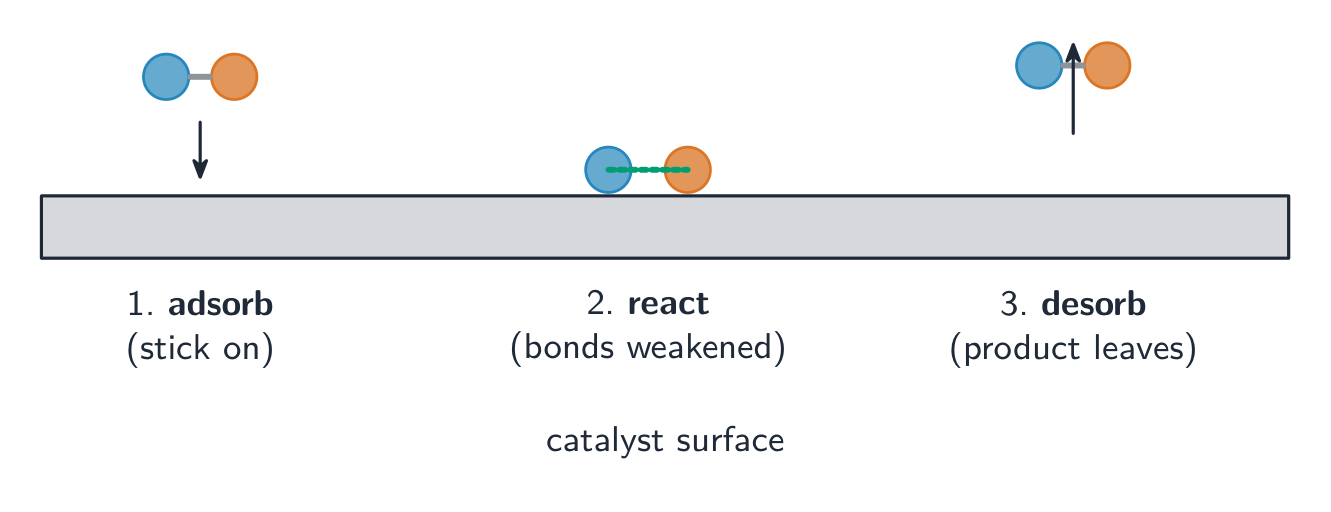
多相催化剂通过在它表面的吸附、反应,然后脱附来工作

工业多相催化剂被制成小的成型颗粒、环和盘,以给反应物粘附一个大表面积
How a catalyst speeds a reaction · 催化剂如何加速反应
Turn the catalyst on and watch the rate jump — it gives more successful collisions per second by offering a lower-energy path. · 打开催化剂,看反应速率跳升——它提供一条更低能量的路径,使每秒成功碰撞更多。
A heterogeneous catalyst: · 一个多相催化剂:
Heterogeneous = different state (e.g. solid + gases); reactants adsorb, react, then products desorb. · 多相 = 不同状态(例如固体 + 气体);反应物吸附、反应,然后产物脱附。
Put the stages of heterogeneous catalysis in order. · 把多相催化的阶段按顺序排列。
Reactants adsorb, their weakened bonds react, then the products desorb. · 反应物吸附,它们削弱的键反应,然后产物脱附。
Homogeneous catalysts 均相催化剂
- In the same physical state as the reactants.
- It is used up in one step and reformed in a later step, so it returns unchanged.
- Examples: NOₓ helping oxidise atmospheric $\text{SO}_2$; $\text{Fe}^{2+}/\text{Fe}^{3+}$ speeding the $\text{I}^-$ + $\text{S}_2\text{O}_8^{2-}$ reaction.
均相催化剂
- 与反应物处于相同的物理状态。
- 它在一个步骤中被用掉并在一个之后的步骤中重新形成,所以它不变地回来。
- 例子:NOₓ 帮助氧化大气中的 $\text{SO}_2$;$\text{Fe}^{2+}/\text{Fe}^{3+}$ 加速 $\text{I}^-$ + $\text{S}_2\text{O}_8^{2-}$ 反应。
A homogeneous catalyst: · 一个均相催化剂:
Homogeneous = same state; it reacts in one step and is regenerated in a later step, so it returns unchanged. · 均相 = 相同状态;它在一个步骤中反应并在一个之后的步骤中再生,所以它不变地回来。
Which is a homogeneous catalyst? · 哪个是一个均相催化剂?
Aqueous Fe²⁺/Fe³⁺ ions are in the same state as the reacting ions — homogeneous; solid Fe and Pt are heterogeneous. · 水性 Fe²⁺/Fe³⁺ 离子与反应的离子处于相同状态——均相;固体 Fe 和 Pt 是多相。
Two kinds of catalyst
- Heterogeneous catalysts (different phase) work by adsorbing reactants on their surface.
- Homogeneous catalysts (same phase) work via an intermediate.
两种催化剂
- 多相催化剂(不同相)通过在它们的表面吸附反应物工作。
- 均相催化剂(相同相)通过一个中间体工作。
You've got it
- heterogeneous (different state): adsorption → weakened bonds → desorption (e.g. Fe in Haber, Pt/Pd/Rh converter)
- homogeneous (same state): used up then reformed, so unchanged (e.g. $\text{Fe}^{2+}/\text{Fe}^{3+}$)
你掌握了
- 多相(不同状态):吸附 → 削弱的键 → 脱附(例如哈伯法中的 Fe,Pt/Pd/Rh 转化器)
- 均相(相同状态):被用掉然后重新形成,所以不变(例如 $\text{Fe}^{2+}/\text{Fe}^{3+}$)