Partition coefficients · 分配系数
| English | 中文 | Pinyin · 拼音 |
|---|---|---|
| solvent/ˈsɒlvənt/ | 溶剂 | róng jì |
| solute/ˈsɒljuːt/ | 溶质 | róng zhì |
| partition coefficient/pɑːˈtɪʃn ˌkəʊɪˈfɪʃənt/ | 分配系数 | fēn pèi xì shù |
| non-polar/nɒn ˈpəʊlə/ | 非极性 | fēi jí xìng |
| polar/ˈpəʊlə/ | 极性 | jí xìng |
| immiscible/ɪˈmɪsəbl/ | 不混溶 | bù hùn róng |
Splitting between two solvents 溶剂
- Shake a solute 溶质 with two solvents that don't mix — it spreads between them.
- The ratio of its concentrations is the partition coefficient 分配系数.
- Polarity decides which solvent it prefers.
在两个溶剂之间分配
- 把一个溶质与两个不混合的溶剂摇晃——它在它们之间散开。
- 它浓度的比是分配系数(partition coefficient)。
- 极性决定它偏好哪个溶剂。
Partition coefficient lab · 分配系数实验室
Kpc = concentration organic / concentration aqueous · Kpc = 有机浓度 / 水性浓度
Change organic-layer concentration and see the partition ratio. · 改变有机层浓度,看分配比。
A partition coefficient describes how a solute distributes between two immiscible solvents. · 一个分配系数描述一个溶质如何在两个不混溶溶剂之间分布。
It is the ratio of concentrations at equilibrium. · 它是平衡时浓度的比。
The partition coefficient
- It is constant at a fixed temperature.
- It only applies when the solute is in the same physical state in both solvents.
分配系数
- 它在一个固定的温度恒定。
- 它只在溶质在两个溶剂中处于相同物理状态时适用。
The partition coefficient is: · 分配系数是:
Kpc = [solute in solvent 1] / [solute in solvent 2], constant at a fixed temperature. · Kpc = [溶剂 1 中的溶质] / [溶剂 2 中的溶质],在固定温度恒定。
The partition coefficient applies only when the solute is: · 分配系数只在溶质是以下哪种时适用:
Kpc is valid when the solute exists in the same physical state in each solvent. · Kpc 在溶质在每个溶剂中以相同物理状态存在时有效。
Match each partition idea. · 匹配每个分配概念。
Each item links the term to its correct meaning. · 每一项把术语链接到它正确的含义。
Polarity decides
- The value depends on the polarity of the solute and each solvent.
- A non-polar 非极性 solute dissolves more in the non-polar 极性 solvent; a polar solute prefers the polar solvent.
Polarity decides the split: a non-polar solute favours the non-polar layer, a polar solute the water layer.
极性决定
- 这个值取决于溶质和每个溶剂的极性(polarity)。
- 一个非极性溶质在非极性溶剂中溶解更多;一个极性溶质偏好极性溶剂。
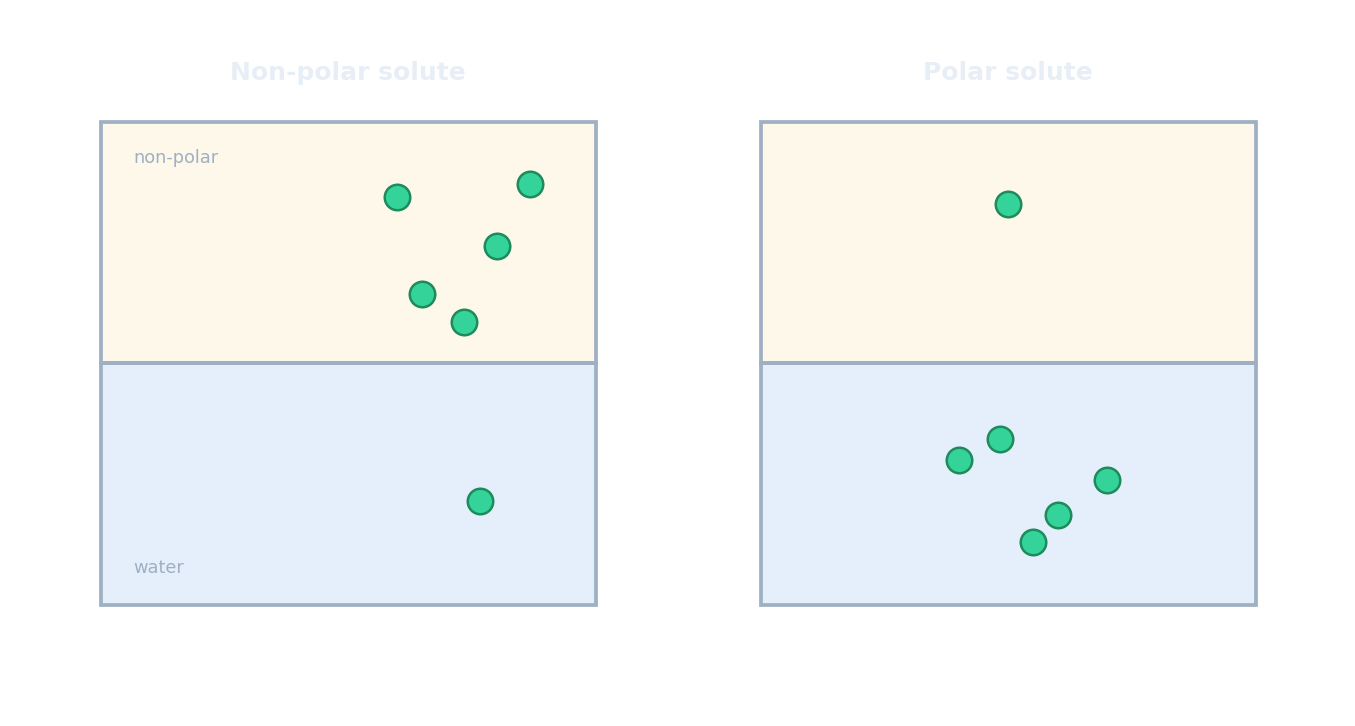
极性决定分配:一个非极性溶质偏好非极性层,一个极性溶质偏好水层。
A non-polar solute will dissolve more in: · 一个非极性溶质将在以下哪种中溶解更多:
"Like dissolves like": a non-polar solute prefers the non-polar solvent; a polar solute the polar one. · "相似相溶":一个非极性溶质偏好非极性溶剂;一个极性溶质偏好极性的。
The value of the partition coefficient depends on the polarity of the solute and solvents. · 分配系数的值取决于溶质和溶剂的极性。
Polarity governs how the solute distributes, so it sets the partition coefficient. · 极性支配溶质如何分布,所以它设定分配系数。
Using a partition coefficient
- The solute distributes between two immiscible 不混溶 solvents in a fixed ratio at equilibrium.
- This underlies solvent extraction and chromatography.
使用一个分配系数
- 溶质在平衡时以一个固定的比分布在两个不混溶溶剂之间。
- 这是溶剂萃取和色谱的基础。
You've got it
- $K_{\text{pc}} = \dfrac{[\text{solute in solvent 1}]}{[\text{solute in solvent 2}]}$ (constant at fixed temperature)
- it applies when the solute is in the same physical state in both solvents
- non-polar solute → non-polar solvent; polar solute → polar solvent
你掌握了
- $K_{\text{pc}} = \dfrac{[\text{solute in solvent 1}]}{[\text{solute in solvent 2}]}$(在固定温度恒定)
- 它在溶质在两个溶剂中处于相同物理状态时适用
- 非极性溶质 → 非极性溶剂;极性溶质 → 极性溶剂