Mass spectrometry · 质谱
| English | 中文 | Pinyin · 拼音 |
|---|---|---|
| mass spectrometry/mæs spekˈtrɒmətri/ | 质谱 | zhì pǔ |
| mass-to-charge ratio/mæs tə tʃɑːdʒ ˈreɪʃɪəʊ/ | 质荷比 | zhì hé bǐ |
| abundance/əˈbʌndəns/ | 丰度 | fēng dù |
| molecular ion/məˈlekjʊlə ˈaɪɒn/ | 分子离子 | fèn zǐ lí zi |
| fragmentation/ˌfræɡmənˈteɪʃn/ | 碎裂 | suì liè |
Weighing a single molecule
- In mass spectrometry 质谱, a molecule is ionised and sorted by mass-to-charge ratio 质荷比 ($m/e$).
- The spectrum is a set of peaks.
- From it we get relative masses and structural clues.
称量一个单一分子
- 在质谱(mass spectrometry)中,一个分子被电离并按质荷比(mass-to-charge ratio,$m/e$)排序。
- 光谱是一组峰。
- 从它我们得到相对质量和结构线索。
Mass spectrometry route · 质谱途径
Follow a molecule through ionisation, separation and detection. · 跟踪一个分子经过电离、分离和检测。
In mass spectrometry, the peak at the highest m/z (the molecular ion) gives the relative molecular . · 在质谱中,最高 m/z 的峰(分子离子)给出相对分子。
The M⁺ peak equals the Mr. · M⁺ 峰等于 Mr。
Relative atomic mass from isotopes
- An element's isotopes give several peaks. From their abundances 丰度, the relative atomic mass is a weighted average:
- Chlorine (75% $^{35}\text{Cl}$, 25% $^{37}\text{Cl}$): $A_r = \dfrac{35 \times 75 + 37 \times 25}{100} = 35.5$.
A mass spectrum: the molecular ion 分子离子 gives the Mr, fragments show what was lost
从同位素得相对原子质量
- 一个元素的同位素给出几个峰。从它们的丰度(abundances),相对原子质量是一个加权平均:
- 氯(75% $^{35}\text{Cl}$,25% $^{37}\text{Cl}$):$A_r = \dfrac{35 \times 75 + 37 \times 25}{100} = 35.5$。
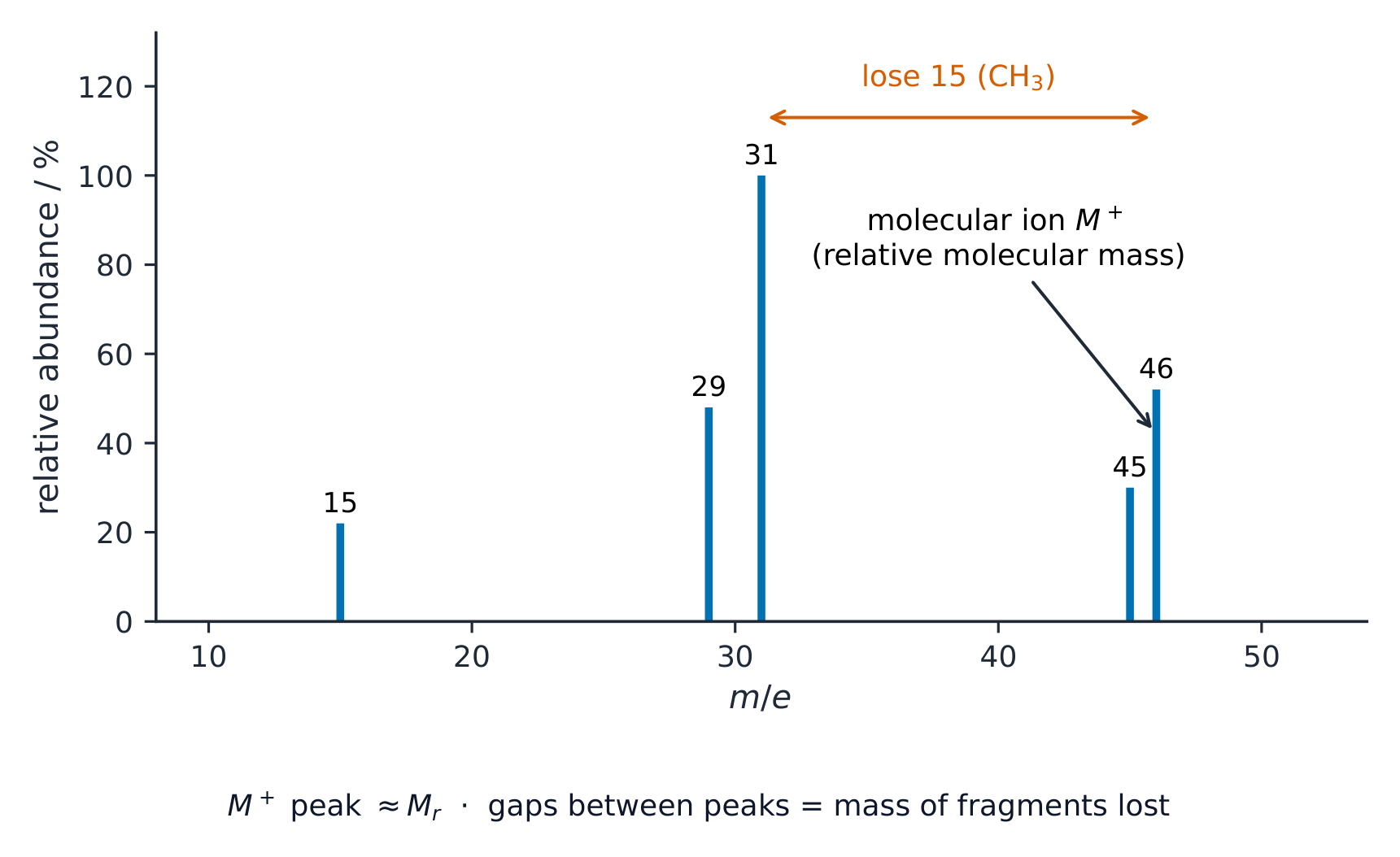
一个质谱:分子离子给出 Mr,碎片显示失去了什么
Chlorine is 75% ³⁵Cl and 25% ³⁷Cl. What is its relative atomic mass? (use (35×75 + 37×25)/100) · 氯是 75% ³⁵Cl 和 25% ³⁷Cl。它的相对原子质量是多少?(用 (35×75 + 37×25)/100)
Ar = (35×75 + 37×25)/100 = (2625 + 925)/100 = 35.5. · Ar = (35×75 + 37×25)/100 = (2625 + 925)/100 = 35.5。
Molecular ion and fragmentation 碎裂
- The highest $m/e$ peak is the molecular ion ($M^{+}$) — it gives the relative molecular mass.
- The molecule also breaks into pieces (fragmentation). The gap between peaks = the mass lost: a loss of 15 = a $\text{CH}_3$ group; a loss of 29 = $\text{CHO}$ or $\text{C}_2\text{H}_5$.
A modern mass spectrometer in a laboratory; the sample is loaded at the front and the machine sorts its ions by mass-to-charge ratio
分子离子和碎裂
- 最高的 $m/e$ 峰是分子离子(molecular ion,$M^{+}$)——它给出相对分子质量。
- 分子也碎成片(碎裂,fragmentation)。峰之间的间隙 = 失去的质量:失去 15 = 一个 $\text{CH}_3$ 基团;失去 29 = $\text{CHO}$ 或 $\text{C}_2\text{H}_5$。
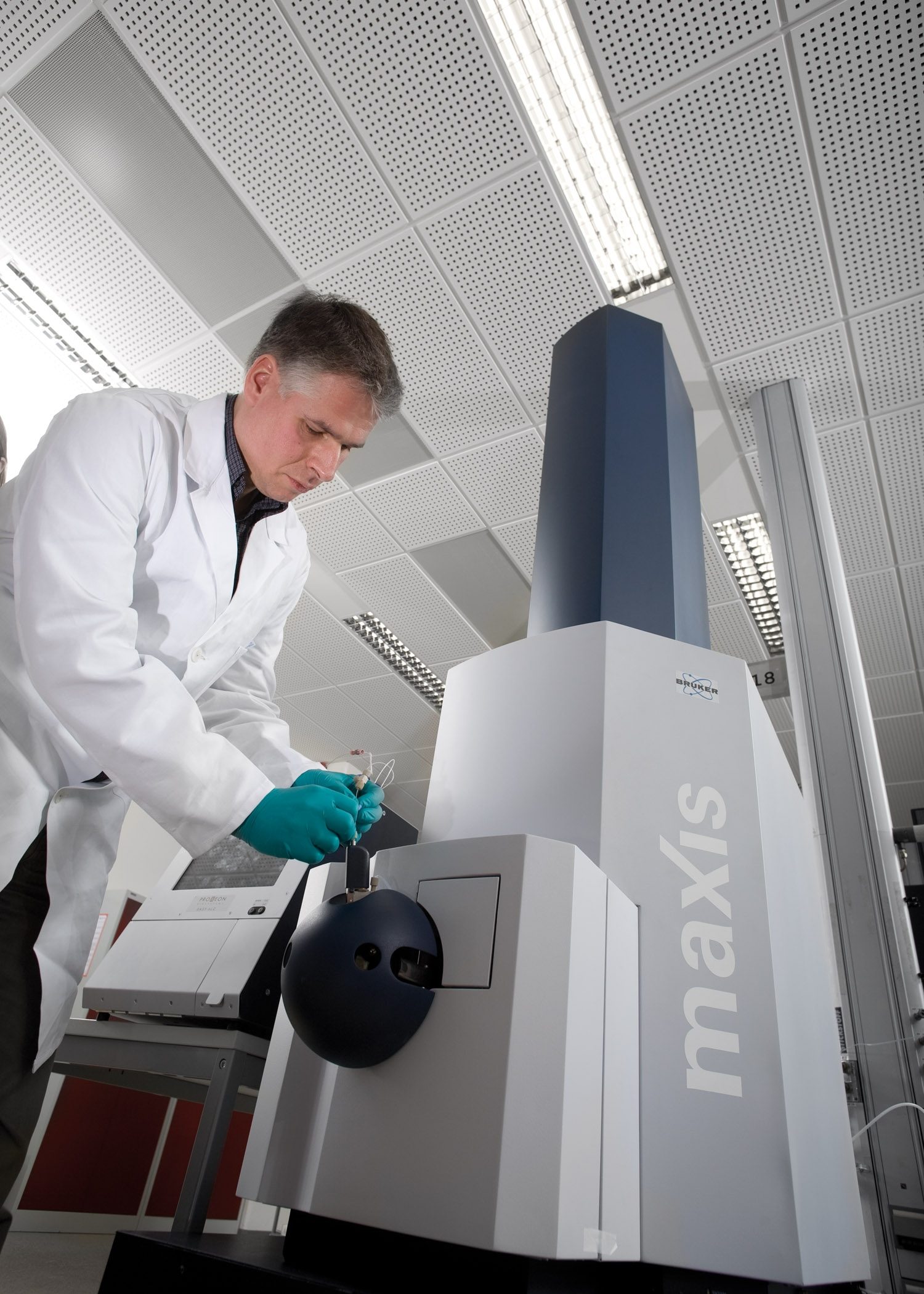
实验室中一台现代质谱仪;样品在前面装入,机器按质荷比对它的离子排序
The molecular ion peak (the highest m/e) gives the: · 分子离子峰(最高的 m/e)给出:
The highest-m/e peak (M⁺) is the whole molecule, so it gives the Mr. · 最高 m/e 峰(M⁺)是整个分子,所以它给出 Mr。
A gap of 15 between two peaks means the molecule has lost: · 两个峰之间 15 的间隙意味着分子失去了:
A loss of 15 mass units corresponds to a CH₃ fragment; a loss of 29 is CHO or C₂H₅. · 失去 15 个质量单位对应一个 CH₃ 碎片;失去 29 是 CHO 或 C₂H₅。
The [M+1] and [M+2] peaks
- a small [M+1] peak (from $^{13}\text{C}$) tells you the number of carbons.
- an [M+2] peak (two units up) shows a halogen: chlorine gives a 3:1 ratio, bromine a 1:1 ratio.
[M+1] 和 [M+2] 峰
- 一个小的 [M+1] 峰(来自 $^{13}\text{C}$)告诉你碳的数目。
- 一个 [M+2] 峰(高两个单位)显示一个卤素:氯给出一个 3:1 比例,溴一个 1:1 比例。
An [M+2] peak about the same height as M⁺ (a 1:1 ratio) shows the molecule contains: · 一个与 M⁺ 大约相同高度的 [M+2] 峰(一个 1:1 比例)显示分子含有:
One bromine gives a 1:1 [M+2]:M⁺ ratio; one chlorine gives about 3:1. · 一个溴给出一个 1:1 的 [M+2]:M⁺ 比例;一个氯给出约 3:1。
You've got it
- mass spec sorts ions by $m/e$; $A_r = \dfrac{\sum(\text{mass} \times \text{abundance})}{\sum \text{abundance}}$ (Cl = 35.5)
- the molecular ion ($M^{+}$, highest $m/e$) = the $M_r$; fragmentation gaps give lost pieces (loss 15 = $\text{CH}_3$)
- [M+1] ($^{13}\text{C}$) → number of carbons; [M+2] → halogen (Cl 3:1, Br 1:1)
你掌握了
- 质谱按 $m/e$ 对离子排序;$A_r = \dfrac{\sum(\text{mass} \times \text{abundance})}{\sum \text{abundance}}$(Cl = 35.5)
- 分子离子($M^{+}$,最高 $m/e$)= $M_r$;碎裂间隙给出失去的片(失去 15 = $\text{CH}_3$)
- [M+1]($^{13}\text{C}$)→ 碳的数目;[M+2] → 卤素(Cl 3:1,Br 1:1)