Lattice energy and Born-Haber cycles · 晶格能和玻恩-哈伯循环
| English | 中文 | Pinyin · 拼音 |
|---|---|---|
| lattice energy/ˈlætɪs ˈenədʒi/ | 晶格能 | jīng gé néng |
| Born–Haber cycle/bɔːn ˈheɪbə ˈsaɪkl/ | 玻恩哈伯循环 | bō ēn hā bó xún huán |
| atomisation/əˌtɒmaɪˈzeɪʃn/ | 原子化 | yuán zi huà |
| electron affinity/ɪˈlektrɒn əˈfɪnɪti/ | 电子亲和能 | diàn zi qīn hé néng |
| ionic radius/aɪˈɒnɪk ˈreɪdɪəs/ | 离子半径 | lí zi bàn jìng |
The energy locked in a lattice
- Forming an ionic solid involves several enthalpy steps.
- The lattice energy 晶格能 is the big energy release.
- A Born–Haber cycle 玻恩哈伯循环 ties them all together.
锁在晶格中的能量
- 形成一个离子固体涉及几个焓步骤。
- 晶格能(lattice energy)是大的能量释放。
- 一个玻恩-哈伯循环(Born–Haber cycle)把它们全部联系起来。
The enthalpy change when one mole of an ionic solid forms from gaseous ions is the ______ energy. · 当一摩尔离子固体从气态离子形成时的焓变是______能。
Born–Haber cycles use Hess's law to find it. · 玻恩-哈伯循环用盖斯定律找到它。
The key enthalpy changes
- atomisation 原子化 $\Delta H_{\text{at}}$: energy to make one mole of gaseous atoms (always positive).
- lattice energy $\Delta H_{\text{latt}}$: change when one mole of solid lattice forms from gaseous ions (always negative).
- first electron affinity 电子亲和能: change when gaseous atoms each gain an electron (usually negative); going down a group it gets less exothermic (larger atom).
A Born-Haber cycle for sodium chloride
关键的焓变
- 原子化(atomisation)$\Delta H_{\text{at}}$:制造一摩尔气态原子的能量(总是正)。
- 晶格能 $\Delta H_{\text{latt}}$:当一摩尔固体晶格从气态离子形成时的变化(总是负)。
- 第一电子亲和能(first electron affinity):当气态原子各得到一个电子时的变化(通常负);沿一个族向下它变得不那么放热(更大的原子)。
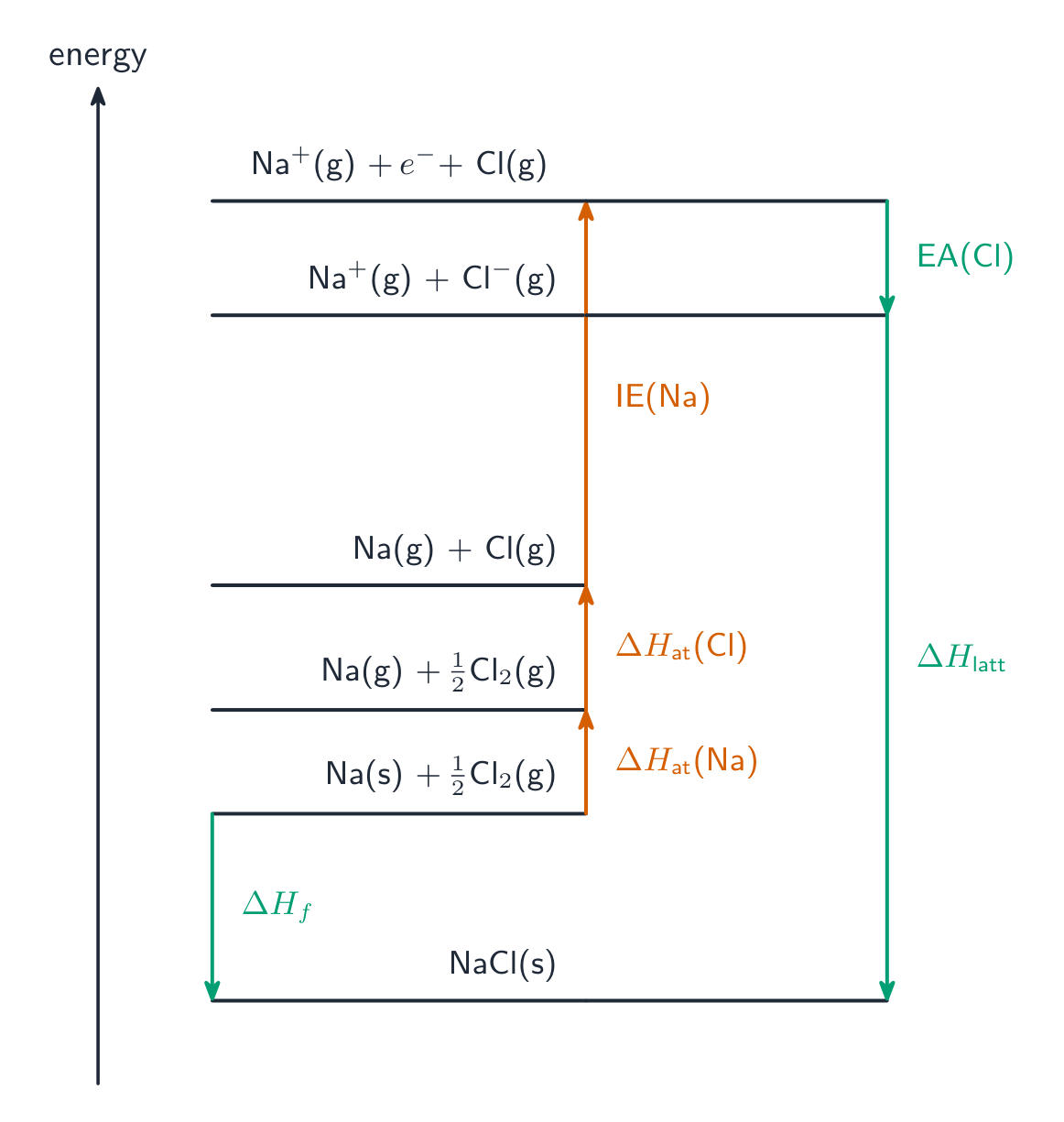
氯化钠的一个玻恩-哈伯循环
The Born–Haber cycle · 玻恩-哈伯循环
Lattice energy can't be measured directly, so it is found from a cycle of measurable steps. · 晶格能不能直接测量,所以它从一个可测量步骤的循环找到。
The lattice energy is: · 晶格能是:
Strong ionic bonds form, so lattice energy is exothermic (negative). · 强离子键形成,所以晶格能是放热的(负的)。
Going down Group 17, the first electron affinity becomes: · 沿第 17 族向下,第一电子亲和能变得:
A bigger atom pulls the incoming electron in less strongly, so EA is less exothermic. · 一个更大的原子把进入的电子拉得不那么强,所以 EA 不那么放热。
Match each Born-Haber term to its meaning. · 把每个玻恩-哈伯术语匹配到它的含义。
Each item links the term to its correct meaning. · 每一项把术语链接到它正确的含义。
Born–Haber cycle and lattice strength
- A Born–Haber cycle links the formation of an ionic solid with atomisation, ionisation energy, electron affinity and lattice energy. Use Hess's law to find any unknown step.
- The lattice energy is more negative (stronger) when:
- the ionic charge is higher ($\text{Mg}^{2+}$ beats $\text{Na}^{+}$), and
- the ionic radius 离子半径 is smaller.
An ionic solid such as sodium chloride is a giant regular lattice of ions.
玻恩-哈伯循环和晶格强度
- 一个玻恩-哈伯循环把一个离子固体的生成与原子化、电离能、电子亲和能和晶格能联系起来。用盖斯定律找任何未知步骤。
- 晶格能更负(更强),当:
- 离子电荷更高($\text{Mg}^{2+}$ 胜过 $\text{Na}^{+}$),以及
- 离子半径更小。
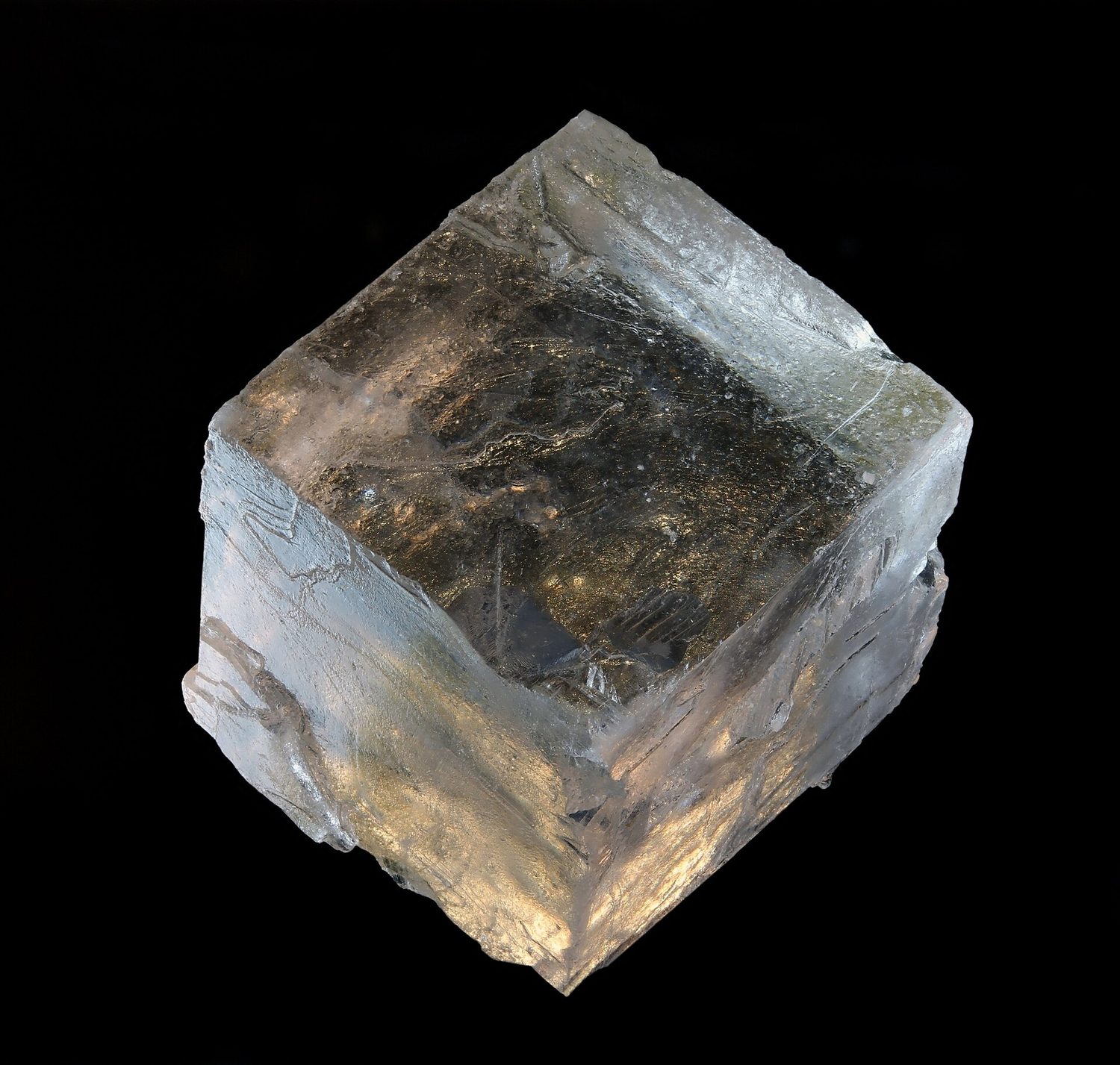
像氯化钠这样的一个离子固体是离子的一个巨型规则晶格。
A Born–Haber cycle lets you find an unknown enthalpy step by using: · 一个玻恩-哈伯循环让你通过使用以下哪种找到一个未知焓步骤:
Because enthalpy is conserved, going round the cycle relates all the steps, so any one can be found. · 因为焓守恒,绕循环把所有步骤联系起来,所以任何一个都能被找到。
Lattice energy is most negative (strongest) for ions with: · 晶格能对有以下哪种的离子最负(最强):
Higher charge and smaller radius both increase the attraction between the ions. · 更高的电荷和更小的半径都增加离子之间的吸引。
What makes lattice energy large
- Lattice energy is more exothermic for smaller, more highly charged ions.
- This is why MgO has a far larger lattice energy than NaCl.
Smaller ions and higher charges give a stronger lattice energy
什么使晶格能大
- 对更小、电荷更高的离子,晶格能更放热。
- 这就是为什么 MgO 有比 NaCl 大得多的晶格能。
You've got it
- atomisation (+, makes gaseous atoms); lattice energy (−, lattice forms from gaseous ions); electron affinity (usually −)
- a Born–Haber cycle uses Hess's law to find any unknown enthalpy step
- lattice energy is stronger (more negative) for higher charge and smaller radius
你掌握了
- 原子化(+,制造气态原子);晶格能(−,晶格从气态离子形成);电子亲和能(通常 −)
- 一个玻恩-哈伯循环用盖斯定律找任何未知焓步骤
- 晶格能对更高电荷和更小半径****更强(更负)