Infrared spectroscopy · 红外光谱
| English | 中文 | Pinyin · 拼音 |
|---|---|---|
| functional group/ˈfʌŋkʃənl ɡruːp/ | 官能团 | guān néng tuán |
| wavenumber/ˈweɪvnʌmbə/ | 波数 | bō shù |
| mass spectrometry/mæs spekˈtrɒmətri/ | 质谱 | zhì pǔ |
| molecular ion/məˈlekjʊlə ˈaɪɒn/ | 分子离子 | fèn zǐ lí zi |
Fingerprinting bonds with light
- Infrared (IR) spectroscopy helps find the functional group 官能团 in a molecule.
- Each kind of bond absorbs IR at its own range of frequencies.
- Where a bond absorbs strongly, the spectrum shows a dip.
用光给键指纹
- 红外(IR)光谱(infrared spectroscopy)帮助找到一个分子中的官能团。
- 每种键在它自己的频率范围吸收 IR。
- 一个键强烈吸收的地方,光谱显示一个凹陷。
IR spectroscopy lab · 红外光谱实验室
Match an absorption to the bond or functional group it reveals. · 把一个吸收匹配到它揭示的键或官能团。
Infrared spectroscopy is mainly used to: · 红外光谱主要用于:
Each bond absorbs IR at its own wavenumber, so the dips reveal the functional groups present. · 每个键在它自己的波数吸收 IR,所以凹陷揭示存在的官能团。
Infrared spectroscopy identifies bonds by the ______ they absorb. · 红外光谱通过键吸收的______来识别它们。
Each bond absorbs a characteristic IR frequency. · 每个键吸收一个特征的 IR 频率。
Reading the spectrum
- The position is measured in wavenumber 波数 (per cm). You're given a data table, so just match dips to bonds:
- broad dip ~$3200$–$3650$ → O–H in an alcohol.
- dip ~$1700$ → C=O (aldehyde, ketone, acid, ester).
- broad dip $2500$–$3000$ with a C=O dip → a carboxylic acid.
An infrared spectrometer records which bonds a molecule contains.
读取光谱
- 位置用波数(wavenumber,每 cm)测量。你被给一个数据表,所以只要把凹陷匹配到键:
- 宽凹陷 ~$3200$–$3650$ → 一个醇中的 O–H。
- 凹陷 ~$1700$ → C=O(醛、酮、酸、酯)。
- 宽凹陷 $2500$–$3000$ 加上一个 C=O 凹陷 → 一个羧酸。
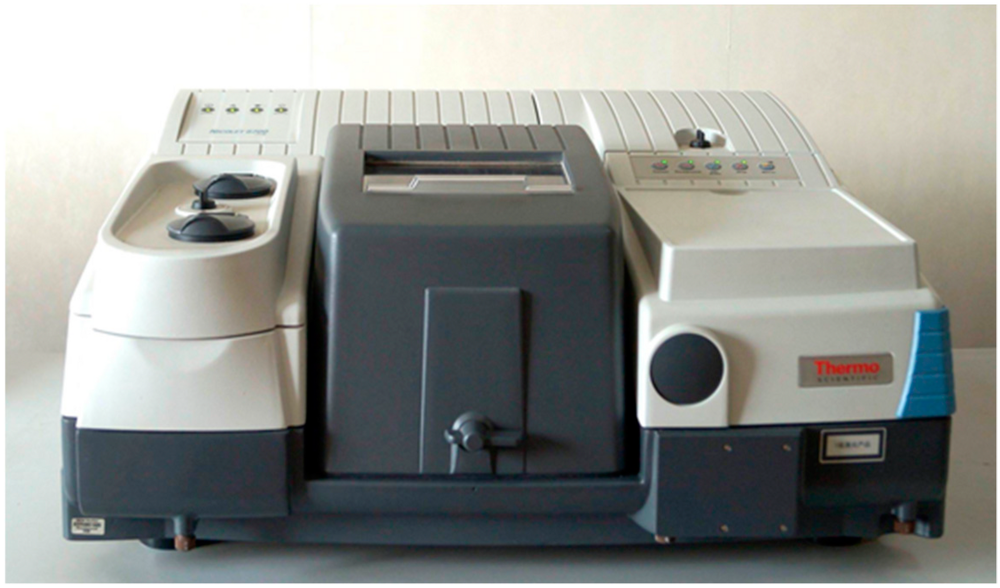
一个红外光谱仪记录一个分子含有哪些键。
A strong dip near a wavenumber of 1700 (per cm) indicates a: · 在波数 1700(每 cm)附近的一个强凹陷表明一个:
A dip around a wavenumber of 1700 (per cm) is the C=O bond (aldehyde, ketone, acid or ester). · 波数 1700(每 cm)附近的一个凹陷是 C=O 键(醛、酮、酸或酯)。
A broad dip around a wavenumber of 3200–3650 (per cm) indicates an: · 波数 3200–3650(每 cm)附近的一个宽凹陷表明一个:
The broad O–H absorption sits in the 3200–3650 (per cm) wavenumber region. · 宽的 O–H 吸收位于 3200–3650(每 cm)波数区域。
Match each IR feature to what it shows. · 把每个 IR 特征匹配到它显示什么。
Each item links the term to its correct meaning. · 每一项把术语链接到它正确的含义。
Checking a reaction
- IR can confirm a reaction worked.
- E.g. if propene became propan-2-ol, the C=C dip should disappear and an O–H dip should appear.
An IR spectrum: the broad O-H and C=O dips identify a carboxylic acid
检查一个反应
- IR 能确认一个反应起作用了。
- 例如,如果丙烯变成丙-2-醇,C=C 凹陷应该消失,一个 O–H 凹陷应该出现。
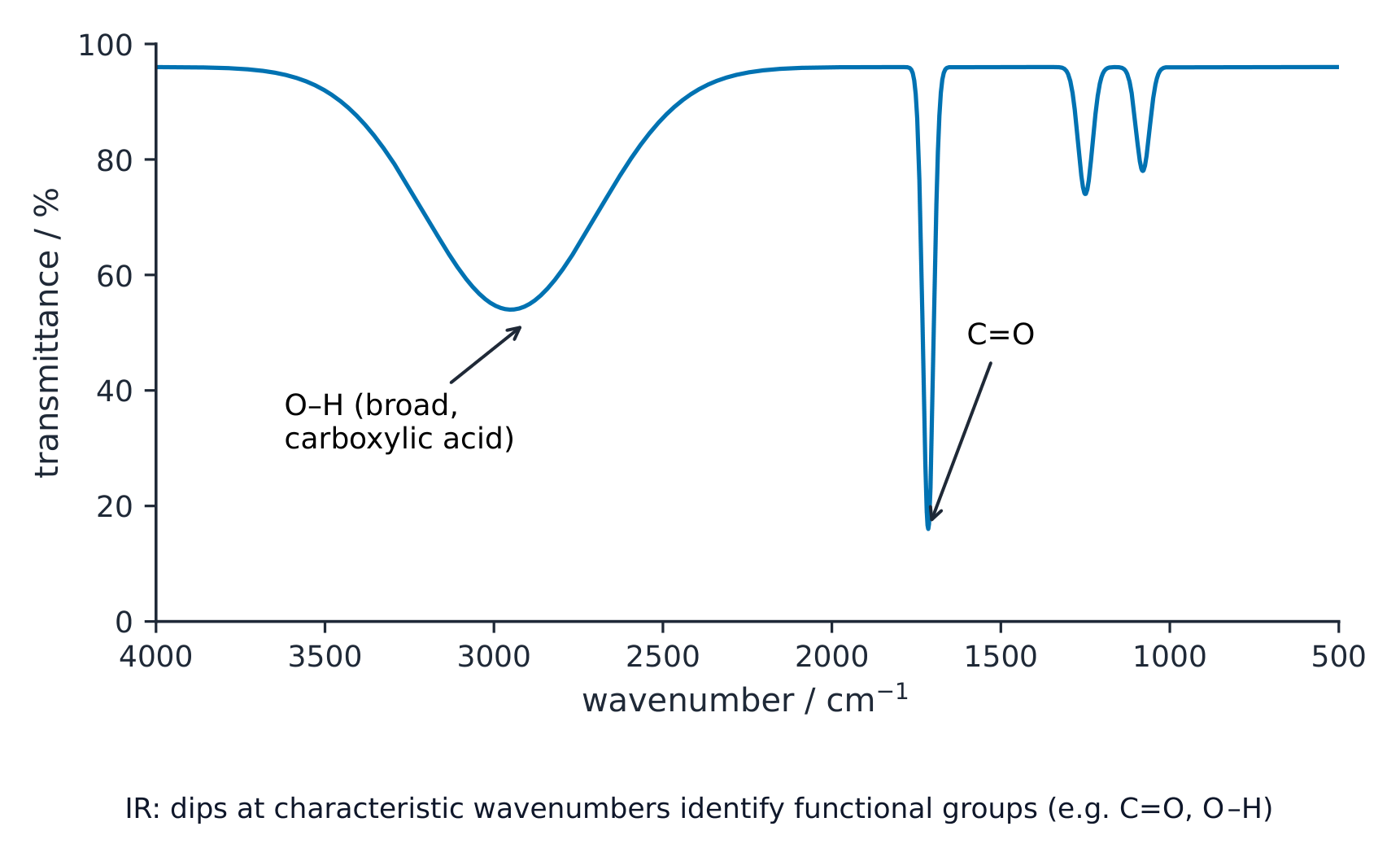
一个 IR 光谱:宽的 O-H 和 C=O 凹陷识别一个羧酸
How could IR confirm that an alkene has become an alcohol? · IR 如何能确认一个烯烃已经变成一个醇?
Losing the C=C and gaining an O–H dip shows the conversion to an alcohol. · 失去 C=C 并获得一个 O–H 凹陷显示转化成一个醇。
Mass spectrometry 质谱: the M+2 clue
- The molecular ion 分子离子 peak (M⁺) gives the molecular mass.
- A peak two units higher (M+2) reveals a halogen:
- M+2 about ⅓ the height of M → chlorine present (³⁵Cl : ³⁷Cl ≈ 3 : 1).
- M+2 about equal to M → bromine present (⁷⁹Br : ⁸¹Br ≈ 1 : 1).
So the ratio of the M and M+2 peaks tells you which halogen the molecule contains.
An (M+2) peak shows chlorine (3:1) or bromine (1:1)
质谱:M+2 线索
- 分子离子峰(M⁺)给出分子质量。
- 一个**高两个单位(M+2)**的峰揭示一个卤素:
- M+2 约为 M 高度的 ⅓ → 氯存在(³⁵Cl : ³⁷Cl ≈ 3 : 1)。
- M+2 约等于 M → 溴存在(⁷⁹Br : ⁸¹Br ≈ 1 : 1)。
所以 M 和 M+2 峰的比例告诉你分子含有哪个卤素。
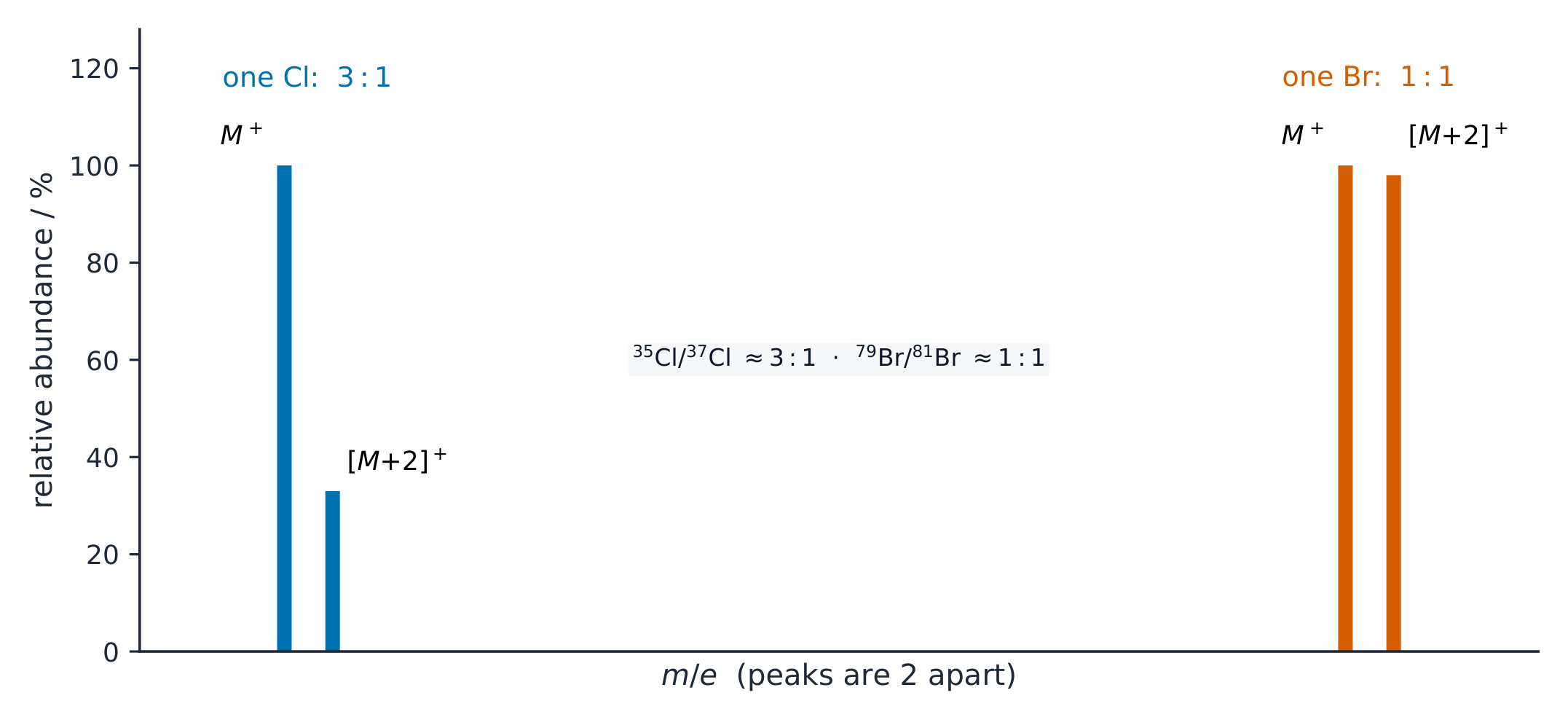
一个(M+2)峰显示氯(3:1)或溴(1:1)
You've got it
- IR finds functional groups: each bond gives a dip at its own wavenumber
- key dips: O–H (broad ~3200–3650), C=O (~1700); a broad O–H plus C=O = a carboxylic acid
- use IR to check a reaction (a group's dip disappears or appears)
- in mass spectra, an M+2 peak shows a halogen — ~⅓ of M = Cl, ~equal to M = Br
你掌握了
- IR 找出官能团:每个键在它自己的波数给出一个凹陷
- 关键凹陷:O–H(宽 ~3200–3650)、C=O(~1700);一个宽 O–H 加上 C=O = 一个羧酸
- 用 IR 来检查一个反应(一个基团的凹陷消失或出现)
- 在质谱中,一个 M+2 峰显示一个卤素——约 ⅓ 的 M = Cl,约等于 M = Br