Esters · 酯
| English | 中文 | Pinyin · 拼音 |
|---|---|---|
| ester/ˈestə/ | 酯 | zhǐ |
| condensation/kɒndenˈseɪʃn/ | 缩合 | suō hé |
| reversible/rɪˈvɜːsɪbl/ | 可逆 | kě nì |
| esterification/ˌestəˌrɪfɪˈkeɪʃn/ | 酯化 | zhǐ huà |
| hydrolysis/haɪˈdrɒləsɪs/ | 水解 | shuǐ jiě |
| carboxylate/ˈkɑːbəksɪleɪt/ | 羧酸盐 | suō suān yán |
The smell of perfumes and fruit
- An ester 酯 has the –COO– group.
- It often smells sweet or fruity.
- It is made from an alcohol and a carboxylic acid, and can be split back apart.
香水和水果的气味
- 一个酯(ester)有 –COO– 基团。
- 它常常闻起来甜或果香。
- 它由一个醇和一个羧酸制造,并能被分回去。
Ester route lab · 酯途径实验室
Follow ester formation and hydrolysis as reversible paths. · 跟踪酯的形成和水解作为可逆的路径。
Esters are often recognised by their: · 酯常常通过它们的以下哪种被识别:
Many esters have pleasant, fruity smells. · 许多酯有令人愉快的、果香的气味。
An ester is made by reacting a carboxylic acid with an ______. · 一个酯通过把一个羧酸与一个______反应制造。
Esterification, usually with an acid catalyst. · 酯化,通常用一个酸催化剂。
Making esters
- An ester forms by condensation 缩合 of an alcohol and a carboxylic acid (conc. $\text{H}_2\text{SO}_4$ catalyst). A water molecule is lost, and the reaction is reversible 可逆:
$$\text{CH}_3\text{COOH} + \text{C}_2\text{H}_5\text{OH} \rightleftharpoons \text{CH}_3\text{COOC}_2\text{H}_5 + \text{H}_2\text{O}$$
Esterification 酯化 joins an acid and an alcohol, losing water
制造酯
- 一个酯由一个醇和一个羧酸的缩合(condensation,浓 $\text{H}_2\text{SO}_4$ 催化剂)形成。一个水分子失去,反应是可逆的:
$$\text{CH}_3\text{COOH} + \text{C}_2\text{H}_5\text{OH} \rightleftharpoons \text{CH}_3\text{COOC}_2\text{H}_5 + \text{H}_2\text{O}$$
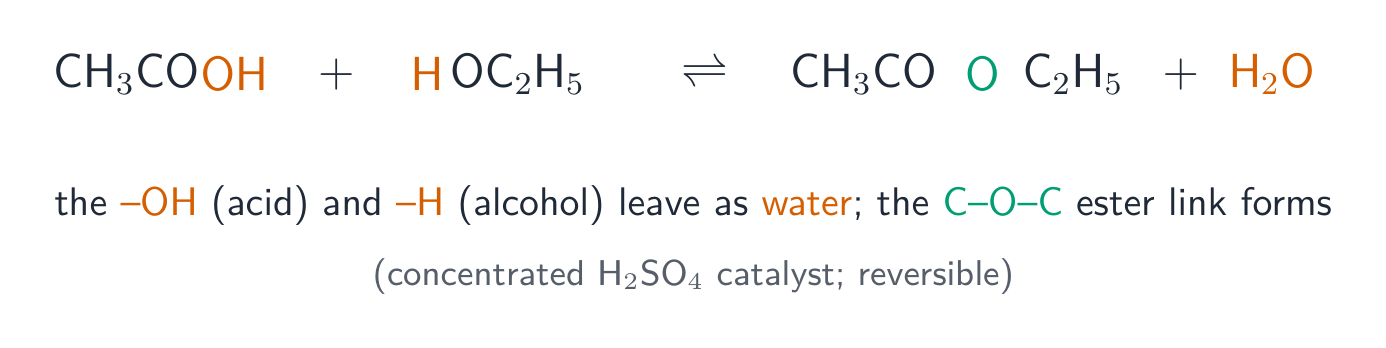
酯化把一个酸和一个醇结合,失去水
An ester is made by reacting: · 一个酯通过反应以下哪种制造:
Esterification is a reversible condensation of an alcohol and a carboxylic acid, releasing water. · 酯化是一个醇和一个羧酸的可逆缩合,释放水。
Match each ester fact. · 匹配每个酯事实。
Each item links the term to its correct meaning. · 每一项把术语链接到它正确的含义。
Hydrolysis 水解 of esters
The conditions change the products:
- dilute acid, heat (reversible) → the carboxylic acid + the alcohol.
- dilute alkali, heat (not reversible) → the carboxylate 羧酸盐 salt + the alcohol.
Esters give many fruits and perfumes their sweet smell.
酯的水解
条件改变产物:
- 稀酸,加热(可逆)→ 羧酸 + 醇。
- 稀碱,加热(不可逆)→ 羧酸盐(carboxylate salt)+ 醇。
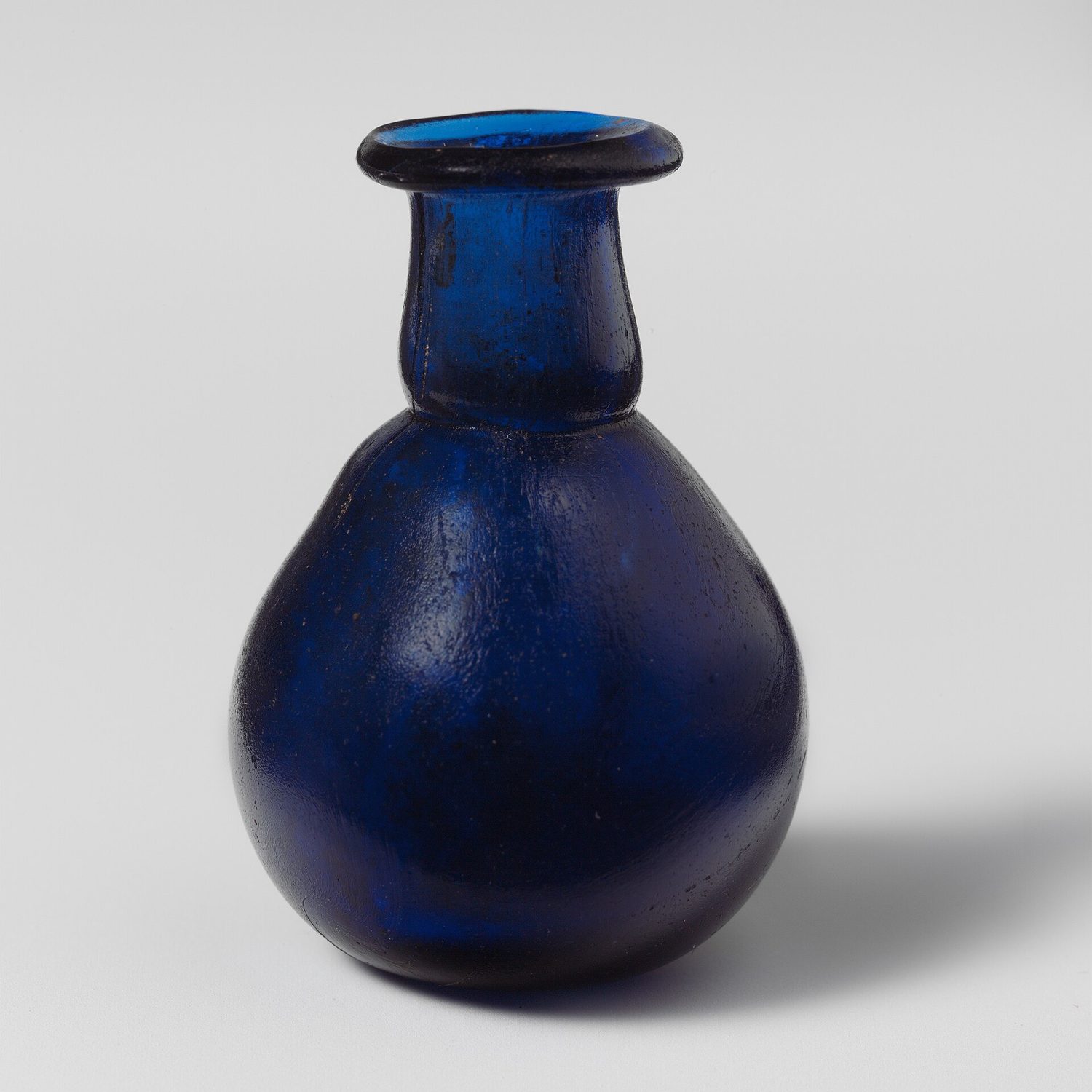
酯给许多水果和香水它们甜的气味。
Hydrolysing an ester with dilute acid gives: · 用稀酸水解一个酯给出:
Acid hydrolysis is the reverse of esterification, giving back the carboxylic acid and alcohol. · 酸性水解是酯化的逆过程,把羧酸和醇还回去。
Hydrolysing an ester with dilute alkali gives: · 用稀碱水解一个酯给出:
Alkali hydrolysis gives the salt of the carboxylic acid (plus the alcohol) and is not reversible. · 碱性水解给出羧酸的盐(加醇)且不可逆。
Making an ester
Worked example. Ethanol + ethanoic acid, warmed with a little concentrated sulfuric acid, gives the sweet-smelling ester ethyl ethanoate plus water.
制造一个酯
例题。 乙醇 + 乙酸,与一点浓硫酸一起加热,给出闻起来甜的酯乙酸乙酯加水。
You've got it
- an ester = –COO– group, often sweet-smelling
- made by condensation of alcohol + carboxylic acid (conc. H₂SO₄, water lost, reversible)
- acid hydrolysis (reversible) → acid + alcohol; alkali hydrolysis (not reversible) → carboxylate salt + alcohol
你掌握了
- 一个酯 = –COO– 基团,常常闻起来甜
- 由醇 + 羧酸的缩合制造(浓 H₂SO₄,失去水,可逆)
- 酸性水解(可逆)→ 酸 + 醇;碱性水解(不可逆)→ 羧酸盐 + 醇