Primary amines · 伯胺
| English | 中文 | Pinyin · 拼音 |
|---|---|---|
| amine/ˈæmaɪn/ | 胺 | àn |
| halogenoalkane/ˈheɪləʊdʒnəʊlkeɪn/ | 卤代烷 | lǔ dài wán |
| nucleophilic substitution/ˌnjuːklɪəˈfɪlɪk ˌsʌbstɪˈtjuːʃn/ | 亲核取代 | qīn hé qǔ dài |
| lone pair/ləʊn peə/ | 孤对电子 | gū duì diàn zi |
| nucleophile/ˈnjuːklɪɒfaɪl/ | 亲核试剂 | qīn hé shì jì |
Organic bases
- An amine 胺 has an –NH₂ group (nitrogen in place of a hydrogen of ammonia).
- We can make a primary amine from a halogenoalkane 卤代烷.
- It happens by nucleophilic substitution 亲核取代.
有机碱
- 一个胺(amine)有一个 –NH₂ 基团(氮代替氨的一个氢)。
- 我们能从一个卤代烷制造一个伯胺。
- 它通过亲核取代发生。
Amine reaction lab · 胺反应实验室
Classify amine examples by basicity and nucleophilic behaviour. · 按碱性和亲核行为对胺例子分类。
An amine contains the: · 一个胺含有:
An amine has an –NH₂ group, where nitrogen replaces a hydrogen of ammonia. · 一个胺有一个 –NH₂ 基团,其中氮代替氨的一个氢。
Amines act as bases because the nitrogen lone pair can accept a . · 胺作为碱,因为氮孤对电子能接受一个。
R–NH₂ + H⁺ → R–NH₃⁺. · R–NH₂ + H⁺ → R–NH₃⁺。
Making a primary amine
- Heat a halogenoalkane with ammonia dissolved in ethanol, under pressure:
$$\text{C}_2\text{H}_5\text{Br} + \text{NH}_3 \rightarrow \text{C}_2\text{H}_5\text{NH}_2 + \text{HBr}$$
Ammonia's lone pair substitutes for the halogen of a halogenoalkane, giving a primary amine
制造一个伯胺
- 把一个卤代烷与溶在乙醇中的氨一起加热,加压:
$$\text{C}_2\text{H}_5\text{Br} + \text{NH}_3 \rightarrow \text{C}_2\text{H}_5\text{NH}_2 + \text{HBr}$$
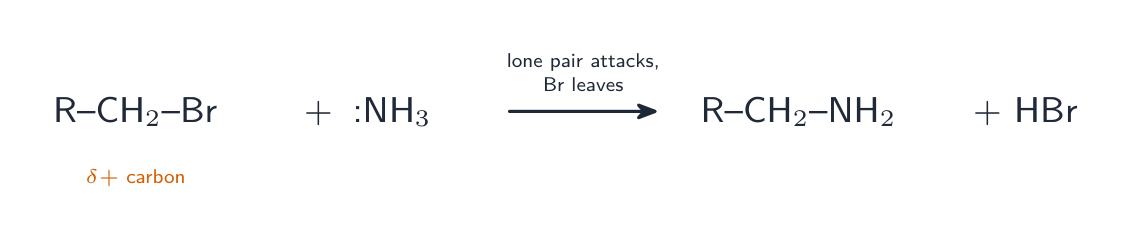
氨的孤对电子取代卤代烷的卤素,给出一个伯胺
A primary amine is made by heating a halogenoalkane with: · 一个伯胺通过把一个卤代烷与以下哪种加热制造:
Ammonia (in ethanol, under pressure) substitutes the halogen to give the amine. · 氨(在乙醇中,加压)取代卤素以给出胺。
Match each amine fact. · 匹配每个胺事实。
Each item links the term to its correct meaning. · 每一项把术语链接到它正确的含义。
The mechanism
- This is a nucleophilic substitution: the lone pair 孤对电子 on ammonia's nitrogen attacks the slightly positive carbon and pushes out the halogen.
- Use an excess of ammonia, or the amine formed reacts again.
Nylon, the first fully synthetic polyamide, was famously first used to make stockings.
机理
- 这是一个亲核取代:氨的氮上的孤对电子进攻稍微正的碳并挤出卤素。
- 使用过量的氨,否则形成的胺会再次反应。
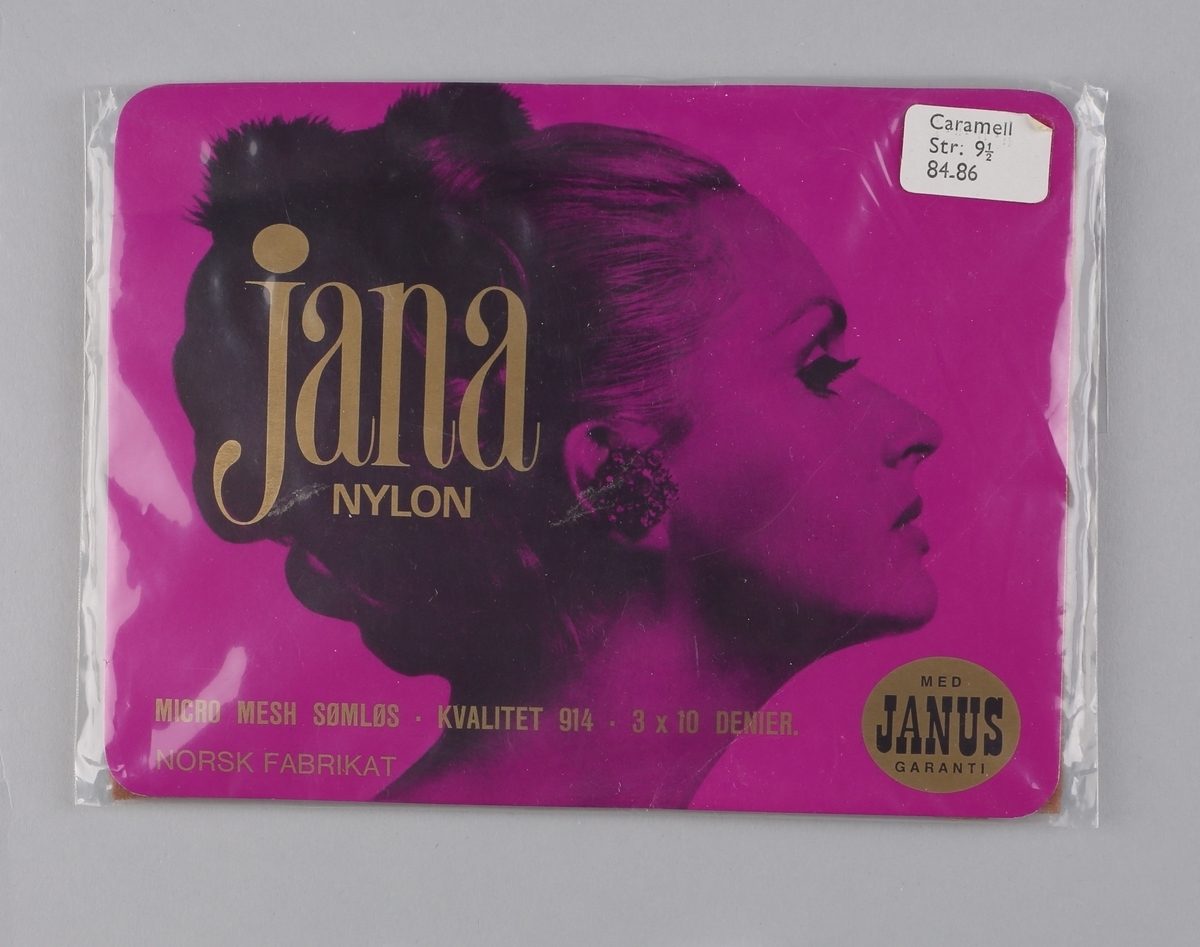
尼龙,第一种完全合成的聚酰胺,著名地首次被用来制造长袜。
The reaction is a nucleophilic substitution because: · 反应是一个亲核取代,因为:
Ammonia is the nucleophile; its nitrogen lone pair attacks the C–X carbon and pushes out the halogen. · 氨是亲核试剂;它的氮孤对电子进攻 C–X 碳并挤出卤素。
Why is an excess of ammonia used? · 为什么使用过量的氨?
The amine is itself a nucleophile and could react again; excess ammonia favours the primary amine. · 胺本身是一个亲核试剂,会再次反应;过量的氨有利于伯胺。
Amines as nucleophiles 亲核试剂
- The nitrogen lone pair lets amines act as nucleophiles as well as bases.
- This is why they react with halogenoalkanes and acyl chlorides.
胺作为亲核试剂
- 氮孤对电子让胺既作为亲核试剂也作为碱。
- 这就是为什么它们与卤代烷和酰氯反应。
You've got it
- an amine has the –NH₂ group
- made by heating a halogenoalkane with NH₃ in ethanol, under pressure
- it is a nucleophilic substitution (ammonia's lone pair attacks); use excess NH₃
你掌握了
- 一个胺有 –NH₂ 基团
- 由把一个卤代烷与乙醇中的 NH₃ 一起加热制造,加压
- 它是一个亲核取代(氨的孤对电子进攻);使用过量 NH₃