Oxidation of alcohols and tests · 醇的氧化和检验
| English | 中文 | Pinyin · 拼音 |
|---|---|---|
| oxidation/ˌɒksɪˈdeɪʃn/ | 氧化 | yǎng huà |
| aldehyde/ˈældɪhaɪd/ | 醛 | quán |
| distillation/dɪstɪˈleɪʃn/ | 蒸馏 | zhēng liú |
| carboxylic acid/ˌkɑːbəkˈsɪlɪk ˈæsɪd/ | 羧酸 | suō suān |
| reflux/ˈriːflʌks/ | 回流 | huí liú |
| ketone/ˈketəʊn/ | 酮 | tóng |
| iodoform test/ˈaɪədɒfɔːm test/ | 碘仿试验 | diǎn fǎng shì yàn |
Oxidation 氧化 and tests
- Alcohols come in three classes: primary, secondary, tertiary.
- Oxidation tells them apart.
- A couple of tests confirm structure.
氧化和检验
- 醇有三类:伯、仲、叔。
- 氧化(oxidation)把它们区分开。
- 几个检验确认结构。
Alcohol oxidation test lab · 醇氧化检验实验室
Classify alcohols by oxidation product and observation. · 按氧化产物和观察对醇分类。
Oxidising a primary alcohol and distilling off the product gives an: · 氧化一个伯醇并蒸馏出产物给出一个:
Distilling removes the aldehyde before further oxidation. · 蒸馏在进一步氧化之前移除醛。
Oxidation by class
| Class | Oxidation product |
|---|---|
| primary | aldehyde 醛 (by distillation 蒸馏), then carboxylic acid 羧酸 (by reflux 回流) |
| secondary | a ketone 酮 |
| tertiary | not oxidised |
- Acidified $\text{K}_2\text{Cr}_2\text{O}_7$ turns orange → green with a primary or secondary alcohol, but stays orange with a tertiary one.
Oxidation products of primary, secondary and tertiary alcohols
按类别氧化
| 类别 | 氧化产物 |
|---|---|
| 伯 | 醛(通过蒸馏),然后羧酸(通过回流) |
| 仲 | 一个酮 |
| 叔 | 不被氧化 |
- 酸化的 $\text{K}_2\text{Cr}_2\text{O}_7$ 与一个伯或仲醇从橙色 → 绿色,但与一个叔的保持橙色。
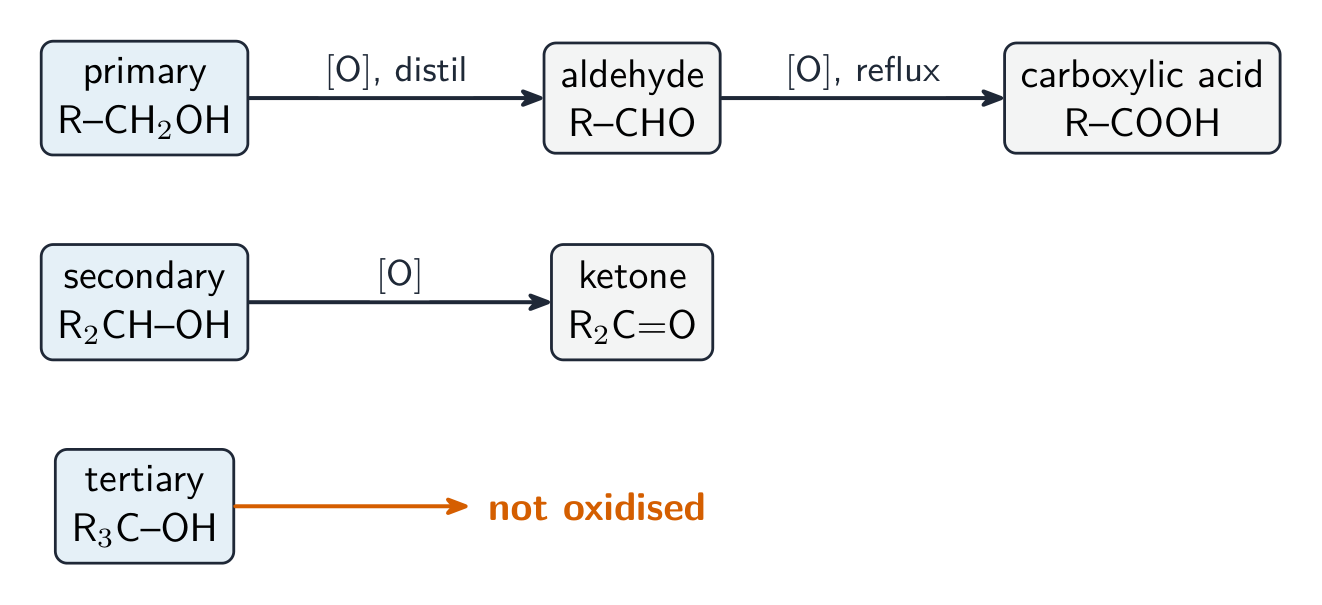
伯、仲和叔醇的氧化产物
A primary alcohol can be oxidised to: · 一个伯醇能被氧化成:
Primary → aldehyde (by distillation) → carboxylic acid (by reflux); secondary → ketone; tertiary → not oxidised. · 伯 → 醛(通过蒸馏)→ 羧酸(通过回流);仲 → 酮;叔 → 不被氧化。
With acidified dichromate, a tertiary alcohol: · 用酸化的重铬酸盐,一个叔醇:
Tertiary alcohols are not oxidised, so the dichromate stays orange; primary/secondary turn it green. · 叔醇不被氧化,所以重铬酸盐保持橙色;伯/仲把它变绿色。
Match each oxidation fact. · 匹配每个氧化事实。
Each item links the term to its correct meaning. · 每一项把术语链接到它正确的含义。
To stop the oxidation of a primary alcohol at the aldehyde you distil the product off as it forms; refluxing instead gives the carboxylic acid. · 为了把一个伯醇的氧化停在醛,你在产物形成时蒸馏出它;回流改为给出羧酸。
Distilling removes the volatile aldehyde before it can be oxidised again; reflux keeps it in the mixture for full oxidation. · 蒸馏在挥发性的醛能再次被氧化之前移除它;回流把它保持在混合物中以完全氧化。
Distillation, reflux and the iodoform test 碘仿试验
- distillation removes the aldehyde as it forms (before further oxidation).
- reflux keeps boiling and returning the vapour, so the alcohol is fully oxidised to the acid.
- iodoform test: an alcohol with the $\text{CH}_3\text{CH(OH)}-$ group, warmed with alkaline aqueous iodine, gives a pale-yellow precipitate of CHI₃.
Ethanol, the alcohol in hand sanitiser, kills microbes.
蒸馏、回流和碘仿检验
- 蒸馏(distillation)在醛形成时就移除它(在进一步氧化之前)。
- 回流(reflux)持续沸腾并返回蒸气,所以醇被完全氧化成酸。
- 碘仿检验(iodoform test):一个有 $\text{CH}_3\text{CH(OH)}-$ 基团的醇,与碱性碘水加热,给出一个淡黄色的 CHI₃ 沉淀。
乙醇,洗手液中的醇,杀死微生物。
To stop oxidation of a primary alcohol at the aldehyde, you use: · 为了把一个伯醇的氧化停在醛,你使用:
Distillation removes the aldehyde before it oxidises further; reflux instead gives the carboxylic acid. · 蒸馏在醛进一步氧化之前移除它;回流改为给出羧酸。
Acidity of alcohols
- Alcohols are very weakly acidic (they can lose $\text{H}^+$ to form $\text{RO}^-$).
- But they are less acidic than water: the alkyl group pushes electrons onto the oxygen, destabilising $\text{RO}^-$.
Distillation removes the aldehyde; reflux fully oxidises to the acid
醇的酸性
- 醇是非常弱酸性的(它们能失去 $\text{H}^+$ 形成 $\text{RO}^-$)。
- 但它们比水酸性弱:烷基把电子推到氧上,使 $\text{RO}^-$ 不稳定。
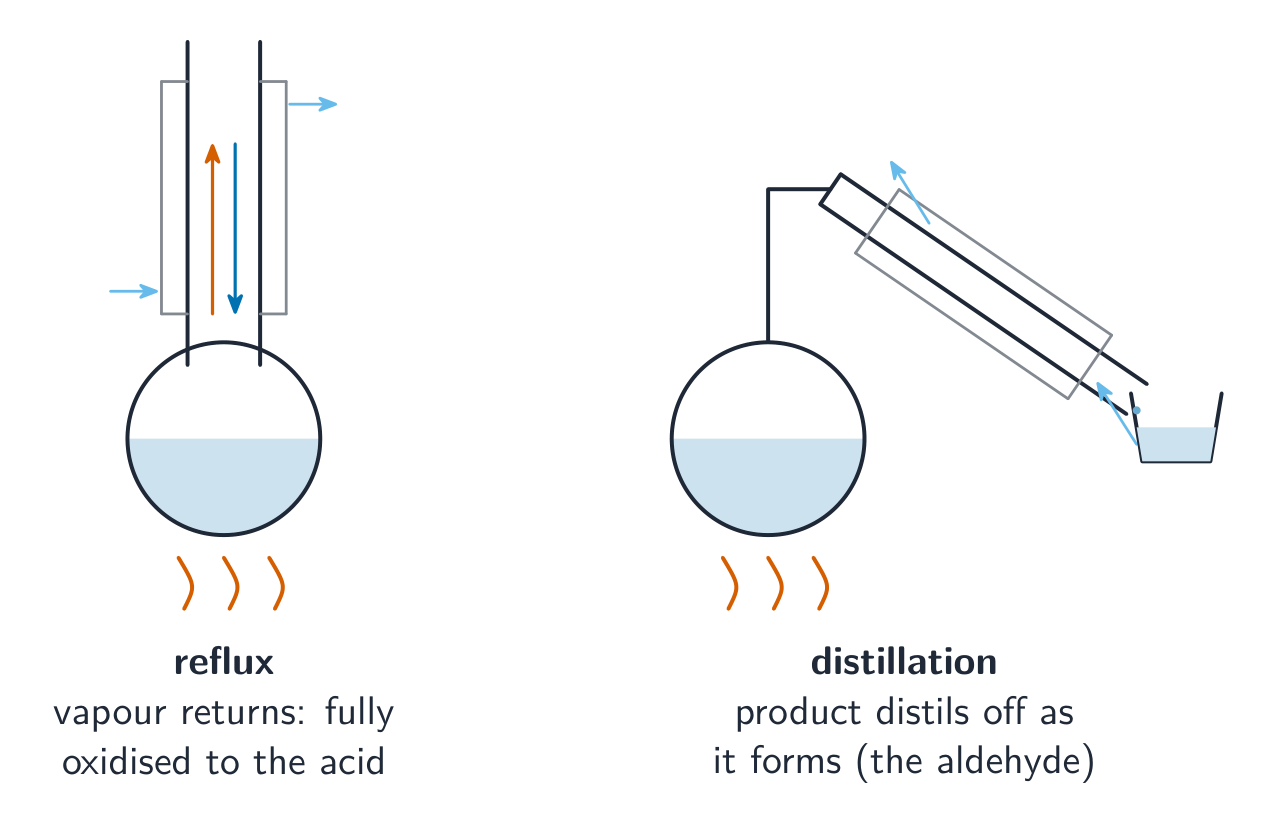
蒸馏移除醛;回流完全氧化成酸
Compared with water, alcohols are: · 与水相比,醇是:
The electron-pushing alkyl group makes RO⁻ less stable, so alcohols hold their H⁺ more tightly than water. · 推电子的烷基使 RO⁻ 不那么稳定,所以醇比水把它们的 H⁺ 抓得更紧。
You've got it
- primary → aldehyde (distil) → carboxylic acid (reflux); secondary → ketone; tertiary → not oxidised
- acidified dichromate goes orange → green (primary/secondary), stays orange (tertiary)
- distillation stops at the aldehyde; reflux gives the acid; iodoform tests for $\text{CH}_3\text{CH(OH)}-$
- alcohols are less acidic than water
你掌握了
- 伯 → 醛(蒸馏)→ 羧酸(回流);仲 → 酮;叔 → 不被氧化
- 酸化的重铬酸盐从橙色 → 绿色(伯/仲),保持橙色(叔)
- 蒸馏停在醛;回流给出酸;碘仿检验 $\text{CH}_3\text{CH(OH)}-$
- 醇比水酸性弱