Reaction and mechanism types · 反应和机理类型
| English | 中文 | Pinyin · 拼音 |
|---|---|---|
| curly arrow/ˈkɜːli ˈærəʊ/ | 弯箭头 | wān jiàn tóu |
| addition/əˈdɪʃn/ | 加成 | jiā chéng |
| substitution/ˌsʌbstɪˈtjuːʃn/ | 取代 | qǔ dài |
| elimination/ɪˌlɪmɪˈneɪʃn/ | 消去 | xiāo qù |
| hydrolysis/haɪˈdrɒləsɪs/ | 水解 | shuǐ jiě |
| condensation/kɒndenˈseɪʃn/ | 缩合 | suō hé |
| initiation/ɪˌnɪʃɪˈeɪʃn/ | 引发 | yǐn fā |
| propagation/ˌprɒpəˈɡeɪʃn/ | 增长 | zēng zhǎng |
| termination/ˌtɜːmɪˈneɪʃn/ | 终止 | zhōng zhǐ |
How reactions actually happen
- Organic reactions fall into a few named types.
- Mechanisms show, step by step, how the electrons move.
- A curly arrow 弯箭头 tracks each electron pair.
反应实际上如何发生
- 有机反应分成几个有名字的类型。
- 机理一步步地显示电子如何移动。
- 一个弯箭头(curly arrow)追踪每对电子。
Organic reaction type lab · 有机反应类型实验室
Classify reaction examples by the pattern of bonds changing. · 按键变化的模式对反应例子分类。
A species that is attracted to an electron-poor site and donates a pair of electrons is a: · 一个被吸引到电子贫位点并提供一对电子的物种是一个:
Nucleophiles donate an electron pair. · 亲核试剂提供一对电子。
Types of reaction
| Reaction | What happens |
|---|---|
| addition 加成 | two molecules join into one |
| substitution 取代 | one atom/group is swapped for another |
| elimination 消去 | a small molecule is removed, making a double bond |
| hydrolysis 水解 | a molecule is split apart by water |
| condensation 缩合 | two molecules join, losing a small molecule (e.g. water) |
- For organic redox, $[\text{O}]$ = one oxygen from an oxidising agent, $[\text{H}]$ = one hydrogen from a reducing agent.
The same molecule shown as molecular, structural, displayed and skeletal formula
反应的类型
| 反应 | 发生什么 |
|---|---|
| 加成(addition) | 两个分子结合成一个 |
| 取代(substitution) | 一个原子/基团被另一个换掉 |
| 消除(elimination) | 一个小分子被移除,形成一个双键 |
| 水解(hydrolysis) | 一个分子被水分开 |
| 缩合(condensation) | 两个分子结合,失去一个小分子(例如水) |
- 对于有机氧化还原,$[\text{O}]$ = 来自一个氧化剂的一个氧,$[\text{H}]$ = 来自一个还原剂的一个氢。
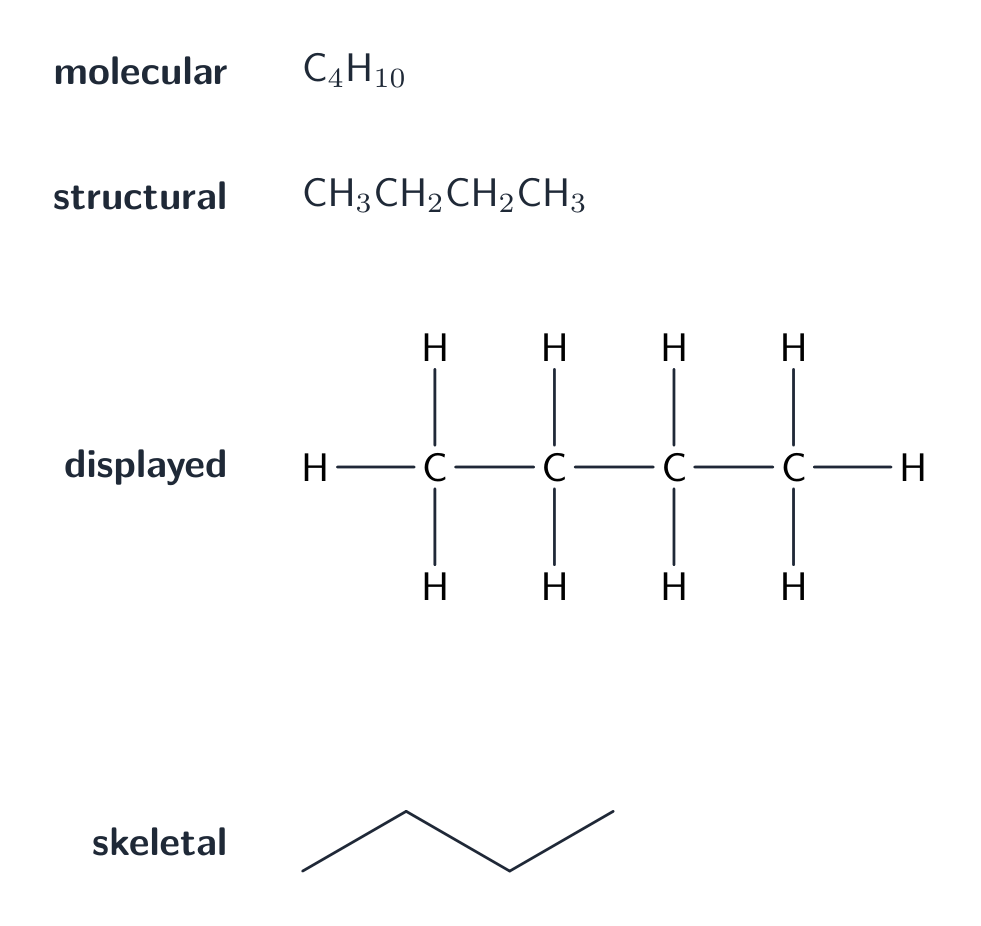
同一个分子显示为分子式、结构式、展示式和骨架式
Match each reaction type to what happens. · 把每个反应类型匹配到发生什么。
Addition joins; substitution swaps; elimination removes a small molecule to form a double bond. · 加成结合;取代交换;消除移除一个小分子以形成一个双键。
In an addition reaction: · 在一个加成反应中:
Addition combines two molecules into a single product (e.g. across a C=C bond). · 加成把两个分子结合成一个单一产物(例如跨一个 C=C 键)。
Types of mechanism
- A free-radical reaction has three steps: initiation 引发 (radicals made), propagation 增长 (radicals react, make new radicals), termination 终止 (radicals join, chain stops).
- Main mechanisms: free-radical substitution (alkanes), electrophilic addition (alkenes), nucleophilic substitution (halogenoalkanes), nucleophilic addition (carbonyls).
- A curly arrow shows a pair of electrons moving (from a bond or a lone pair).
机理的类型
- 一个自由基反应有三步:引发(initiation,制造自由基)、链增长(propagation,自由基反应,制造新自由基)、终止(termination,自由基结合,链停止)。
- 主要机理:自由基取代(烷烃)、亲电加成(烯烃)、亲核取代(卤代烷)、亲核加成(羰基)。
- 一个弯箭头显示一对电子移动(从一个键或一对孤对电子)。
Put the steps of a free-radical mechanism in order. · 把一个自由基机理的步骤按顺序排列。
Initiation makes radicals, propagation keeps the chain going, termination joins radicals to stop it. · 引发制造自由基,链增长保持链进行,终止结合自由基以停止它。
In a mechanism, a curly arrow shows: · 在一个机理中,一个弯箭头显示:
A curly arrow represents the movement of a pair of electrons, starting from a bond or a lone pair. · 一个弯箭头代表一对电子的移动,从一个键或一对孤对电子开始。
Classifying a reaction
- Identify the type — addition, substitution, elimination — and the attacking species.
- Nucleophiles attack electron-poor carbons; electrophiles attack electron-rich sites.
给一个反应分类
- 识别类型——加成、取代、消除——和进攻的物种。
- 亲核试剂进攻电子贫的碳;亲电试剂进攻电子富的位点。
You've got it
- reaction types: addition, substitution, elimination, hydrolysis, condensation; $[\text{O}]$ / $[\text{H}]$ for redox
- a free-radical mechanism runs initiation → propagation → termination
- main mechanisms: free-radical substitution, electrophilic addition, nucleophilic substitution/addition
- a curly arrow = a moving electron pair
你掌握了
- 反应类型:加成、取代、消除、水解、缩合;氧化还原用 $[\text{O}]$ / $[\text{H}]$
- 一个自由基机理运行引发 → 链增长 → 终止
- 主要机理:自由基取代、亲电加成、亲核取代/加成
- 一个弯箭头 = 一对移动的电子对