Bond fission and attacking species · 键断裂和进攻的物种
| English | 中文 | Pinyin · 拼音 |
|---|---|---|
| nucleophile/ˈnjuːklɪɒfaɪl/ | 亲核试剂 | qīn hé shì jì |
| electrophile/ɪˌlektrəʊˈfaɪl/ | 亲电试剂 | qīn diàn shì jì |
| heterolytic fission/ˌhetrəˈlɪtɪk ˈfɪʃn/ | 异裂 | yì liè |
| homolytic fission/ˌhɒməˈlɪtɪk ˈfɪʃn/ | 均裂 | jūn liè |
| free radical/friː ˈrædɪkl/ | 自由基 | zì yóu jī |
Breaking bonds and attacking species
- A covalent bond can break in two ways.
- The fragments may be radicals or ions.
- Reactions are driven by nucleophiles 亲核试剂 and electrophiles 亲电试剂.
断裂键和进攻的物种
- 一个共价键能以两种方式断裂。
- 碎片可能是自由基或离子。
- 反应由亲核试剂和亲电试剂驱动。
Bond fission and attack route · 键断裂和进攻途径
Watch a polar bond lead to electrophiles, nucleophiles and radicals. · 观看一个极性键导致亲电试剂、亲核试剂和自由基。
Breaking a bond so each atom keeps one electron is ______ fission. · 断裂一个键使每个原子保留一个电子是______裂。
It forms free radicals. · 它形成自由基。
Homolytic vs heterolytic fission 异裂
- Homolytic fission 均裂: the bond splits evenly, one electron to each atom → two free radicals 自由基 (unpaired electron).
- Heterolytic fission: the bond splits unevenly, both electrons to one atom → two ions.
Homolytic fission gives two radicals; heterolytic fission gives two ions
均裂对比异裂
- 均裂(homolytic fission):键均匀地分裂,每个原子一个电子 → 两个自由基(free radicals,不成对的电子)。
- 异裂(heterolytic fission):键不均匀地分裂,两个电子都到一个原子 → 两个离子。
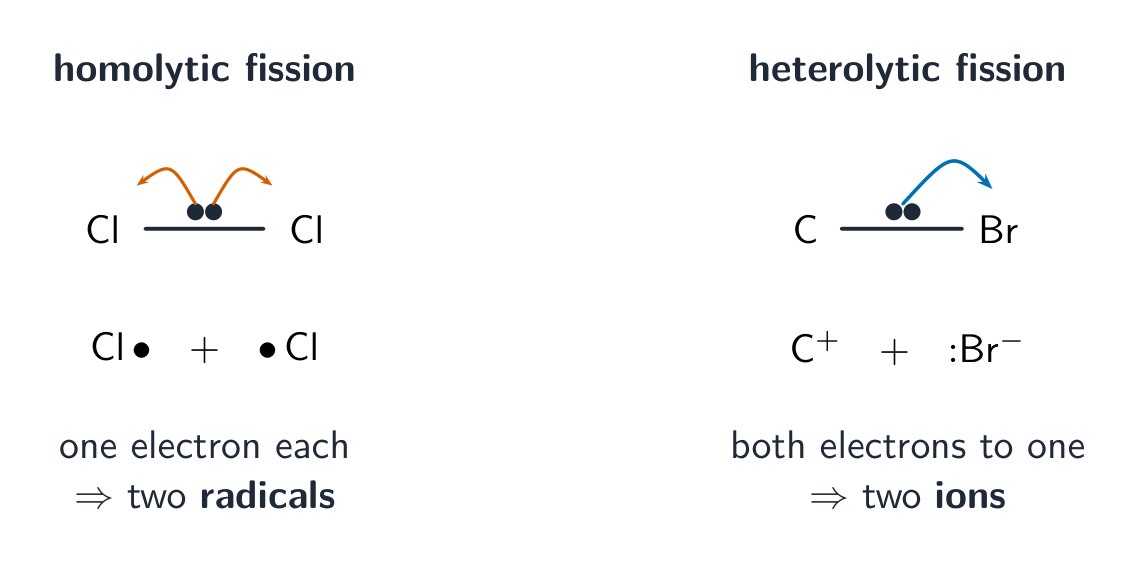
均裂给出两个自由基;异裂给出两个离子
Homolytic fission of a covalent bond produces: · 一个共价键的均裂产生:
Homolytic = even split, one electron each → two radicals; heterolytic = uneven → two ions. · 均裂 = 均匀分裂,各一个电子 → 两个自由基;异裂 = 不均匀 → 两个离子。
Heterolytic fission produces: · 异裂产生:
In heterolytic fission both bonding electrons go to one atom, giving a positive and a negative ion. · 在异裂中两个成键电子都到一个原子,给出一个正离子和一个负离子。
Match each species/process to its meaning. · 把每个物种/过程匹配到它的含义。
Each item links the term to its correct meaning. · 每一项把术语链接到它正确的含义。
Nucleophiles and electrophiles
- a nucleophile has a lone pair and is attracted to an electron-poor (positive) centre.
- an electrophile is attracted to an electron-rich (negative) centre, such as a C=C double bond.
亲核试剂和亲电试剂
- 一个亲核试剂(nucleophile)有一对孤对电子,被一个电子贫(正)中心吸引。
- 一个亲电试剂(electrophile)被一个电子富(负)中心吸引,例如一个 C=C 双键。
A nucleophile is a species that: · 一个亲核试剂是这样一个物种,它:
Nucleophiles use a lone pair to attack electron-poor carbons; electrophiles seek electron-rich centres. · 亲核试剂用一对孤对电子进攻电子贫的碳;亲电试剂寻找电子富的中心。
An electrophile is attracted to: · 一个亲电试剂被以下哪种吸引:
Electrophiles are electron-seeking; a C=C double bond is electron-rich and attracts them. · 亲电试剂寻找电子;一个 C=C 双键是电子富的并吸引它们。
Two ways a bond can break
- Homolytic fission gives two radicals (each atom keeps one electron).
- Heterolytic fission gives ions (one atom keeps both electrons).
一个键能断裂的两种方式
- 均裂给出两个自由基(每个原子保留一个电子)。
- 异裂给出离子(一个原子保留两个电子)。
You've got it
- homolytic fission → two free radicals (one electron each); heterolytic fission → two ions
- a nucleophile (lone pair) attacks an electron-poor centre
- an electrophile is drawn to an electron-rich centre (e.g. C=C)
你掌握了
- 均裂 → 两个自由基(各一个电子);异裂 → 两个离子
- 一个亲核试剂(孤对电子)进攻一个电子贫中心
- 一个亲电试剂被吸引到一个电子富中心(例如 C=C)