The Haber and Contact processes · 哈伯法和接触法
| English | 中文 | Pinyin · 拼音 |
|---|---|---|
| yield/jiːld/ | 产率 | chǎn lǜ |
| Haber process/ˈheɪbə ˈprəʊses/ | 哈伯法 | hā bó fǎ |
| ammonia/æˈməʊnɪə/ | 氨 | ān |
| catalyst/ˈkætəlɪst/ | 催化剂 | cuī huà jì |
| compromise/ˈkɒmprəmaɪz/ | 折中 | zhé zhōng |
| Contact process/ˈkɒntækt ˈprəʊses/ | 接触法 | jiē chù fǎ |
Equilibrium that feeds the world
- These industrial processes balance yield 产率, rate and cost.
- They use Le Chatelier's principle to choose conditions.
- Both reactions are exothermic.
养活世界的平衡
- 这些工业过程平衡产率(yield)、速率和成本。
- 它们使用勒夏特列原理来选择条件。
- 两个反应都是放热的。
The Haber process combines nitrogen and hydrogen to make . · 哈伯法把氮和氢结合来制造。
N₂ + 3H₂ ⇌ 2NH₃. · N₂ + 3H₂ ⇌ 2NH₃。
The Haber process 哈伯法
- Makes ammonia 氨: $\text{N}_2 + 3\text{H}_2 \rightleftharpoons 2\text{NH}_3$ (exothermic).
- Conditions: about $450\,°\text{C}$, $200\ \text{atm}$, iron catalyst 催化剂.
- A low temperature would give more ammonia, but too slowly — so a moderate temperature is a compromise 折中.
Haber process yield: more ammonia at lower temperature and higher pressure
哈伯法
- 制造氨:$\text{N}_2 + 3\text{H}_2 \rightleftharpoons 2\text{NH}_3$(放热)。
- 条件:大约 $450\,°\text{C}$,$200\ \text{atm}$,铁催化剂。
- 一个低温会给出更多氨,但太慢——所以一个中等温度是一个折衷(compromise)。
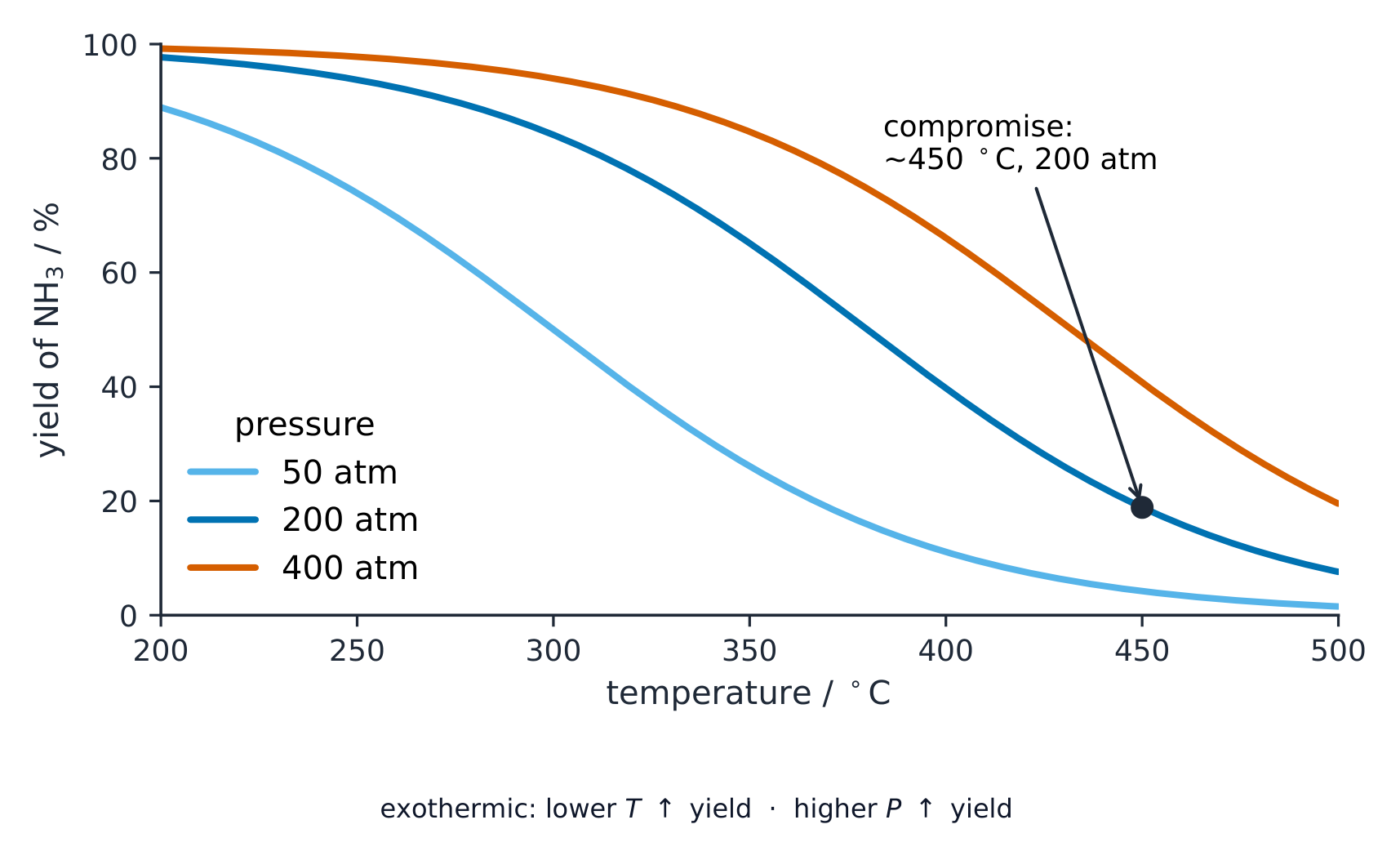
哈伯法产率:更低温度和更高压强下更多的氨
The Haber & Contact processes · 哈伯法和接触法
compromise: yield vs rate · 折衷:产率对速率
High pressure boosts yield; high temperature speeds it up but lowers yield — a compromise. · 高压提升产率;高温加速它但降低产率——一个折衷。
The Haber process makes: · 哈伯法制造:
The Haber process makes ammonia: N₂ + 3H₂ ⇌ 2NH₃ (exothermic). · 哈伯法制造氨:N₂ + 3H₂ ⇌ 2NH₃(放热)。
Why is a moderate temperature (~450 °C) used in the Haber process? · 为什么哈伯法使用一个中等温度(~450 °C)?
The reaction is exothermic, so low temperature favours yield but is too slow; ~450 °C balances yield and rate. · 反应是放热的,所以低温有利于产率但太慢;~450 °C 平衡产率和速率。
High pressure increases the yield of ammonia in the Haber process because: · 高压增加哈伯法中氨的产率,因为:
4 gas molecules become 2, so higher pressure shifts the equilibrium towards ammonia. · 4 个气体分子变成 2 个,所以更高的压强使平衡朝向氨移动。
The Contact process 接触法
- Makes sulfur trioxide: $2\text{SO}_2 + \text{O}_2 \rightleftharpoons 2\text{SO}_3$ (exothermic).
- Conditions: about $450\,°\text{C}$, near $1$–$2\ \text{atm}$, vanadium(V) oxide catalyst.
Ammonia for fertiliser is made by the Haber process, a key equilibrium
接触法
- 制造三氧化硫:$2\text{SO}_2 + \text{O}_2 \rightleftharpoons 2\text{SO}_3$(放热)。
- 条件:大约 $450\,°\text{C}$,接近 $1$–$2\ \text{atm}$,五氧化二钒(vanadium(V) oxide)催化剂。
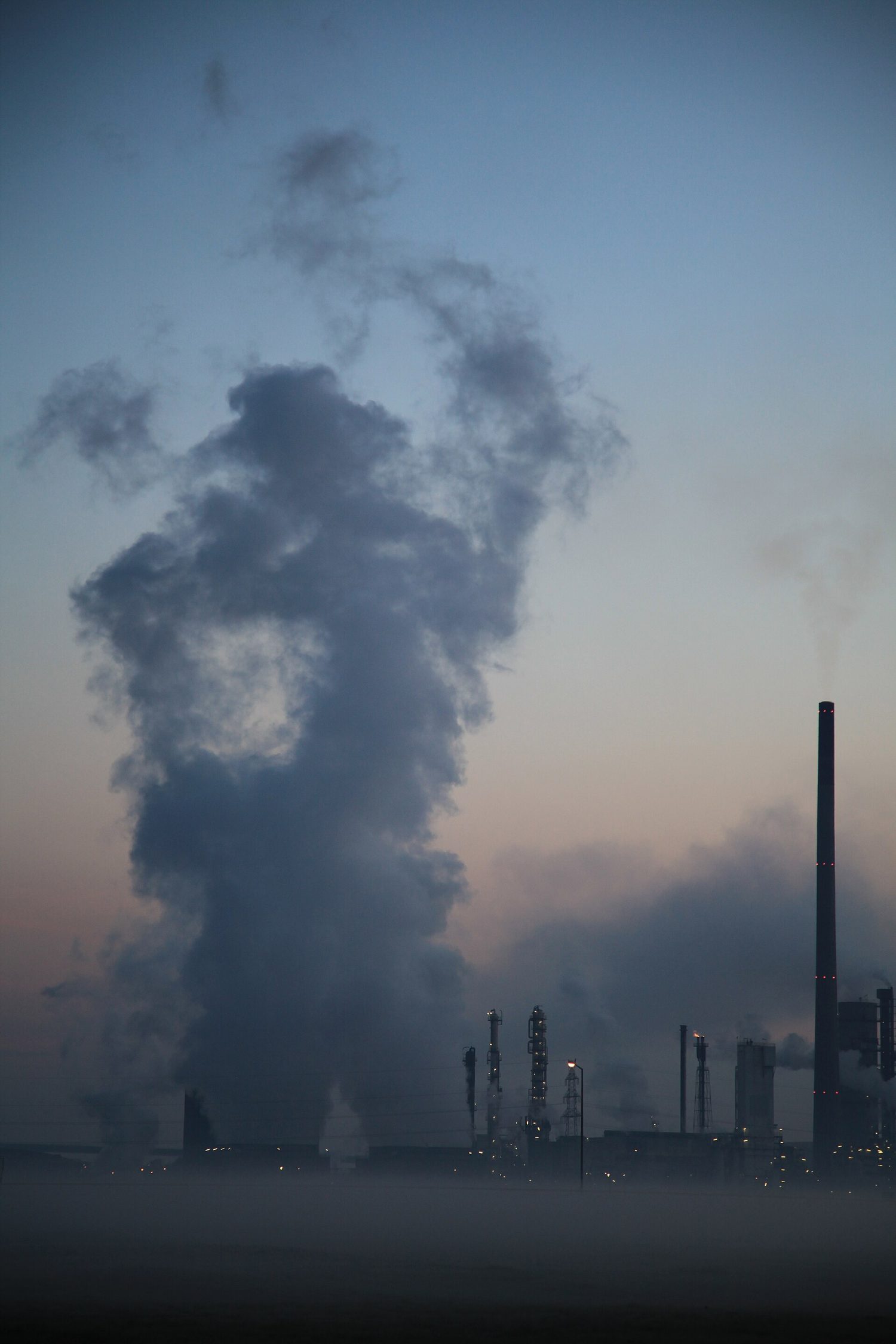
用于肥料的氨由哈伯法制造,一个关键的平衡
The Contact process uses which catalyst? · 接触法使用哪个催化剂?
The Contact process (2SO₂ + O₂ ⇌ 2SO₃) uses a vanadium(V) oxide catalyst. · 接触法(2SO₂ + O₂ ⇌ 2SO₃)使用一个五氧化二钒催化剂。
Match each process to its facts. · 把每个过程匹配到它的事实。
Each item links the term to its correct meaning. · 每一项把术语链接到它正确的含义。
Why the compromise conditions
- The Haber process uses ~450 °C and ~200 atm: a compromise between yield, rate and cost.
- A lower temperature would give more ammonia but far too slowly.
为什么是折衷条件
- 哈伯法使用约 450 °C 和约 200 atm:产率、速率和成本之间的一个折衷。
- 一个更低的温度会给出更多氨,但太慢了。
You've got it
- both processes balance yield + rate + cost (Le Chatelier), and both are exothermic
- Haber: $\text{N}_2 + 3\text{H}_2 \rightleftharpoons 2\text{NH}_3$; ~450 °C, 200 atm, iron catalyst (moderate temp = compromise)
- Contact: $2\text{SO}_2 + \text{O}_2 \rightleftharpoons 2\text{SO}_3$; ~450 °C, 1–2 atm, V₂O₅ catalyst
你掌握了
- 两个过程都平衡产率 + 速率 + 成本(勒夏特列),且都是放热的
- 哈伯:$\text{N}_2 + 3\text{H}_2 \rightleftharpoons 2\text{NH}_3$;约 450 °C,200 atm,铁催化剂(中等温度 = 折衷)
- 接触:$2\text{SO}_2 + \text{O}_2 \rightleftharpoons 2\text{SO}_3$;约 450 °C,1–2 atm,V₂O₅ 催化剂