Oxidation number and redox · 氧化数和氧化还原
| English | 中文 | Pinyin · 拼音 |
|---|---|---|
| oxidation number/ˌɒksɪˈdeɪʃn ˈnʌmbə/ | 氧化数 | yǎng huà shù |
| redox/rɪˈdɒks/ | 氧化还原 | yǎng huà huán yuán |
| oxidation/ˌɒksɪˈdeɪʃn/ | 氧化 | yǎng huà |
| electron transfer/ɪˈlektrɒn ˈtrænsfɜː/ | 电子转移 | diàn zi zhuǎn yí |
| reduction/rɪˈdʌkʃn/ | 还原 | huán yuán |
Tracking the electrons
- The oxidation number 氧化数 shows how many electrons an atom has lost or gained vs the free element.
- A redox 氧化还原 reaction moves electrons from one species to another.
- One mnemonic ties it all together: OIL RIG.
追踪电子
- 氧化数(oxidation number)显示一个原子相对于自由元素失去或得到了多少电子。
- 一个氧化还原(redox)反应把电子从一个物种移到另一个。
- 一个助记词把这一切联系起来:OIL RIG。
A substance that loses electrons in a reaction is being . · 一个在反应中失去电子的物质正在被。
OIL: Oxidation Is Loss of electrons. · OIL:氧化是失去电子(Oxidation Is Loss)。
The rules
- an uncombined element is $0$.
- a simple ion equals its charge ($\text{Mg}^{2+}$ is $+2$).
- Group 1 is $+1$, Group 2 is $+2$; H is $+1$ (but $-1$ in metal hydrides); O is $-2$ (but $-1$ in peroxides); F is $-1$.
- the numbers add to 0 in a compound, or to the charge in an ion.
Balancing redox: total rise in oxidation 氧化 number equals total fall
Disproportionation: the same element is both oxidised and reduced
规则
- 一个未化合的元素是 $0$。
- 一个简单离子等于它的电荷($\text{Mg}^{2+}$ 是 $+2$)。
- 第 1 族是 $+1$,第 2 族是 $+2$;H 是 $+1$(但在金属氢化物中是 $-1$);O 是 $-2$(但在过氧化物中是 $-1$);F 是 $-1$。
- 这些数在一个化合物中加到 0,或在一个离子中加到电荷。
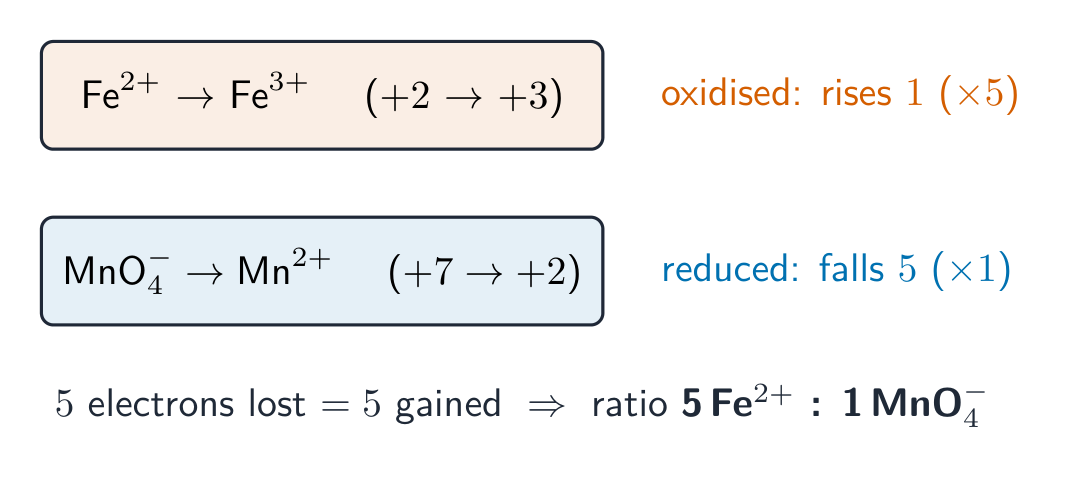
配平氧化还原:氧化数的总上升等于总下降
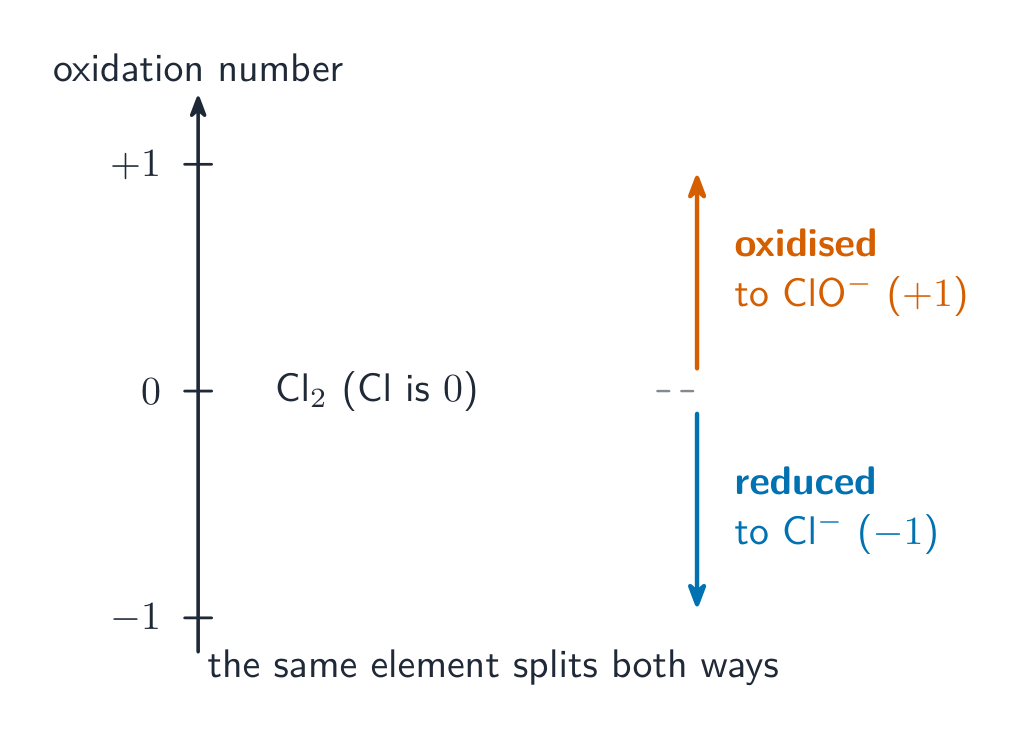
歧化:同一个元素既被氧化又被还原
Redox is electron transfer · 氧化还原是电子转移
Step through it: the metal loses (is oxidised) and the non-metal gains (is reduced) — oxidation number rises for one, falls for the other. · 逐步看:金属失去电子(被氧化),非金属得到电子(被还原)——一方的氧化数升高,另一方降低。
The oxidation number of an uncombined element (like O₂ or Fe) is: · 一个未化合元素(像 O₂ 或 Fe)的氧化数是:
A free, uncombined element always has an oxidation number of 0. · 一个自由的、未化合的元素总是有 0 的氧化数。
The usual oxidation number of oxygen in a compound is: · 氧在一个化合物中通常的氧化数是:
Oxygen is normally −2, except −1 in peroxides. · 氧通常是 −2,除了在过氧化物中是 −1。
In KMnO₄, K is +1 and each O is −2. What is the oxidation number of Mn? (give the number, e.g. 7) · 在 KMnO₄ 中,K 是 +1,每个 O 是 −2。Mn 的氧化数是多少?(给出数字,例如 7)
+1 (K) + Mn + 4×(−2) = 0, so Mn = +7. · +1(K)+ Mn + 4×(−2) = 0,所以 Mn = +7。
OIL RIG
- Oxidation Is Loss of electrons → oxidation number goes up.
- Reduction Is Gain of electrons → oxidation number goes down.
- They always happen together — electrons lost by one are gained by another (electron transfer 电子转移).
A battery uses redox reactions to push electrons round a circuit
OIL RIG
- Oxidation Is Loss of electrons(氧化是失去电子)→ 氧化数上升。
- Reduction Is Gain of electrons(还原是得到电子)→ 氧化数下降。
- 它们总是一起发生——一方失去的电子被另一方得到(电子转移)。
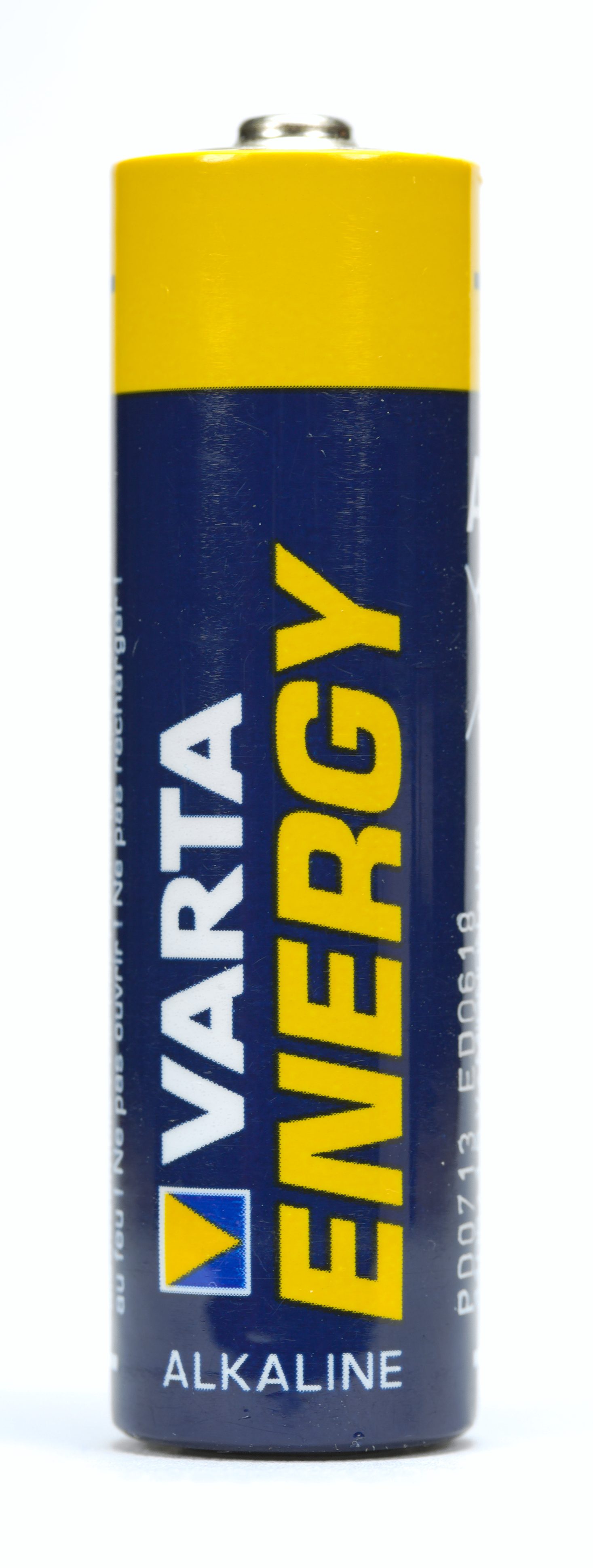
一个电池使用氧化还原反应把电子推过一个电路
Using OIL RIG, oxidation is: · 使用 OIL RIG,氧化是:
Oxidation Is Loss of electrons; the oxidation number rises. Reduction Is Gain (number falls). · 氧化是失去电子(Oxidation Is Loss);氧化数上升。还原是得到(Reduction Is Gain,数下降)。
Oxidation-number rules
- Uncombined elements are 0; simple ions equal their charge; oxygen is usually −2 and hydrogen +1.
- The oxidation numbers in a neutral compound add up to 0.
Rusting is the oxidation of iron
氧化数规则
- 未化合的元素是 0;简单离子等于它们的电荷;氧通常是 −2,氢是 +1。
- 一个中性化合物中的氧化数加到 0。
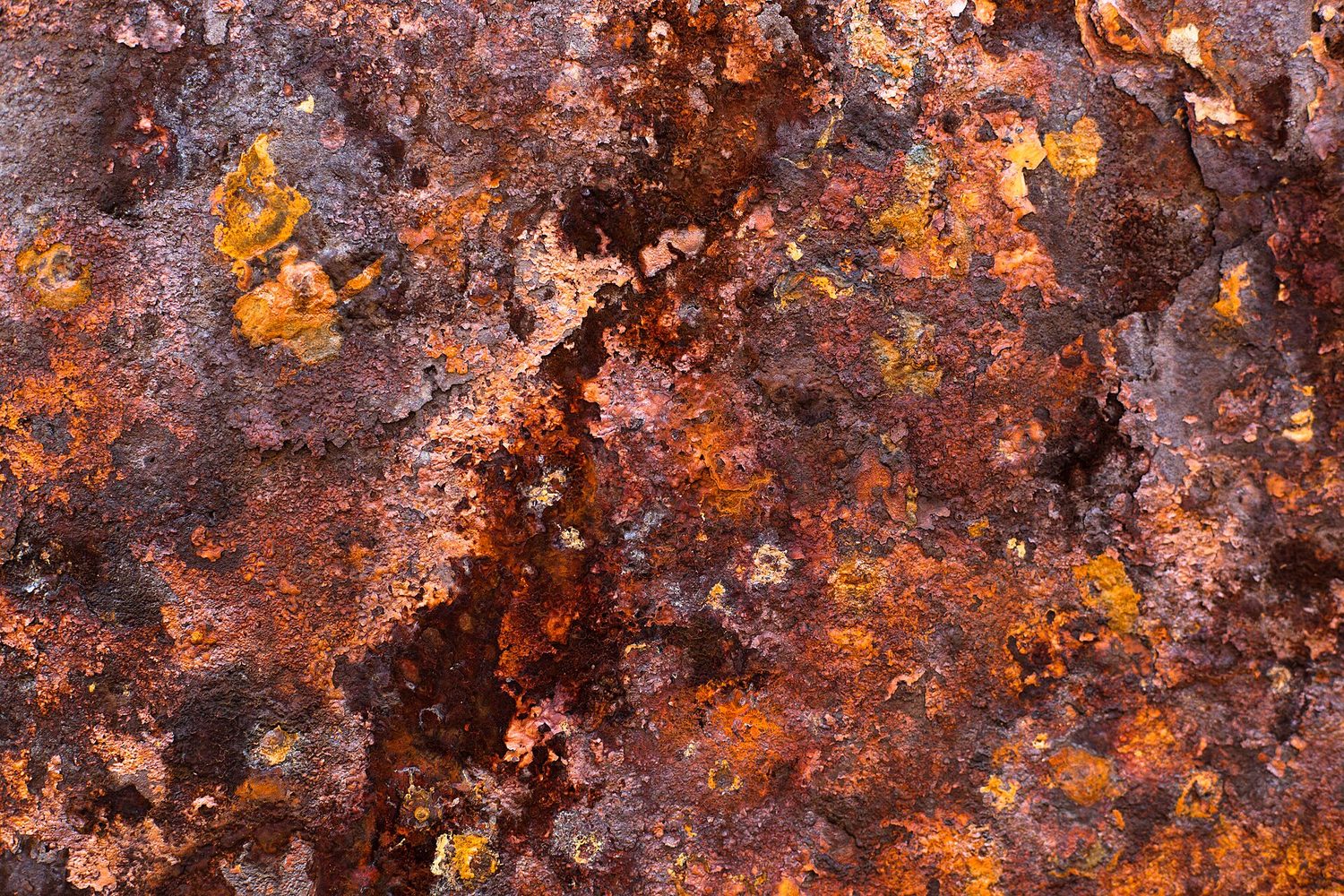
生锈是铁的氧化
You've got it
- oxidation number = electrons lost/gained vs the free element (element = 0, ion = charge)
- key values: H $+1$, O $-2$, F $-1$; sum to 0 (compound) or charge (ion)
- OIL RIG: Oxidation Is Loss (number ↑), Reduction 还原 Is Gain (number ↓)
- oxidation and reduction always happen together (electron transfer)
你掌握了
- 氧化数 = 相对于自由元素失去/得到的电子(元素 = 0,离子 = 电荷)
- 关键值:H $+1$,O $-2$,F $-1$;加到 0(化合物)或电荷(离子)
- OIL RIG:Oxidation Is Loss(数 ↑),Reduction Is Gain(数 ↓)
- 氧化和还原总是一起发生(电子转移)