Balancing redox and agents · 配平氧化还原和试剂
| English | 中文 | Pinyin · 拼音 |
|---|---|---|
| disproportionation/ˌdɪsprəˈpɔːʃəneɪʃn/ | 歧化 | qí huà |
| reducing agent/rɪˈdjuːsɪŋ ˈeɪdʒənt/ | 还原剂 | huán yuán jì |
| oxidised/ˈɒksɪdaɪzd/ | 被氧化 | bèi yǎng huà |
| reduced/rɪˈdjuːst/ | 被还原 | bèi huán yuán |
| oxidising agent/ˈɒksɪdaɪzɪŋ ˈeɪdʒənt/ | 氧化剂 | yǎng huà jì |
Balancing the electron books
- Oxidation numbers help balance redox equations.
- A special case is disproportionation 歧化.
- And every redox reaction has an oxidising and a reducing agent 还原剂.
平衡电子账本
- 氧化数帮助配平氧化还原方程。
- 一个特殊情况是歧化(disproportionation)。
- 而每个氧化还原反应都有一个氧化剂和一个还原剂。
An oxidising agent is itself reduced during a reaction. · 一个氧化剂在一个反应期间自己被还原。
It gains the electrons lost by the other species. · 它得到另一个物种失去的电子。
Balancing with oxidation numbers
- find the element whose number rises (oxidised 被氧化) and the one whose number falls (reduced 被还原).
- the total rise = total fall (every electron lost is gained somewhere).
- choose the ratio so they match, then balance the rest.
Redox is electron transfer: the reducing agent is oxidised, the oxidising agent 氧化剂 is reduced
用氧化数配平
- 找出数上升(被氧化)的元素和数下降(被还原)的元素。
- 总上升 = 总下降(失去的每个电子都在某处被得到)。
- 选择比例使它们匹配,然后配平其余的。
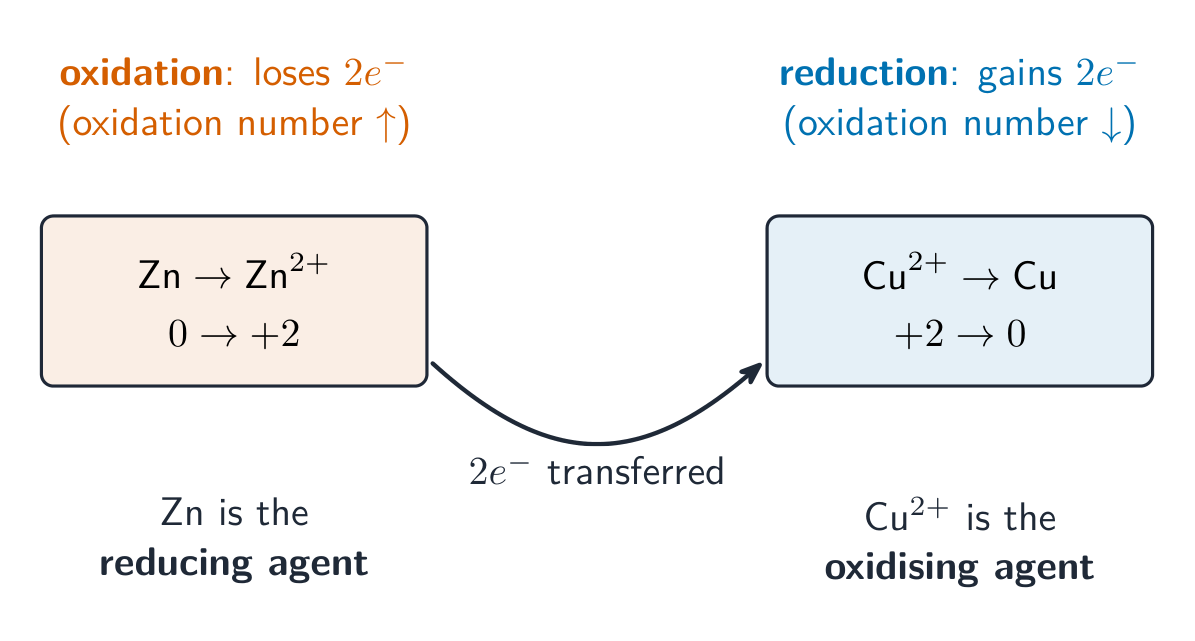
氧化还原是电子转移:还原剂被氧化,氧化剂被还原
Counting the electrons moved · 数一数转移的电子
Watch the electrons hand over: the oxidising agent takes them, the reducing agent gives them — balance the half-equations so the electrons cancel. · 看电子的交接:氧化剂取走电子,还原剂给出电子——配平半反应式,让电子相互抵消。
When balancing a redox equation using oxidation numbers: · 当使用氧化数配平一个氧化还原方程时:
Every electron lost is gained, so the total increase in oxidation number equals the total decrease. · 失去的每个电子都被得到,所以氧化数的总增加等于总减少。
Disproportionation
- Disproportionation is when the same element is both oxidised and reduced at once.
- E.g. chlorine + cold water: some Cl atoms are reduced to $\text{Cl}^{-}$ ($-1$) and others oxidised to $\text{ClO}^{-}$ ($+1$).
歧化
- 歧化是当同一个元素同时既被氧化又被还原。
- 例如氯 + 冷水:一些 Cl 原子被还原成 $\text{Cl}^{-}$($-1$),另一些被氧化成 $\text{ClO}^{-}$($+1$)。
Disproportionation is a reaction in which: · 歧化是这样一个反应,其中:
In disproportionation one element goes both up and down in oxidation number (e.g. Cl₂ → Cl⁻ and ClO⁻). · 在歧化中一个元素的氧化数既上升又下降(例如 Cl₂ → Cl⁻ 和 ClO⁻)。
Match each redox term to its meaning. · 把每个氧化还原术语匹配到它的含义。
Each item links the term to its correct meaning. · 每一项把术语链接到它正确的含义。
Oxidising and reducing agents
- an oxidising agent takes electrons from another species — so it is itself reduced.
- a reducing agent gives electrons to another species — so it is itself oxidised.
氧化剂和还原剂
- 一个氧化剂(oxidising agent)从另一个物种取走电子——所以它自己被还原。
- 一个还原剂(reducing agent)给另一个物种电子——所以它自己被氧化。
An oxidising agent: · 一个氧化剂:
An oxidising agent removes electrons from another species, so it gains electrons and is reduced itself. · 一个氧化剂从另一个物种移除电子,所以它得到电子并且自己被还原。
A reducing agent: · 一个还原剂:
A reducing agent donates electrons, causing reduction of the other species while being oxidised itself. · 一个还原剂提供电子,引起另一个物种的还原,同时自己被氧化。
You've got it
- balance redox by making the total rise = total fall in oxidation number
- disproportionation: the same element is both oxidised and reduced (Cl₂ → Cl⁻ + ClO⁻)
- oxidising agent takes electrons (itself reduced); reducing agent gives electrons (itself oxidised)
你掌握了
- 通过使氧化数的总上升 = 总下降来配平氧化还原
- 歧化:同一个元素既被氧化又被还原(Cl₂ → Cl⁻ + ClO⁻)
- 氧化剂取走电子(自己被还原);还原剂给出电子(自己被氧化)