Dot-and-cross diagrams · 点叉图
| English | 中文 | Pinyin · 拼音 |
|---|---|---|
| dot-and-cross diagram/dɒt ænd krɒs ˈdaɪəɡræm/ | 点叉图 | diǎn chā tú |
| expanded octet/ekˈspændɪd ɒkˈtet/ | 扩展八隅 | kuò zhǎn bā yú |
| bonding pair/ˈbɒndɪŋ peə/ | 成键电子对 | chéng jiàn diàn zi duì |
| lone pair/ləʊn peə/ | 孤对电子 | gū duì diàn zi |
| triple bond/ˈtrɪpl bɒnd/ | 三键 | sān jiàn |
Drawing the electrons
- A dot-and-cross diagram 点叉图 shows the outer electrons of each atom.
- Dots for one atom, crosses for the other.
- This makes it clear where each bonding electron came from.
把电子画出来
- 点叉图(dot-and-cross diagram) 显示每个原子的外层电子。
- 一个原子用点,另一个用叉。
- 这清楚地表明 每个成键电子来自哪里。
A dot-and-cross diagram uses dots and crosses to: · 一个点叉图用点和叉来:
Different symbols (dots/crosses) track which atom each outer electron came from. · 不同的符号(点/叉)追踪每个外层电子来自哪个原子。
A dot-and-cross diagram shows the outer electrons of each atom in a bond. · 一个点叉图显示一个键中每个原子的外层电子。
Dots and crosses distinguish the atoms' electrons. · 点和叉区分这些原子的电子。
What they can show
- You can draw them for ionic, covalent and coordinate bonding.
- They also handle molecules with an expanded octet 扩展八隅 or an odd number of electrons.
它们能显示什么
- 你可以为 离子、共价 和 配位 键合画它们。
- 它们也能处理有 扩展八隅体 或 奇数 电子的分子。
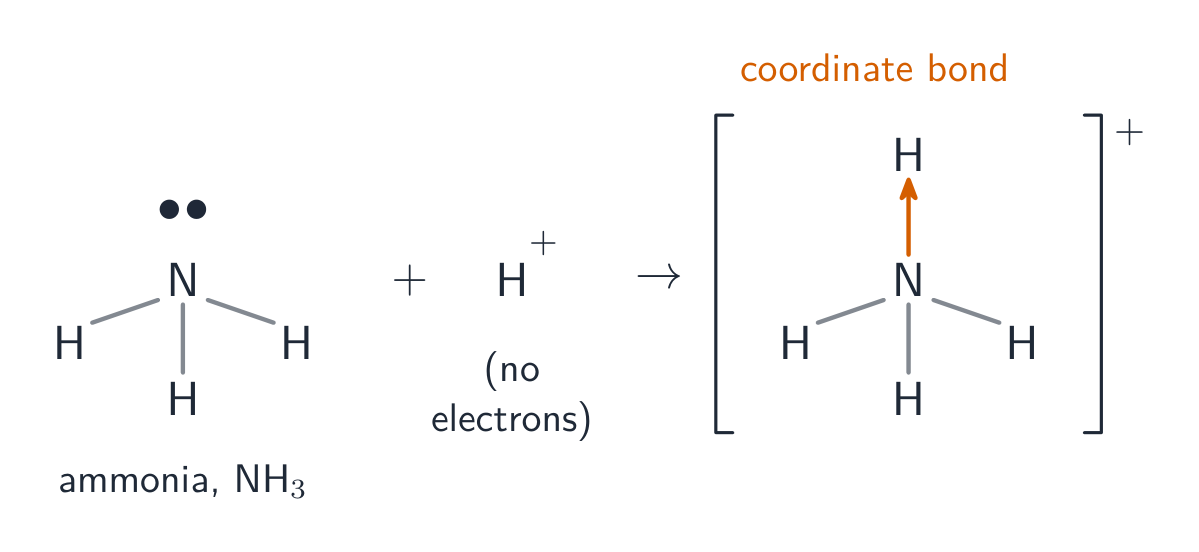
一个配位键:氨的孤对与 H+ 成键形成铵离子
Dot-and-cross diagrams can be drawn for: · 点叉图可以为以下画出:
They work for all three, including expanded-octet and odd-electron species. · 它们对全部三种都有效,包括扩展八隅体和奇数电子的物种。
Match each dot-and-cross term to its meaning. · 把每个点叉图术语与它的含义配对。
Dots and crosses track which atom each electron came from; lone pairs shape the molecule. · 点和叉追踪每个电子来自哪个原子;孤对决定分子的形状。
Worked examples
- Water: oxygen has two bonding pairs 成键电子对 and two lone pairs 孤对电子.
- Nitrogen ($\text{N}_2$): the atoms share three pairs (a triple bond 三键), with a lone pair on each.
Water (two bonding + two lone pairs on O) and nitrogen (a triple bond) drawn with dots and crosses.
例题
- 水:氧有 两个成键对 和 两个孤对。
- 氮($\text{N}_2$):这两个原子共享 三对(一个三键),每个上有一个孤对。
Shape from bonding and lone pairs · 由成键对和孤对决定的形状
Count the bonding pairs and lone pairs around the central atom; they repel into the shape with least strain. Three bonds and one lone pair give a pyramid, like ammonia (NH3). · 数一数中心原子周围的成键对和孤对;它们互相排斥成应变最小的形状。三个键和一个孤对给出一个锥形,像氨(NH3)。
In the dot-and-cross diagram of water, the oxygen atom has: · 在水的点叉图中,氧原子有:
Oxygen forms two O–H bonds (two bonding pairs) and keeps two lone pairs. · 氧形成两个 O–H 键(两个成键对),并保留两个孤对。
The dot-and-cross diagram of N₂ shows: · N₂ 的点叉图显示:
Nitrogen molecules share three pairs of electrons (a triple bond) plus a lone pair on each atom. · 氮分子共享三对电子(一个三键),每个原子上还有一个孤对。
Common dot-and-cross slips
- Show only the outer-shell electrons, and make sure each atom reaches a full shell.
- For ions, draw square brackets and the charge outside.
常见的点叉图失误
- 只显示 外壳层 电子,并确保每个原子达到一个充满的壳层。
- 对离子,画方括号,电荷 放在外面。
You've got it
- dot-and-cross = outer electrons, dots for one atom and crosses for the other
- shows where each bonding electron came from; works for ionic, covalent and coordinate bonds
- water = 2 bonding + 2 lone pairs on O; $\text{N}_2$ = 3 shared pairs (triple bond)
你掌握了
- 点叉图 = 外层电子,一个原子用 点,另一个用 叉
- 显示每个成键电子来自哪里;对 离子、共价和配位 键都有效
- 水 = O 上 2 个成键对 + 2 个孤对;$\text{N}_2$ = 3 个共享对(三键)