The gaseous state · 气态
| English | 中文 | Pinyin · 拼音 |
|---|---|---|
| collide/kəˈlaɪd/ | 碰撞 | pèng zhuàng |
| pressure/ˈpreʃə/ | 压强 | yā qiáng |
| real gas/rɪəl ɡæs/ | 实际气体 | shí jì qì tǐ |
| ideal gas/aɪˈdɪəl ɡæs/ | 理想气体 | lǐ xiǎng qì tǐ |
| molar mass/ˈməʊlə mæs/ | 摩尔质量 | mó ěr zhì liàng |
The freedom of gases
- Gas molecules move fast in all directions and collide 碰撞 with the walls.
- The many tiny pushes add up to the gas pressure 压强.
- We model gases as ideal to make calculations simple.
气体的自由
- 气体分子向各个方向快速运动,并与器壁 碰撞。
- 许多微小的推力加起来成为气体 压强。
- 我们把气体建模为 理想 的,以使计算简单。
Gas pressure is caused by: · 气体压强由以下引起:
Each collision with the wall gives a tiny push; the many pushes add up to the pressure. · 每次与壁的碰撞给出一个微小的推力;许多推力加起来成为压强。
Ideal vs real gases 实际气体
- An ideal gas 理想气体 assumes: the particles take up zero volume, and there are no forces between them.
- A real gas follows this closely at low pressure and high temperature.
- It behaves least ideally at high pressure and low temperature (particles crowded, forces matter).
The ideal-gas model: point particles of zero volume with no forces between them
Boiling turns liquid water into steam, a change between states of matter
理想气体与真实气体
- 理想气体(ideal gas) 假设:粒子占据 零体积,而且它们之间 没有作用力。
- 真实气体(real gas) 在 低压 和 高温 下很接近地遵循这一点。
- 它在 高压 和 低温 下 最不 理想(粒子拥挤,作用力重要)。
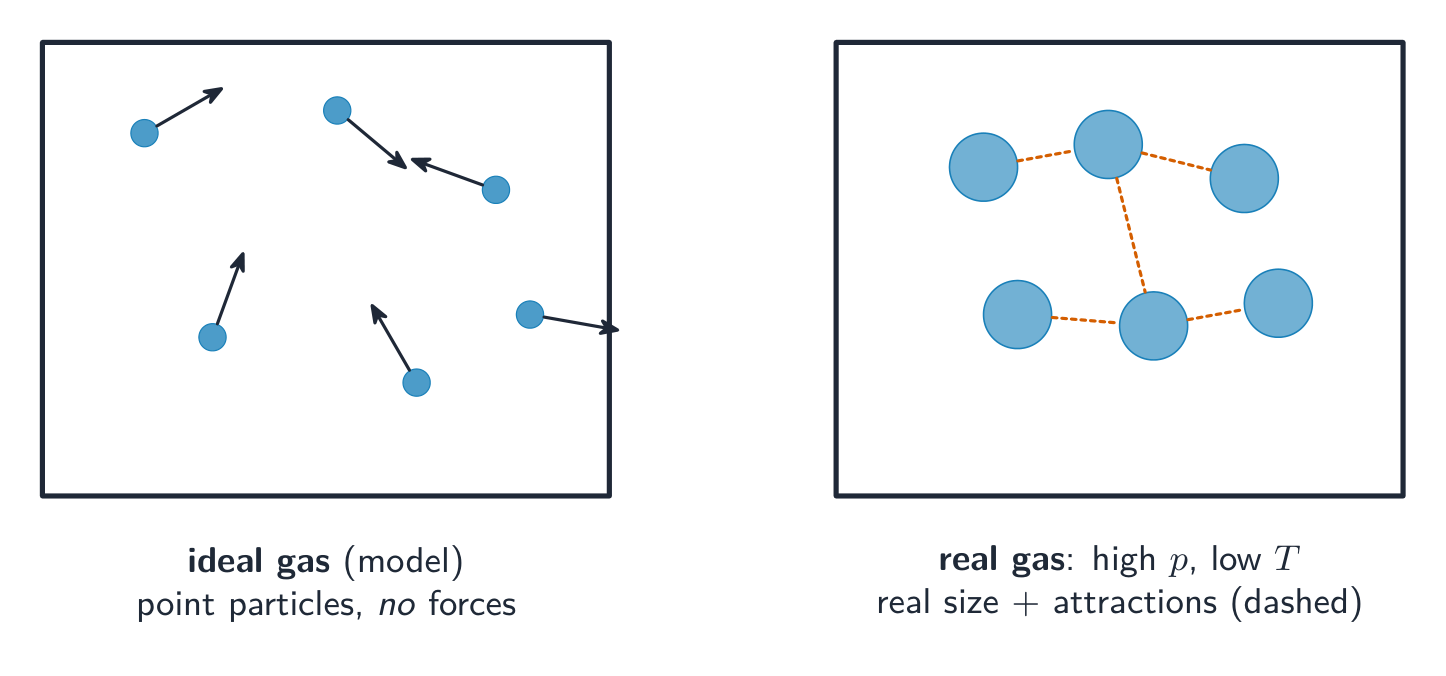
理想气体模型:零体积的点粒子,之间没有作用力
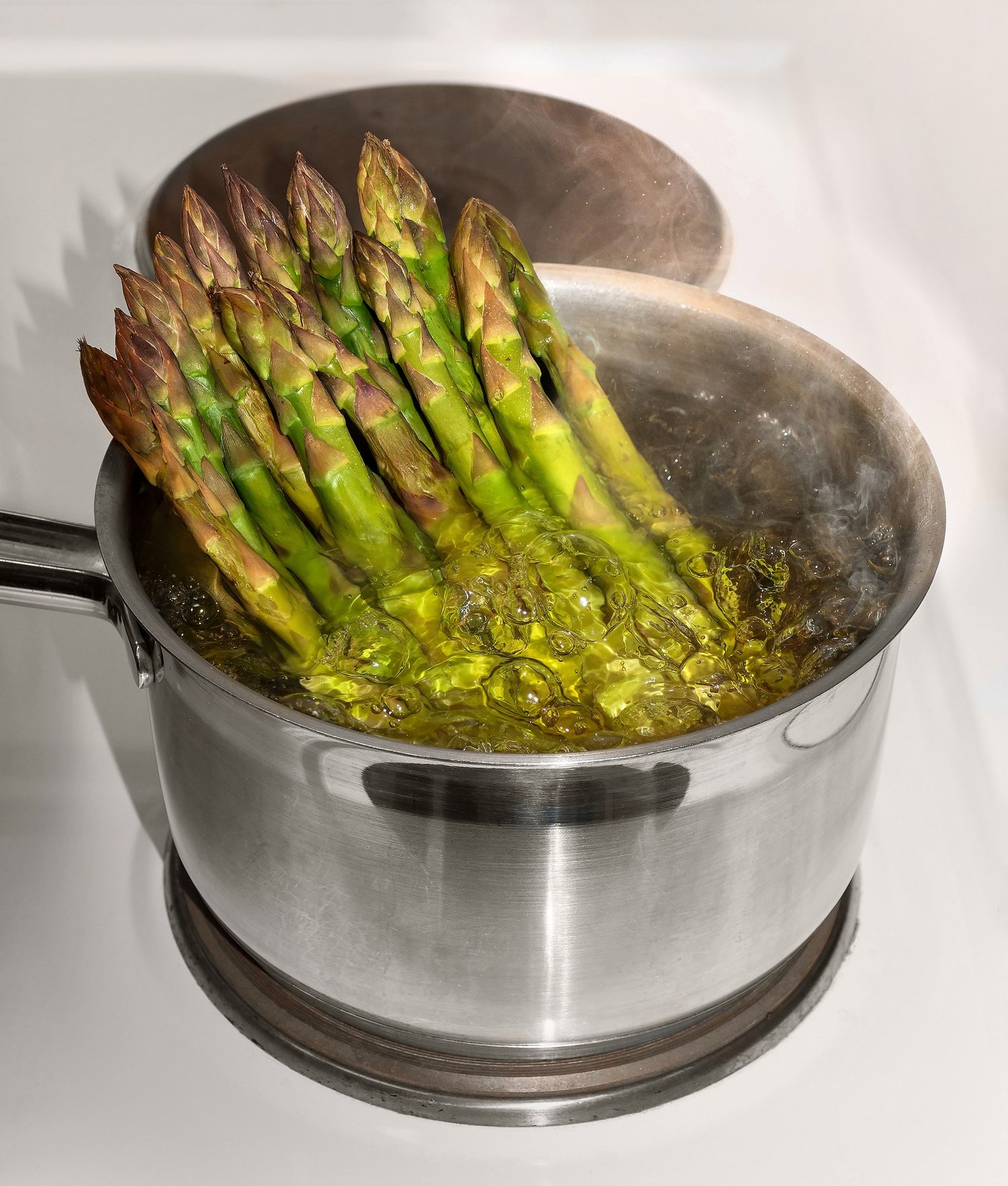
沸腾把液态水变成蒸汽,一种物态之间的变化
The gaseous state · 气态
p = k / V
Boyle's law: at constant temperature pressure ∝ 1/volume. · 玻意耳定律:在恒定温度下压强 ∝ 1/体积。
An ideal gas is assumed to have: · 理想气体被假设有:
The ideal-gas model assumes point particles (zero volume) with no intermolecular forces. · 理想气体模型假设点粒子(零体积),没有分子间作用力。
A real gas behaves LEAST like an ideal gas at: · 真实气体在以下条件下最不像理想气体:
At high pressure and low temperature the particles are crowded, so their size and attractions matter. · 在高压和低温下粒子拥挤,所以它们的大小和吸引力重要。
Match each gas idea to its meaning. · 把每个气体概念与它的含义配对。
Pressure comes from collisions; an ideal gas ignores particle volume and forces; pV = nRT links them. · 压强来自碰撞;理想气体忽略粒子体积和作用力;pV = nRT 把它们联系起来。
An ideal gas is assumed to have no forces between its particles and particles of negligible volume; real gases deviate most at high pressure and low temperature. · 理想气体被假设粒子间没有作用力、粒子体积可忽略;真实气体在高压和低温时偏差最大。
At high pressure and low temperature the particles are close, so their real volume and attractions matter. · 在高压和低温下粒子靠得很近,所以它们真实的体积和吸引力变得重要。
The ideal gas equation
- $p$ in Pa, $V$ in $\text{m}^3$, $n$ in mol, $T$ in kelvin (K), $R = 8.31\ \text{J}/(\text{K}\cdot\text{mol})$.
- Convert first: °C → K (add 273), and $\text{cm}^3$/$\text{dm}^3$ → $\text{m}^3$.
Gas pressure comes from many fast molecules colliding with the container walls
理想气体方程
- $p$ 单位 Pa,$V$ 单位 $\text{m}^3$,$n$ 单位 mol,$T$ 单位 开尔文(K),$R = 8.31\ \text{J}/(\text{K}\cdot\text{mol})$。
- 先换算:°C → K(加 273),以及 $\text{cm}^3$/$\text{dm}^3$ → $\text{m}^3$。
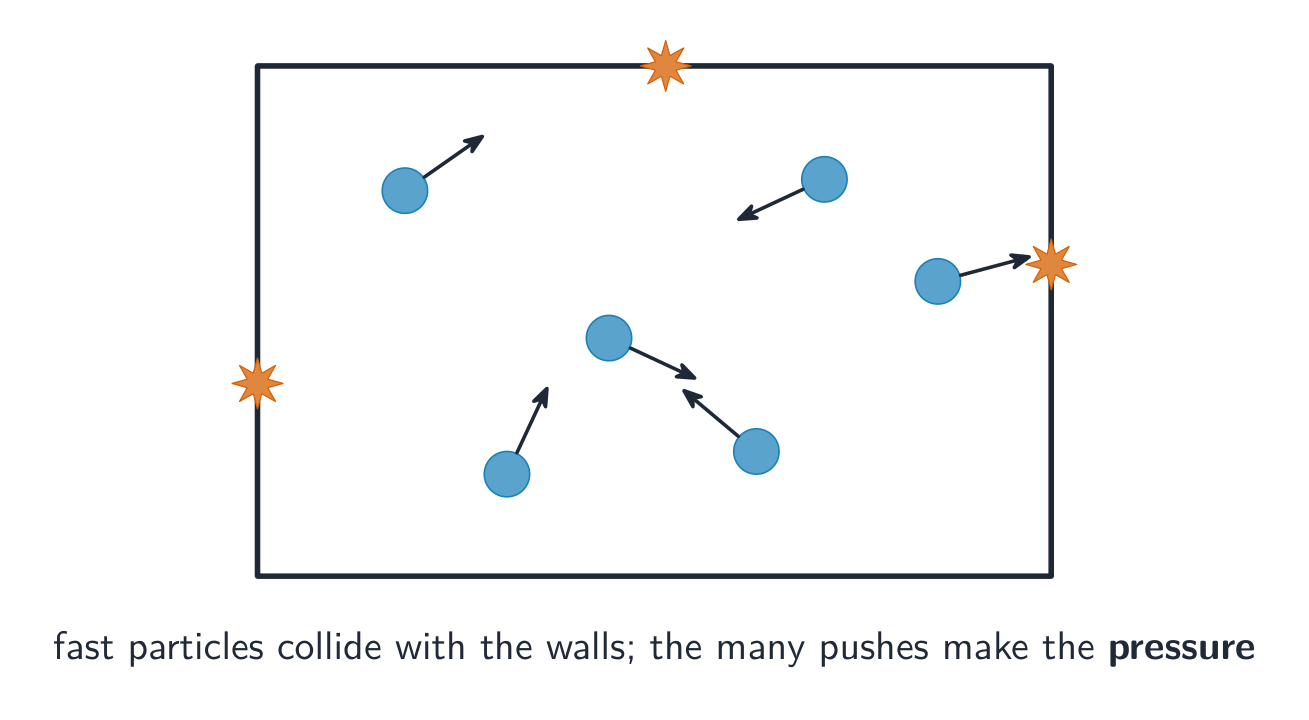
气体压强来自许多快速分子与容器壁的碰撞
In pV = nRT, the temperature T must be in: · 在 pV = nRT 中,温度 T 必须用:
T must be in kelvin; convert °C to K by adding 273 (and volumes to m³). · T 必须用开尔文;把 °C 换成 K 要加 273(并把体积换成 m³)。
Finding molar mass 摩尔质量
Since $n = m/M$:
- This finds $M_r$ from the mass (or density) of a gas.
求摩尔质量
因为 $n = m/M$:
- 这从一种气体的质量(或密度)求出 $M_r$。
Which equation gives the molar mass of a gas? · 哪个方程给出一种气体的摩尔质量?
From pV = (m/M)RT, rearranging gives M = mRT/(pV). · 由 pV = (m/M)RT,变形得到 M = mRT/(pV)。
You've got it
- gas pressure = sum of molecule–wall collisions
- ideal gas: zero particle volume, no forces; real gases deviate at high P, low T
- $pV = nRT$ (T in K, convert units first; $R = 8.31\ \text{J}/(\text{K}\cdot\text{mol})$)
- molar mass: $M = \dfrac{mRT}{pV}$
你掌握了
- 气体 压强 = 分子–器壁碰撞之和
- 理想气体:零粒子体积,无作用力;真实气体在 高压、低温 时偏离
- $pV = nRT$(T 单位 K,先换算单位;$R = 8.31\ \text{J}/(\text{K}\cdot\text{mol})$)
- 摩尔质量:$M = \dfrac{mRT}{pV}$