Shapes of molecules · 分子的形状
| English | 中文 | Pinyin · 拼音 |
|---|---|---|
| VSEPR theory/ˈvespə ˈθɪəri/ | 价层电子对互斥理论 | jià céng diàn zi duì hù chì lǐ lùn |
| lone pair/ləʊn peə/ | 孤对电子 | gū duì diàn zi |
| tetrahedral/ˌtetrəˈhiːdrəl/ | 四面体形 | sì miàn tǐ xíng |
| bonding pair/ˈbɒndɪŋ peə/ | 成键电子对 | chéng jiàn diàn zi duì |
| bond angle/bɒnd ˈæŋɡl/ | 键角 | jiàn jiǎo |
| octahedral/ˌɒktəˈhiːdrəl/ | 八面体形 | bā miàn tǐ xíng |
Why molecules have shape
- To predict a shape, use VSEPR theory 价层电子对互斥理论.
- Electron pairs around the central atom push apart as far as possible.
- Lone pairs 孤对电子 push hardest, squeezing the angles.
为什么分子有形状
- 要预测一个形状,用 VSEPR 理论(VSEPR theory)。
- 中心原子周围的电子对尽可能地 推开。
- 孤对推得最厉害,挤压角度。
VSEPR theory says the shape of a molecule is set by: · VSEPR 理论说一个分子的形状由以下决定:
Like charges repel, so the electron pairs push apart to minimise repulsion, fixing the shape. · 同种电荷互相排斥,所以电子对推开以使排斥最小,从而确定形状。
A molecule with four bonding pairs and no lone pairs (e.g. methane) is: · 一个有四个成键对、没有孤对的分子(例如甲烷)是:
Four pairs repel to ~109.5°. · 四对排斥到约 109.5°。
Lone pairs push harder
- A lone pair (not in a bond) repels more strongly than a bonding pair 成键电子对.
- Each lone pair squeezes the bond angle 键角 by about $2.5°$.
- That's why $\text{NH}_3$ ($107°$) and $\text{H}_2\text{O}$ ($104.5°$) have smaller angles than $\text{CH}_4$ ($109.5°$).
A molecular model shows the shape of a covalent molecule
孤对推得更厉害
- 孤对(lone pair)(不在键中的)比 成键对(bonding pair) 排斥更强。
- 每个孤对把 键角 挤小约 $2.5°$。
- 这就是为什么 $\text{NH}_3$($107°$)和 $\text{H}_2\text{O}$($104.5°$)的角比 $\text{CH}_4$($109.5°$)小。
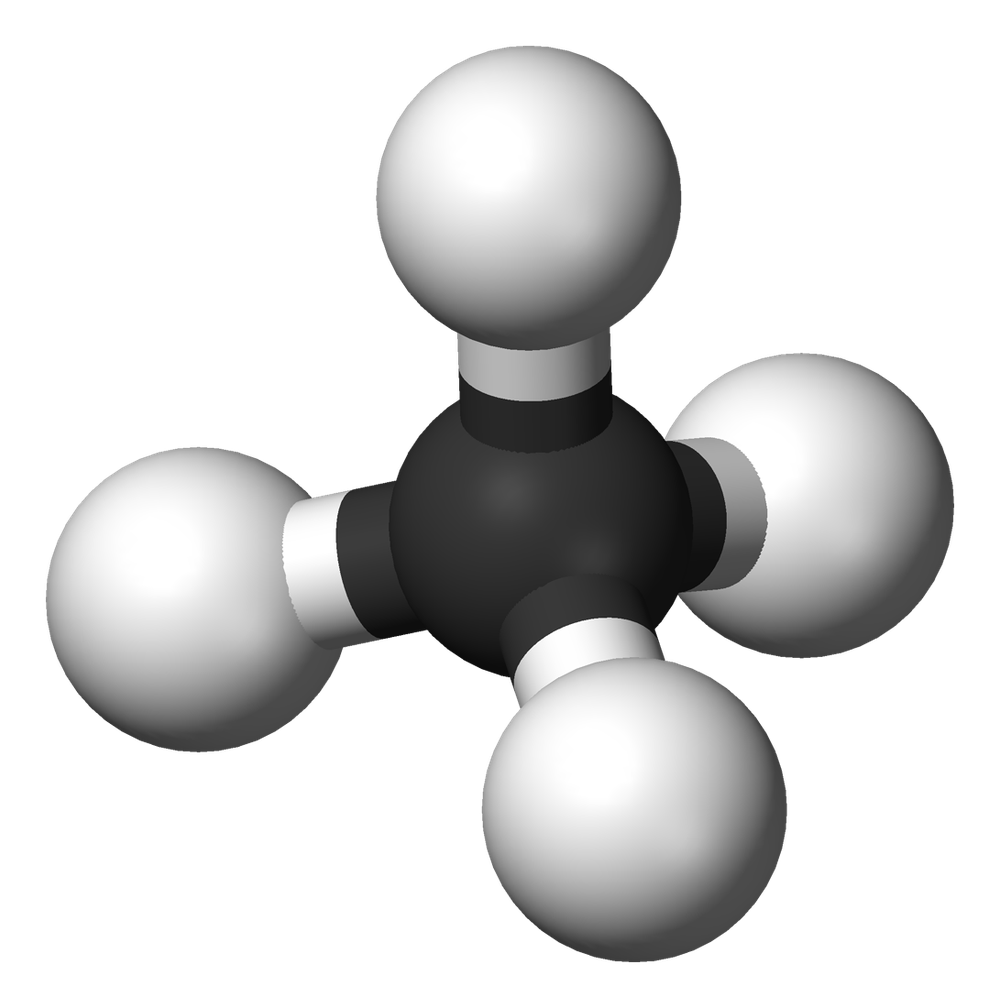
一个分子模型显示一个共价分子的形状
Shapes of molecules · 分子的形状
electron pairs repel (VSEPR) · 电子对互相排斥(VSEPR)
Electron pairs spread out as far as possible; lone pairs · 孤电子对 squeeze the bond angle. · 电子对尽可能分散开;孤对 挤压键角。
Why is the bond angle in water (104.5°) smaller than in methane (109.5°)? · 为什么水中的键角(104.5°)比甲烷中的(109.5°)小?
Lone pairs repel more than bonding pairs; water's two lone pairs squeeze the H–O–H angle below 109.5°. · 孤对比成键对排斥更多;水的两个孤对把 H–O–H 角挤到 109.5° 以下。
The shapes
| Molecule | Shape | Angle |
|---|---|---|
| $\text{CO}_2$ | linear | $180°$ |
| $\text{BF}_3$ | trigonal planar | $120°$ |
| $\text{CH}_4$ | tetrahedral 四面体形 | $109.5°$ |
| $\text{NH}_3$ | pyramidal | $107°$ |
| $\text{H}_2\text{O}$ | bent | $104.5°$ |
| $\text{SF}_6$ | octahedral 八面体形 | $90°$ |
The common VSEPR shapes, from linear (180°) to octahedral (90°)
这些形状
| 分子 | 形状 | 角度 |
|---|---|---|
| $\text{CO}_2$ | 直线形 | $180°$ |
| $\text{BF}_3$ | 平面三角形 | $120°$ |
| $\text{CH}_4$ | 四面体形 | $109.5°$ |
| $\text{NH}_3$ | 三角锥形 | $107°$ |
| $\text{H}_2\text{O}$ | 角形 | $104.5°$ |
| $\text{SF}_6$ | 八面体形 | $90°$ |
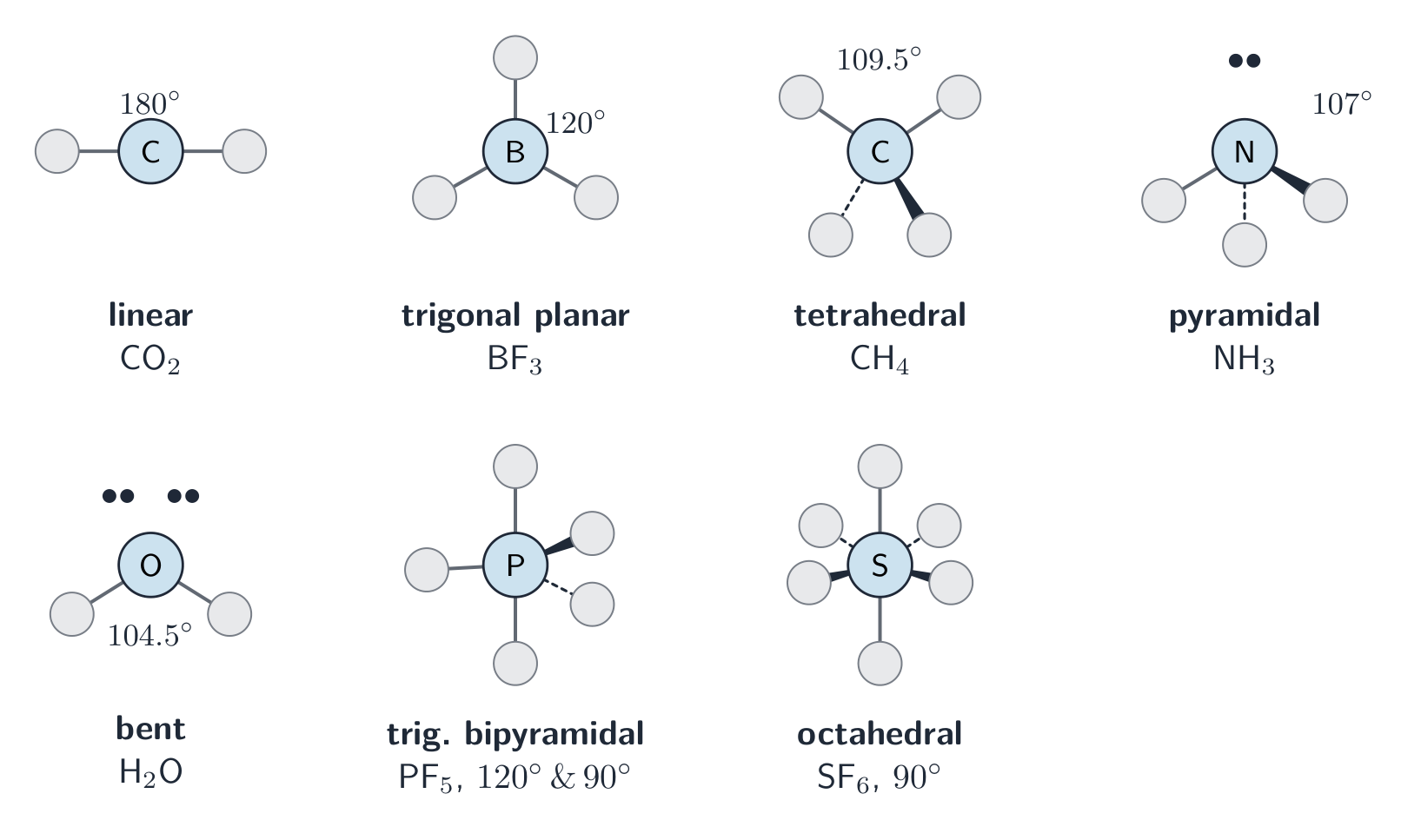
常见的 VSEPR 形状,从直线形(180°)到八面体形(90°)
Methane (CH₄) is: · 甲烷(CH₄)是:
Four bonding pairs and no lone pairs give a tetrahedral shape at 109.5°. · 四个成键对、没有孤对给出 109.5° 的四面体形。
Match each molecule to its shape. · 把每个分子与它的形状配对。
CO₂ = linear (180°); BF₃ = trigonal planar (120°); NH₃ = pyramidal (107°). · CO₂ = 直线形(180°);BF₃ = 平面三角形(120°);NH₃ = 三角锥形(107°)。
Match each electron arrangement to its shape. · 把每种电子排布与它的形状配对。
Electron pairs repel to spread out; lone pairs repel more, so they shrink the angle. · 电子对相互排斥而散开;孤对排斥更强,所以缩小键角。
VSEPR predicts a molecule's shape from the number of electron pairs around the central atom, and lone pairs repel more strongly than bonding pairs. · VSEPR 从中心原子周围的电子对数目预测分子的形状,而孤对比成键对排斥更强。
That extra lone-pair repulsion is why water (104.5°) has a smaller angle than methane (109.5°). · 正是这额外的孤对排斥,使水(104.5°)的键角比甲烷(109.5°)更小。
Don't forget lone pairs
- Lone pairs repel more than bonding pairs, so they squeeze bond angles down.
- Water (2 lone pairs) is bent at ~104.5°; ammonia (1 lone pair) is ~107°.
别忘了孤对
- 孤对比成键对排斥更多,所以它们把键角挤小。
- 水(2 个孤对)是角形,约 104.5°;氨(1 个孤对)约 107°。
You've got it
- VSEPR: electron pairs repel and spread out as far as possible
- lone pairs push harder than bonding pairs (≈ $2.5°$ each)
- linear $180°$, trigonal planar $120°$, tetrahedral $109.5°$, pyramidal $107°$, bent $104.5°$, octahedral $90°$
你掌握了
- VSEPR:电子对互相排斥并尽可能分散开
- 孤对 比成键对推得更厉害(每个约 $2.5°$)
- 直线形 $180°$、平面三角形 $120°$、四面体形 $109.5°$、三角锥形 $107°$、角形 $104.5°$、八面体形 $90°$