Polarity and van der Waals forces · 极性与范德华力
| English | 中文 | Pinyin · 拼音 |
|---|---|---|
| intermolecular force/ˌɪntəməˈlekjʊlə fɔːs/ | 分子间力 | fèn zǐ jiān lì |
| dipole/ˈdaɪpəʊl/ | 偶极 | ǒu jí |
| polar/ˈpəʊlə/ | 极性 | jí xìng |
| non-polar/nɒn ˈpəʊlə/ | 非极性 | fēi jí xìng |
| van der Waals' forces/ˈvændɜː wɑːlz ˈfɔːsɪz/ | 范德华力 | fàn dé huá lì |
| London dispersion/ˈlʌndn dɪˈspɜːʃn/ | 伦敦色散 | lún dūn sè sàn |
Why some molecules stick
- Intermolecular forces 分子间力 act between molecules.
- They are much weaker than the bonds inside substances.
- They start with bond polarity.
为什么有些分子会粘在一起
- 分子间作用力(intermolecular forces) 作用在分子之间。
- 它们比物质内部的键 弱得多。
- 它们始于 键的极性。
Polarity and intermolecular forces lab · 极性与分子间作用力实验
Classify molecules by the feature that controls attractions. · 根据控制吸引力的特征对分子进行分类。
Compared with the bonds inside substances, intermolecular forces are: · 与物质内部的化学键相比,分子间作用力:
Intermolecular forces (between molecules) are far weaker than ionic, covalent or metallic bonds within substances. · 分子间作用力(分子之间)远弱于物质内部的离子键、共价键或金属键。
The weakest intermolecular forces, present between all molecules, are van der Waals (London) ______ forces. · 最弱的分子间作用力,存在于所有分子之间,是范德华(伦敦)______ 力。
Caused by temporary induced dipoles. · 由临时诱导偶极引起。
Polarity and dipoles 偶极
- When two atoms of different electronegativity bond, the electrons sit closer to the more electronegative one.
- This gives a dipole: one end slightly negative ($\delta-$), the other slightly positive ($\delta+$).
- If the dipoles don't cancel, the molecule is polar 极性; if they cancel by symmetry (like $\text{CO}_2$), it is non-polar 非极性.
Electronegativity rises across a period and falls down a group; fluorine is highest
极性和偶极
- 当两个电负性不同的原子成键时,电子坐得更靠近电负性更高的那个。
- 这给出一个 偶极(dipole):一端略负($\delta-$),另一端略正($\delta+$)。
- 如果偶极 不抵消,分子是 极性的;如果它们因对称而抵消(像 $\text{CO}_2$),它是 非极性的。

电负性沿一个周期上升、沿一个族向下下降;氟最高
A polar bond has: · 极性键具有:
Unequal sharing of electrons gives a dipole: δ− at the more electronegative end, δ+ at the other. · 电子的不均等共享产生偶极:电负性较强的一端为 δ−,另一端为 δ+。
CO₂ is non-polar even though its bonds are polar because: · CO₂ 是非极性分子,尽管其化学键是极性的,因为:
CO₂ is linear and symmetric, so the two bond dipoles point opposite ways and cancel. · CO₂ 呈线性且对称,因此两个键偶极方向相反并相互抵消。
Match each force to what it is. · 将每种力与其类型匹配。
Intermolecular forces, weakest to strongest: van der Waals, permanent dipole, hydrogen bond. · 分子间作用力,从弱到强:范德华力、永久偶极力、氢键。
Van der Waals' forces 范德华力
- Van der Waals' forces is the general name for intermolecular forces. Two types:
- London dispersion 伦敦色散 (instantaneous dipole–induced dipole): brief dipoles from moving electrons; act between all molecules and get stronger with more electrons.
- permanent dipole–permanent dipole: between molecules that are always polar.
A momentary dipole induces one in a neighbour — the London dispersion force between all molecules
范德华力
- 范德华力(Van der Waals' forces) 是分子间作用力的总称。两种类型:
- 伦敦色散力(London dispersion)(瞬时偶极–诱导偶极):由运动的电子产生的短暂偶极;作用在 所有 分子之间,并随 更多电子而变强。
- 永久偶极–永久偶极:作用在始终极性的分子之间。
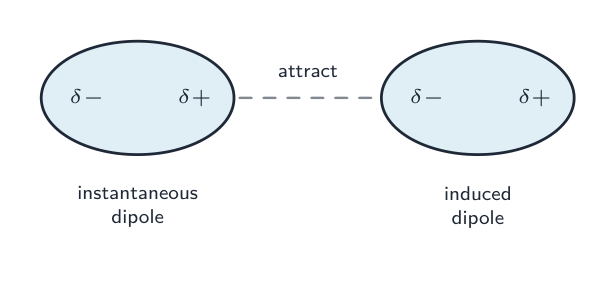
一个瞬时偶极在邻居中诱导出一个——所有分子之间的伦敦色散力
London dispersion forces get stronger when a molecule has: · 当分子具有:时,伦敦色散力增强。
More electrons give larger instantaneous dipoles, so London (dispersion) forces are stronger. · 更多电子产生更大的瞬时偶极,因此伦敦(色散)力更强。
Bigger molecules, stronger forces
- Van der Waals forces get stronger as the number of electrons (molecular size) rises.
- This is why boiling points increase down a homologous series of alkanes.
更大的分子,更强的力
- 范德华力随电子数(分子大小)上升而 变强。
- 这就是为什么沿烷烃同系列向下沸点升高。
You've got it
- intermolecular forces are weaker than the bonds inside substances
- a polar bond has $\delta-$ and $\delta+$ ends; a molecule is polar if its dipoles don't cancel ($\text{CO}_2$ cancels → non-polar)
- London dispersion acts between all molecules (stronger with more electrons); permanent dipole–dipole acts between polar molecules
你掌握了
- 分子间作用力 比物质内部的键弱
- 极性键 有 $\delta-$ 和 $\delta+$ 端;如果一个分子的偶极 不抵消,它是极性的($\text{CO}_2$ 抵消 → 非极性)
- 伦敦色散力 作用在所有分子之间(电子越多越强);永久偶极–偶极 作用在极性分子之间