The nerve impulse · 神经冲动
| English | 中文 | Pinyin · 拼音 |
|---|---|---|
| resting potential/ˈrestɪŋ pəˈtenʃl/ | 静息电位 | jìng xī diàn wèi |
| action potential/ˈækʃn pəˈtenʃl/ | 动作电位 | dòng zuò diàn wèi |
| depolarisation/diːˌpəʊləraɪˈzeɪʃn/ | 去极化 | qù jí huà |
| repolarisation/rɪˌpəʊləraɪˈzeɪʃn/ | 复极化 | fù jí huà |
| refractory period/rɪˈfræktəri ˈpɪərɪəd/ | 不应期 | bù yīng qī |
| myelin sheath/ˈmaɪɪlɪn ʃiːθ/ | 髓鞘 | suǐ qiào |
| saltatory conduction/ˈsɒltətəri kənˈdʌkʃn/ | 跳跃式传导 | tiào yuè shì chuán dǎo |
A wave of electricity
- An impulse is a change in the voltage across the neurone's membrane.
- At rest the inside is negative; an impulse flips it briefly positive.
- A fatty sheath can make it travel far faster.
一波电
- 一个冲动是神经元膜两侧 电压 的一个变化。
- 在静息时内部是负的;一个冲动短暂地把它翻成正的。
- 一层脂肪鞘能使它传播得快得多。
The brief reversal of charge across a neurone membrane is an action ______. · 神经元膜两侧电荷的短暂逆转是一个动作 ______。
It travels along the axon as the nerve impulse. · 它作为神经冲动沿轴突传播。
The resting potential 静息电位
- When no impulse passes, the inside is negative compared with the outside — the resting potential.
- It is kept this way by a pump that moves sodium out and potassium in, and by the membrane being more permeable to potassium.
静息电位
- 当没有冲动通过时,与外部相比内部是 负 的——静息电位(resting potential)。
- 它由一个把 钠移出、钾移入 的泵,以及膜对 钾 更可透,保持这样。
The nerve impulse · 神经冲动
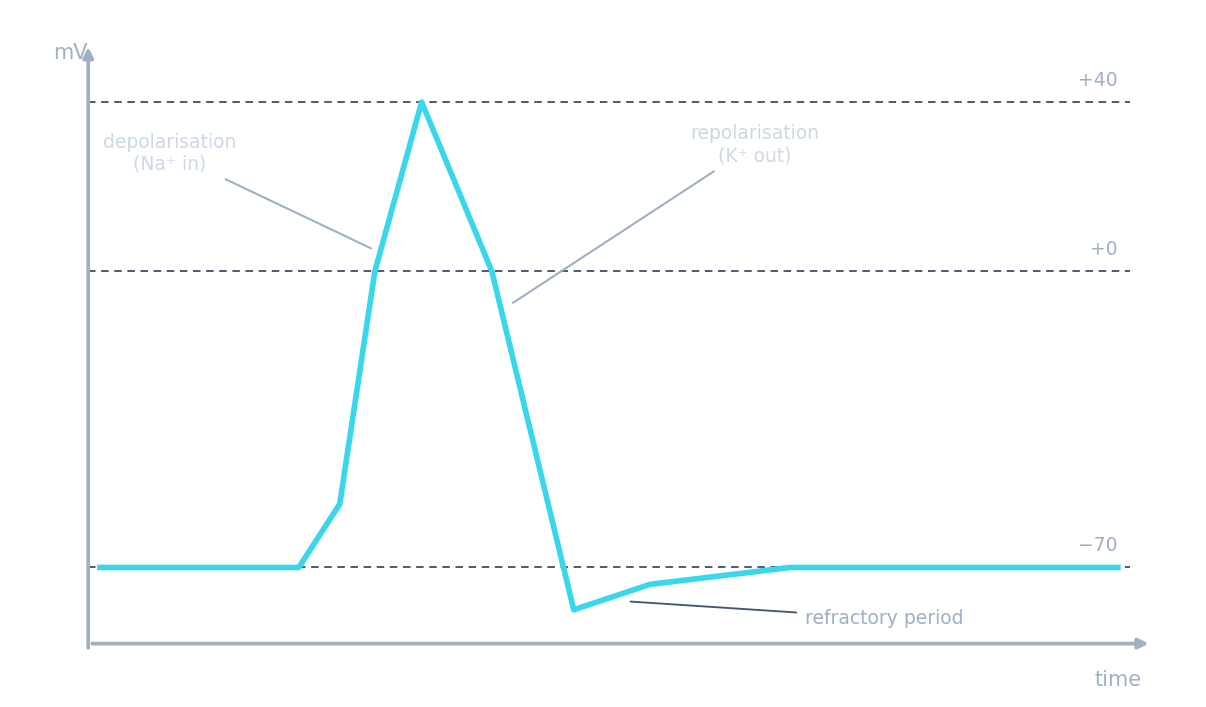
resting −70 → spike +40 mV · 静息 −70 → 峰值 +40 mV
Scrub the spike: Na⁺ floods in to depolarise, then K⁺ leaves to repolarise. · 拖动这个峰:Na⁺ 涌入以 去极化,然后 K⁺ 离开以 复极化。
At the resting potential, the inside of the neurone is: · 在静息电位时,神经元的内部是:
The resting potential keeps the inside negative, maintained by the Na⁺/K⁺ pump and K⁺ permeability. · 静息电位保持内部为负,由 Na⁺/K⁺ 泵和 K⁺ 可透性维持。
The action potential 动作电位
- A stimulus opens sodium channels → Na⁺ rushes in → inside briefly positive (depolarisation 去极化).
- Then potassium channels open → K⁺ leaves → the membrane returns to negative (repolarisation 复极化).
- A short refractory period 不应期 follows: sodium channels can't reopen, restoring rest and limiting how often impulses fire.
动作电位
- 一个刺激打开 钠通道 → Na⁺ 涌入 → 内部短暂地 变正(去极化(depolarisation))。
- 然后 钾通道 打开 → K⁺ 离开 → 膜恢复到负(复极化(repolarisation))。
- 一个短的 不应期(refractory period) 随后:钠通道不能重新打开,恢复静息并限制冲动多频繁地发放。
Depolarisation during an action potential is caused by: · 动作电位期间的去极化由以下引起:
Sodium channels open and Na⁺ floods in, reversing the charge (depolarisation); then K⁺ leaves to repolarise. · 钠通道打开,Na⁺ 涌入,逆转电荷(去极化);然后 K⁺ 离开以复极化。
Put the action potential in order. · 把动作电位按顺序排列。
Rest → Na⁺ in (depolarise) → K⁺ out (repolarise) → reset. The spike is brief and all-or-nothing. · 静息 → Na⁺ 进入(去极化)→ K⁺ 出去(复极化)→ 重置。这个峰短暂且全或无。
Match each phase to what is happening. · 把每个阶段与正在发生的事配对。
Na⁺ in flips the charge; K⁺ out restores it; the refractory period stops a backward impulse. · Na⁺ 进入翻转电荷;K⁺ 出去恢复它;不应期阻止一个向后的冲动。
The refractory period resets the neurone and limits how often impulses can fire. · 不应期重置神经元并限制冲动多频繁地发放。
Sodium channels cannot reopen for a moment, so the neurone resets and impulses stay separate and one-way. · 钠通道有一会儿不能重新打开,所以神经元重置,冲动保持分开和单向。
Faster: myelin
- Some axons are wrapped in a fatty myelin sheath 髓鞘 that the impulse cannot cross.
- So the impulse jumps from one gap (node) to the next — saltatory conduction 跳跃式传导 — travelling much faster.
Saltatory conduction: the impulse jumps between the gaps in the myelin
更快:髓鞘
- 一些轴突被一层冲动无法穿过的脂肪 髓鞘(myelin sheath) 包裹。
- 所以冲动从一个间隙(结)跳 到下一个——跳跃式传导(saltatory conduction)——传播得快得多。

跳跃式传导:冲动在髓鞘的间隙之间跳跃
Saltatory conduction makes impulses faster because the impulse: · 跳跃式传导使冲动更快,因为冲动:
The impulse cannot cross the myelin, so it jumps node to node — much faster than along a bare axon. · 冲动无法穿过髓鞘,所以它从结跳到结——比沿一个裸轴突快得多。
You've got it
- resting potential: inside negative (Na⁺ pumped out, K⁺ in; membrane leaks K⁺)
- action potential: Na⁺ in → depolarisation (+); K⁺ out → repolarisation (−)
- refractory period: Na⁺ channels can't reopen → limits impulse frequency
- myelin → saltatory conduction (jumps node to node) → much faster
你掌握了
- 静息电位:内部负(Na⁺ 被泵出,K⁺ 进入;膜漏 K⁺)
- 动作电位:Na⁺ 进入 → 去极化(+);K⁺ 出去 → 复极化(−)
- 不应期:Na⁺ 通道不能重新打开 → 限制冲动频率
- 髓鞘 → 跳跃式传导(从结到结跳)→ 快得多