Investigation of limiting factors · 限制因素的探究
| English | 中文 | Pinyin · 拼音 |
|---|---|---|
| limiting factor/ˈlɪmɪtɪŋ ˈfæktə/ | 限制因素 | xiàn zhì yīn sù |
| light intensity/laɪt ɪnˈtensɪti/ | 光照强度 | guāng zhào qiáng dù |
| denature/ˈdenətʃə/ | 变性 | biàn xìng |
| greenhouse/ˈɡriːnhaʊs/ | 温室 | wēn shì |
What holds photosynthesis back?
- The rate of photosynthesis depends on conditions.
- A limiting factor 限制因素 is the one in shortest supply that holds the rate back.
- The three main ones: light intensity 光照强度, CO₂ concentration, and temperature.
什么拖住光合作用?
- 光合作用的速率取决于条件。
- 限制因素(limiting factor) 是 供应最短缺 的那个,它拖住速率。
- 三个主要的:光强度、CO₂ 浓度 和 温度。
A limiting factor is: · 一个限制因素是:
The limiting factor is whichever requirement is in shortest supply, capping the overall rate. · 限制因素是供应最短缺的那个需求,给总速率封顶。
Adding carbon dioxide can raise the rate of photosynthesis when CO₂ is the limiting factor. · 当 CO₂ 是限制因素时,加二氧化碳能提高光合作用的速率。
Only the factor in shortest supply limits the rate, so increasing it speeds things up. · 只有供应最短缺的因素限制速率,所以增加它会加快进度。
Reading the graph
- Raising light speeds photosynthesis — until another factor becomes limiting.
- Raising CO₂ speeds it — until another factor becomes limiting.
- Raising temperature speeds it — but only to an optimum; too hot and the enzymes denature 变性.
- While the line rises, light is limiting. Where it levels off, something else (CO₂ or temperature) is.
读图
- 提高 光 加快光合作用——直到另一个因素变成限制性的。
- 提高 CO₂ 加快它——直到另一个因素变成限制性的。
- 提高 温度 加快它——但只到一个 最适点;太热酶就 变性。
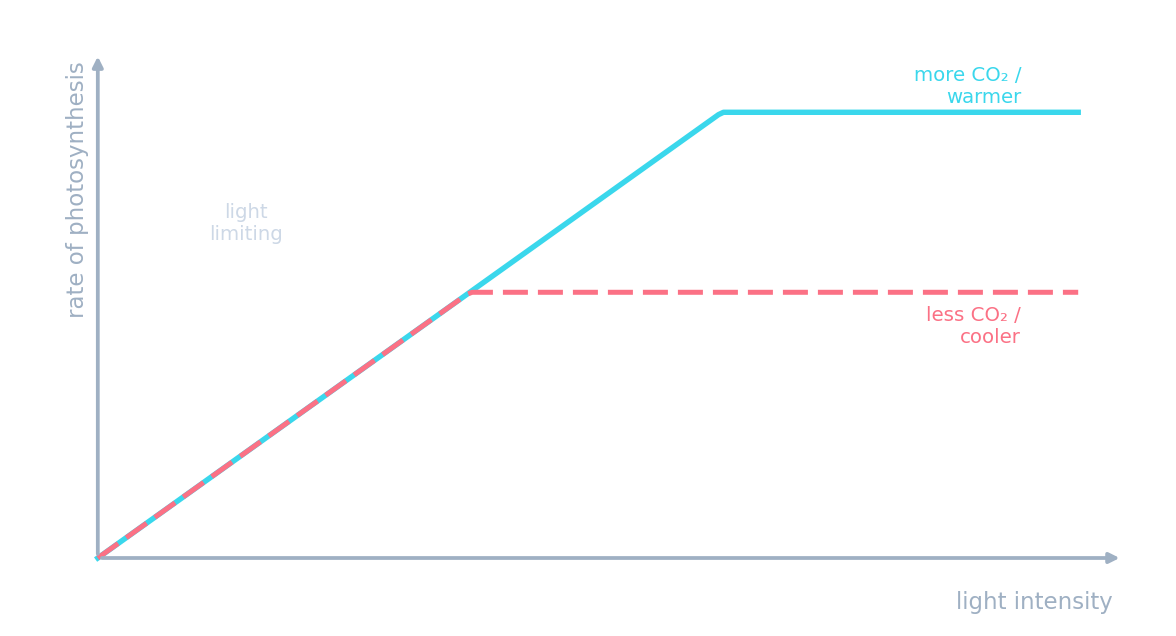
- 当线 上升 时,光是限制性的。它 变平 的地方,是另一个东西(CO₂ 或温度)。
Limiting factors · 限制因素
rate rises, then plateaus · 速率上升,然后达到平台
Drag the sliders. More light speeds photosynthesis — until CO₂ or temperature caps it (the plateau). · 拖动滑块。更多的光加快光合作用——直到 CO₂ 或温度 给它封顶(平台)。
On a graph of rate against light intensity, where the line levels off: · 在速率对光强度的图上,线变平的地方:
While the rate rises, light limits it; once it plateaus, light is plentiful and something else limits the rate. · 当速率上升时,光限制它;一旦它达到平台,光充足了,别的东西限制速率。
Why does raising temperature only speed photosynthesis up to a point? · 为什么提高温度只在一定程度上加快光合作用?
Higher temperature speeds the enzyme reactions until the optimum; beyond it, the enzymes denature and the rate falls. · 更高的温度加快酶反应直到最适点;超过它,酶变性,速率下降。
Match each factor to its role in photosynthesis. · 把每个因素与它在光合作用中的作用配对。
Light powers the light reactions, CO₂ feeds the Calvin cycle, temperature controls the enzymes — the scarcest one caps the rate. · 光为光反应提供动力,CO₂ 供给卡尔文循环,温度控制酶——最稀缺的那个给速率封顶。
Measuring the rate
- Use a redox indicator (DCPIP / methylene blue) with a suspension of chloroplasts: the dye loses colour as they work — test different light intensities or wavelengths.
- With a whole aquatic plant, count the oxygen bubbles given off to compare conditions.
测量速率
- 用一个氧化还原 指示剂(DCPIP / 亚甲蓝)加一份 叶绿体 悬浮液:染料在它们工作时失去颜色——测试不同的光强度或波长。
- 用一整株 水生植物,数放出的 氧气气泡 来比较条件。
One simple way to measure the rate of photosynthesis is to count the ______ bubbles given off by an aquatic plant. · 测量光合作用速率的一个简单方法是数一株水生植物放出的 ______ 气泡。
Oxygen is a product of photosynthesis; counting (or collecting) the bubbles tracks the rate. · 氧气是光合作用的一个产物;数(或收集)气泡可追踪速率。
Using limiting factors commercially
- Growers raise yields by removing the limiting factor in greenhouses 温室: adding light, warmth and extra CO₂.
Worked example. On a bright warm day, CO₂ is often limiting. A grower pipes extra CO₂ into the greenhouse, and the rate of photosynthesis — and the crop yield — rises.
在商业上利用限制因素
- 种植者通过在 温室 中移除限制因素来提高产量:增加光、温暖和额外的 CO₂。
例题。 在一个明亮温暖的日子,CO₂ 常常是限制性的。一个种植者把额外的 CO₂ 通入温室,光合作用的速率——以及作物产量——上升。
You've got it
- a limiting factor = the factor in shortest supply that caps the rate
- three factors: light intensity, CO₂ concentration, temperature
- on a rate-vs-light graph: rising = light limiting; plateau = another factor; too hot → enzymes denature
- measure with DCPIP/methylene blue + chloroplasts, or count O₂ bubbles from an aquatic plant
你掌握了
- 限制因素 = 供应最短缺、给速率封顶的因素
- 三个因素:光强度、CO₂ 浓度、温度
- 在速率对光的图上:上升 = 光限制;平台 = 另一个因素;太热 → 酶 变性
- 用 DCPIP/亚甲蓝 + 叶绿体测量,或从一株水生植物 数 O₂ 气泡