The Calvin cycle · 卡尔文循环
| English | 中文 | Pinyin · 拼音 |
|---|---|---|
| fixation/fɪkˈseɪʃn/ | 固定 | gù dìng |
| rubisco/ruːˈbɪskəʊ/ | 核酮糖二磷酸羧化酶 | hé tóng táng èr lín suān suō huà méi |
| RuBP/ruː ˌbiːˈpiː/ | 核酮糖二磷酸 | hé tóng táng èr lín suān |
| regeneration/riːˌdʒenəˈreɪʃn/ | 再生 | zài shēng |
| triose phosphate/ˈtraɪəʊs ˈfɒsfeɪt/ | 丙糖磷酸 | bǐng táng lín suān |
Building sugar from air
- The light-independent stage builds sugars in the stroma.
- It uses the ATP and reduced NADP made by the light stage.
- It runs as a cycle, in three main steps.
从空气建造糖
- 光非依赖阶段在 基质(stroma) 中建造糖。
- 它使用光阶段制造的 ATP 和 还原型 NADP。
- 它作为一个循环运行,分 三个 主要步骤。
Step 1: Fixation 固定
- The enzyme rubisco 核酮糖二磷酸羧化酶 joins carbon dioxide to a 5-carbon molecule, RuBP 核酮糖二磷酸 (ribulose bisphosphate).
- This makes two molecules of a 3-carbon compound, GP (glycerate 3-phosphate).
The Calvin cycle: fixation, reduction and regeneration 再生
步骤 1:固定
- 酶 rubisco(核酮糖二磷酸羧化酶)把 二氧化碳 连接到一个 5 碳分子 RuBP(核酮糖二磷酸)。
- 这制造 两 个 3 碳化合物 GP(甘油酸-3-磷酸)分子。
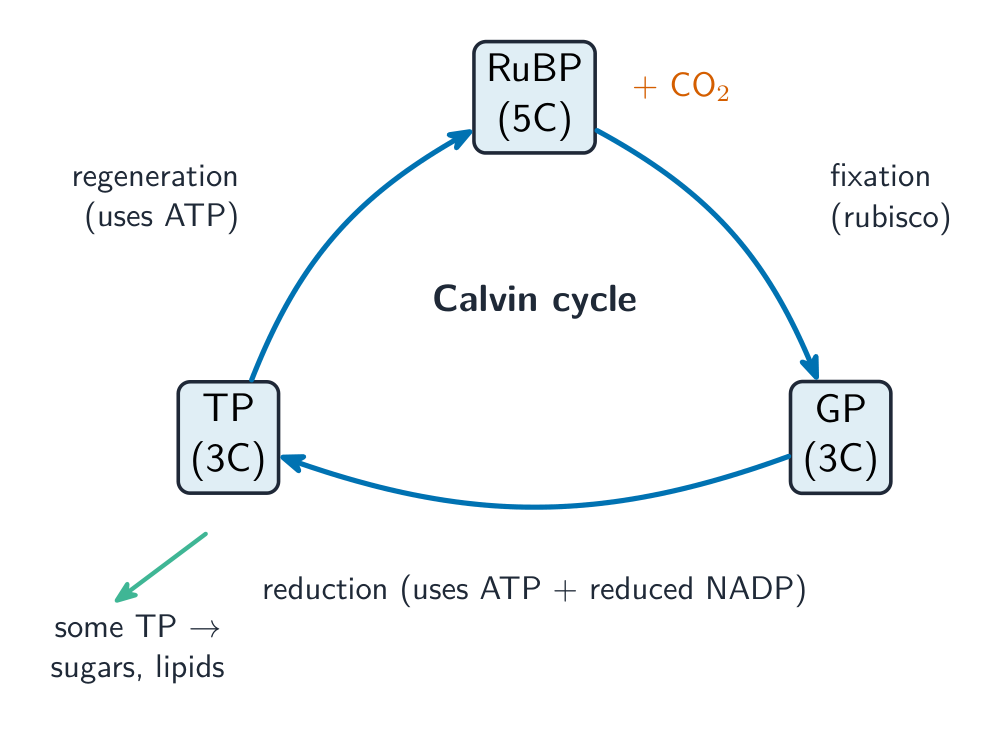
卡尔文循环:固定、还原和再生
The Calvin cycle · 卡尔文循环
Step around the cycle. CO₂ is fixed onto RuBP, reduced to sugar using the light-stage's ATP and NADP, and RuBP is regenerated. · 绕这个循环走。CO₂ 被固定到 RuBP 上,用光阶段的 ATP 和 NADP 被还原成糖,RuBP 被再生。
In fixation, the enzyme rubisco: · 在固定中,酶 rubisco:
Rubisco catalyses carbon fixation: CO₂ + RuBP → 2 GP. · Rubisco 催化碳固定:CO₂ + RuBP → 2 GP。
The enzyme that joins CO₂ to RuBP in the fixation step is ______. · 在固定步骤中把 CO₂ 连接到 RuBP 的酶是 ______。
Rubisco is the most abundant enzyme on Earth — it fixes nearly all the carbon in the living world. · Rubisco 是地球上最丰富的酶——它固定生命世界中几乎所有的碳。
The Calvin cycle is the light-independent stage; it uses the ATP and reduced NADP made by the light-dependent stage. · 卡尔文循环是光非依赖阶段;它使用光依赖阶段制造的 ATP 和还原型 NADP。
It does not need light directly, but it cannot run without the ATP and reduced NADP from the light reactions. · 它不直接需要光,但没有来自光反应的 ATP 和还原型 NADP 它就不能运行。
Steps 2 & 3: Reduction and regeneration
- Reduction: GP is reduced to TP (triose phosphate 丙糖磷酸), using reduced NADP and ATP.
- Regeneration: most TP is used (with more ATP) to regenerate RuBP, so the cycle keeps running.
步骤 2 和 3:还原和再生
- 还原:GP 用 还原型 NADP 和 ATP 被还原成 TP(磷酸丙糖)。
- 再生:大部分 TP 被用来(连同更多 ATP)再生 RuBP,所以循环持续运行。
GP is reduced to TP using: · GP 用以下被还原成 TP:
The reduction step uses the reduced NADP and ATP made in the light-dependent stage. · 还原步骤使用光依赖阶段制造的还原型 NADP 和 ATP。
Put the steps of the Calvin cycle in order. · 把卡尔文循环的步骤按顺序排列。
CO₂ is fixed onto RuBP (fixation) → GP reduced to TP (reduction) → RuBP regenerated (regeneration). · CO₂ 被固定到 RuBP 上(固定)→ GP 被还原成 TP(还原)→ RuBP 被再生(再生)。
Match each step or molecule to its role. · 把每个步骤或分子与它的作用配对。
Fix the carbon, reduce GP to sugar, then regenerate the RuBP acceptor so the cycle keeps turning. · 固定碳,把 GP 还原成糖,然后再生 RuBP 受体,所以循环持续转动。
Making useful molecules
- Some TP leaves the cycle to make carbohydrates, lipids and amino acids.
- GP can also be used to make some amino acids.
制造有用的分子
- 一些 TP 离开循环去制造 碳水化合物、脂质 和 氨基酸。
- GP 也能被用来制造一些 氨基酸。
What happens to the TP that leaves the cycle? · 离开循环的 TP 发生了什么?
TP that leaves the cycle builds useful molecules: carbohydrates, lipids and amino acids. · 离开循环的 TP 建造有用的分子:碳水化合物、脂质和氨基酸。
You've got it
- fixation: rubisco + CO₂ + RuBP (5C) → 2 GP (3C)
- reduction: GP → TP using reduced NADP + ATP
- regeneration: TP → RuBP (more ATP) to keep the cycle going
- some TP leaves → carbohydrates, lipids, amino acids
你掌握了
- 固定:rubisco + CO₂ + RuBP(5C) → 2 个 GP(3C)
- 还原:GP → TP,用 还原型 NADP + ATP
- 再生:TP → RuBP(更多 ATP)以保持循环运行
- 一些 TP 离开 → 碳水化合物、脂质、氨基酸