The light-dependent stage · 光依赖阶段
| English | 中文 | Pinyin · 拼音 |
|---|---|---|
| photophosphorylation/ˌfəʊtəʊˌfɒsfɔːrɪˈleɪʃn/ | 光合磷酸化 | guāng hé lín suān huà |
| cyclic/ˈsaɪklɪk/ | 循环 | xún huán |
| non-cyclic/nɒn ˈsaɪklɪk/ | 非循环 | fēi xún huán |
| photosystem/ˌfəʊtəʊˈsɪstəm/ | 光系统 | guāng xì tǒng |
| photolysis/fəʊˈtɒləsɪs/ | 光解 | guāng jiě |
| ATP synthase/ˌeɪ tiː ˈpiː ˈsɪnθeɪs/ | ATP合酶 | hé méi |
Capturing the Sun
- In the thylakoids, light energy is used to make ATP.
- This is photophosphorylation 光合磷酸化, and it comes in two forms.
- One form also splits water and releases the oxygen we breathe.
捕获太阳
- 在类囊体中,光能被用来制造 ATP。
- 这是 光合磷酸化(photophosphorylation),它有 两种形式。
- 一种形式还分裂水并释放我们呼吸的氧气。
Water is split in the light-dependent stage by ______. · 在光依赖阶段,水被 ______ 分裂。
Photolysis releases electrons, H⁺ and oxygen — the oxygen we breathe is a by-product. · 光解释放电子、H⁺ 和氧气——我们呼吸的氧气是一个副产物。
Cyclic 循环 vs non-cyclic 非循环
- Cyclic photophosphorylation: uses photosystem 光系统 I only; chlorophyll is photoactivated; makes only ATP.
- Non-cyclic photophosphorylation: uses photosystems I and II; the oxygen-evolving complex carries out photolysis 光解 of water (releasing oxygen); makes ATP and reduced NADP.
Non-cyclic photophosphorylation in the light-dependent stage
循环与非循环
- 循环光合磷酸化(cyclic photophosphorylation):只用光系统 I;叶绿素被光激活;只制造 ATP。
- 非循环光合磷酸化(non-cyclic photophosphorylation):用光系统 I 和 II;放氧复合体进行水的 光解(photolysis)(释放 氧气);制造 ATP 和还原型 NADP。
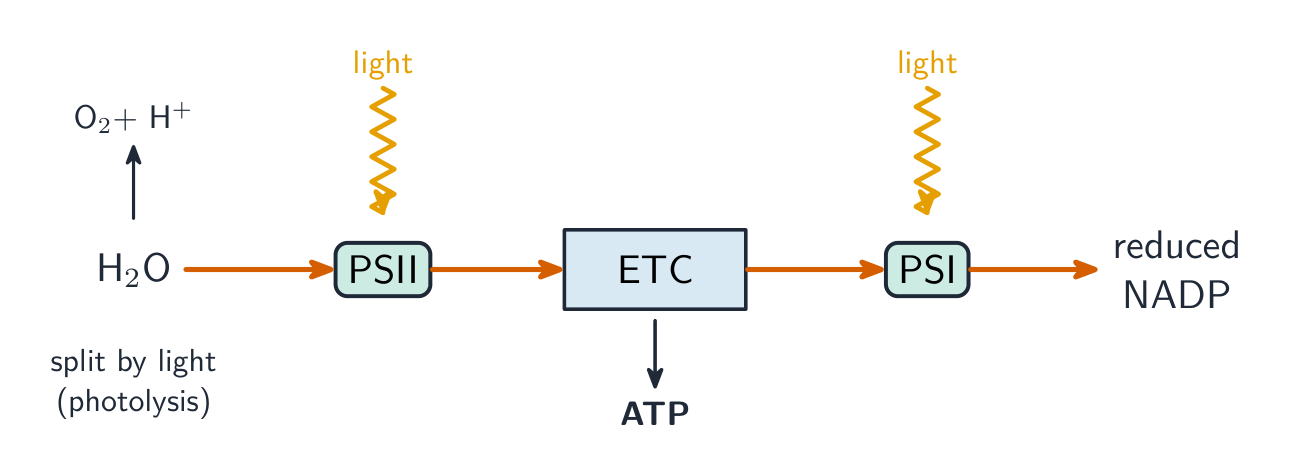
光依赖阶段中的非循环光合磷酸化
The light-dependent stage · 光依赖阶段
Step through it. Light excites electrons and splits water; the result is ATP, reduced NADP and oxygen. · 一步步走过它。光激发电子并分裂水;结果是 ATP、还原型 NADP 和氧气。
Cyclic photophosphorylation: · 循环光合磷酸化:
Cyclic photophosphorylation uses PSI alone and produces ATP only (no NADP reduced, no water split). · 循环光合磷酸化单独使用 PSI,只产生 ATP(没有 NADP 被还原,没有水被分裂)。
Non-cyclic photophosphorylation produces: · 非循环光合磷酸化产生:
Using PSI and PSII, it makes ATP and reduced NADP, and photolysis of water releases oxygen. · 使用 PSI 和 PSII,它制造 ATP 和还原型 NADP,水的光解释放氧气。
How the ATP is made
- In both forms:
- energetic electrons pass along an electron transport chain, releasing energy.
- that energy pumps protons across the thylakoid membrane.
- protons flow back into the stroma through ATP synthase ATP合酶, making ATP (chemiosmosis).
ATP 如何制造
- 在两种形式中:
- 有能量的 电子 沿一条 电子传递链 通过,释放能量。
- 那能量 泵质子 跨过类囊体膜。
- 质子通过 ATP 合酶 流回基质,制造 ATP(化学渗透)。
Photolysis splits water using light energy, releasing oxygen as a by-product. · 光解用光能分裂水,作为副产物释放氧气。
The oxygen released by photolysis is the source of the oxygen in our atmosphere. · 光解释放的氧气是我们大气中氧气的来源。
In the thylakoid, ATP is made as protons flow back through: · 在类囊体中,ATP 在质子通过以下流回时被制造:
Protons pumped into the thylakoid space flow back through ATP synthase, driving ATP synthesis. · 被泵进类囊体空间的质子通过 ATP 合酶流回,驱动 ATP 合成。
Match each part of the light-dependent stage to what it does. · 把光依赖阶段的每个部分与它做的事配对。
Light excites electrons and splits water; the chain makes ATP; reduced NADP carries hydrogen onward. · 光激发电子并分裂水;链制造 ATP;还原型 NADP 把氢带向前。
Photolysis of water
- Light energy splits water in photolysis: water → hydrogen ions + electrons + oxygen.
- The electrons replace those lost by chlorophyll, and the oxygen is released as a waste product.
水的光解
- 光能在 光解 中分裂水:水 → 氢离子 + 电子 + 氧气。
- 电子替换叶绿素失去的那些,氧气作为废产物被释放。
You've got it
- the light-dependent stage = photophosphorylation in the thylakoids
- cyclic: PSI only → ATP only
- non-cyclic: PSI + PSII → photolysis of water (releases O₂) → ATP + reduced NADP
- electrons pump protons → flow back through ATP synthase → ATP (chemiosmosis)
你掌握了
- 光依赖阶段 = 类囊体中的 光合磷酸化
- 循环:只有 PSI → 只有 ATP
- 非循环:PSI + PSII → 水的 光解(释放 O₂)→ ATP + 还原型 NADP
- 电子泵质子 → 通过 ATP 合酶 流回 → ATP(化学渗透)