Scope and prerequisites
Digital SAT framework; original paper practice is nonadaptive and gives no scaled-score prediction.
- Match verbs and pronouns to their actual referents
- Choose tense and verb form from the passage’s time relationship
- Place modifiers and parallel elements so their logical subject is clear
Prerequisites: Subject head; verb timelines; participles and infinitives.
Explain and choose the method
Find the head of the subject rather than agreeing with the nearest noun. A singular collection takes is even when a following of-phrase contains plural maps. A pronoun must agree with and clearly refer to its antecedent 先行词. If two possible antecedents make a pronoun ambiguous, a precise noun can restore the intended reference.
Choose verb tense from the surrounding timeline and logical relationship, not an isolated word. A completed event at a stated past time normally takes a past form. Perfect forms can mark an event before another reference time. An infinitive or participle is not automatically a finite verb 限定动词 and cannot alone supply the main predicate.
An introductory modifier 修饰语 must attach to the appropriate subject. “Walking through the gallery, Maya noticed the new labels” makes Maya the walker. “Walking through the gallery, the labels attracted Maya” incorrectly makes the labels walk. Identify the performer of the introductory action, then check the main subject.
Parallel structures put comparable ideas into compatible grammatical forms: “to collect, to classify and to display” or “collecting, classifying and displaying”. A comparison must compare like things, such as one museum’s hours with another’s hours, not hours with a museum. Meaning and structure work together; a grammatically shaped choice can still create an illogical reference.
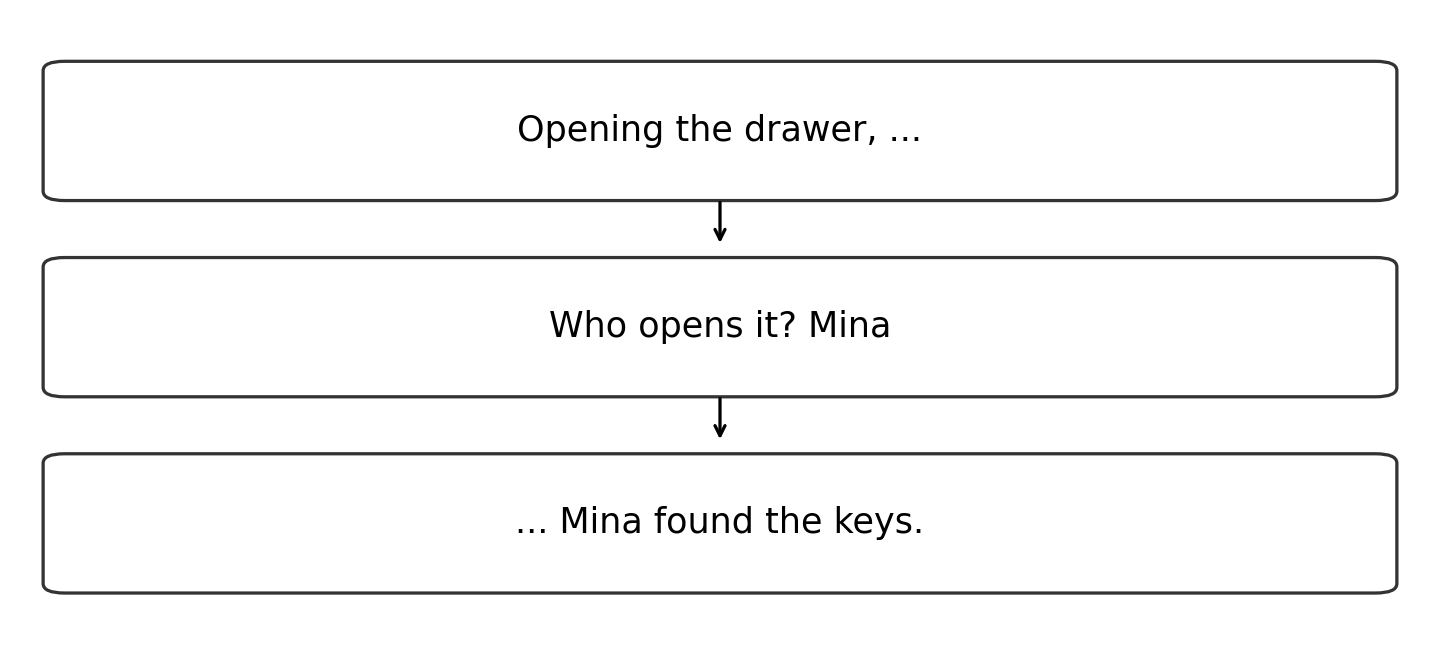
Agreement follows the subject head, not the nearest noun. “The set of keys is missing” has singular set. An introductory modifier must describe the correct actor: “Opening the drawer, Mina found the keys.” “Opening the drawer, the keys appeared” incorrectly makes keys do the opening.
Existing worked example: Original agreement: “The list of proposed changes includes a longer opening period.” List is singular, so includes is correct. Modifier repair: “After examining the samples, the researchers revised their prediction.” Researchers examine; a version beginning “After examining the samples, the prediction…” dangles. Parallel repair: “The team aimed to record, analyse and publish the findings.”
Complete original context
Original editing passage: The collection of donated tools [1: include/includes] three old drills. Examining the smallest drill, [2: a crack surprised Jo/Jo noticed a crack]. Yesterday Jo [3: repairs/repaired] the casing. The volunteer team plans to clean, [4: label/labelling], and display the tools. The museum's opening hours are longer than [5: the archive/the archive's opening hours].
Independent practice and checked reasoning
Transfer 1
Choose forms at [1]–[5] and explain their grammatical and logical roles.
Reasoning: [1] includes agrees with collection. [2] Jo noticed a crack makes Jo the examiner. [3] repaired matches yesterday. [4] label parallels clean and display after to. [5] the archive's opening hours compares hours with hours, not hours with an institution.
Transfer 2
“Before the shop opened last Monday, Jo had checked the drills.” Explain the relationship conveyed by had checked. Is the past perfect required in every sentence about two past events?
Reasoning: The check was completed before the past reference point, opening. Past perfect makes that sequence explicit. It is not compulsory in every two-event account; before or after and context can sometimes make simple past order clear. Judge the actual sentence rather than a universal rule.
Transfer 3
Repair “When Jo met Mina, she showed her the repaired drill” so that Jo is clearly the person presenting and Mina receives it. Give a parallel list of three possible maintenance actions.
Reasoning: “Jo showed Mina the repaired drill when they met.” This removes ambiguous she/her reference. One parallel list is “checking cables, replacing screws, and cleaning handles”; all three use -ing forms.
Limits and next use
Do not agree with a noun inside a prepositional phrase or let an introductory action attach to an inanimate subject that cannot perform it.
All tasks here are public original practice with authored guidance. They are not official questions or fresh diagnostics. Existing protected tests and mocks remain separate.