Scope and prerequisites
Digital SAT framework; original paper practice is nonadaptive and gives no scaled-score prediction.
- Identify each author’s claim and degree of certainty separately
- Explain agreement, disagreement or qualification on the same issue
- Predict one author’s response using their stated reasoning
Prerequisites: Keep speakers separate; distinguish observation from explanation.
Explain and choose the method
Build a brief claim record for each text: topic, position, evidence 证据 and limit. Keep the speakers separate. If Text 1 reports a possibility and Text 2 reports a concern, a response that makes both certain has altered both positions.
Compare claims about the same relationship, not just shared vocabulary. Agreement may concern a benefit while disagreement concerns generalisation. One text may supply evidence absent from the other rather than directly contradict it. Identify exactly which proposition is supported, challenged or narrowed.
When asked how one author would respond, use that author’s reasoning and scope. Do not choose your preferred opinion or a compromise that neither text supports. A response can acknowledge the other text’s evidence while resisting its broad conclusion if that matches the stated limitation.
Check every clause of the answer. A choice may describe Text 1 correctly and misrepresent Text 2, or identify a real disagreement then exaggerate its importance. Trace each assertion back to its source. The final choice must accurately connect both texts, not merely summarise one.
Cross-text comparison 跨文本比较 connects claims about the same issue. “Signs reduced wrong turns” and “lighting also changed during the trial” can coexist. The second statement challenges a causal explanation, not necessarily the recorded reduction.
Existing worked example: Original Text 1: “A trial in one gallery found that longer labels increased the time visitors spent at exhibits, suggesting that detailed labels can promote engagement.” Original Text 2: “Time spent reading does not necessarily indicate deeper engagement; visitors may be trying to understand unclear wording.” Text 2 would question whether time alone supports Text 1’s engagement inference 推断, not deny that the trial recorded more time.
Complete original context
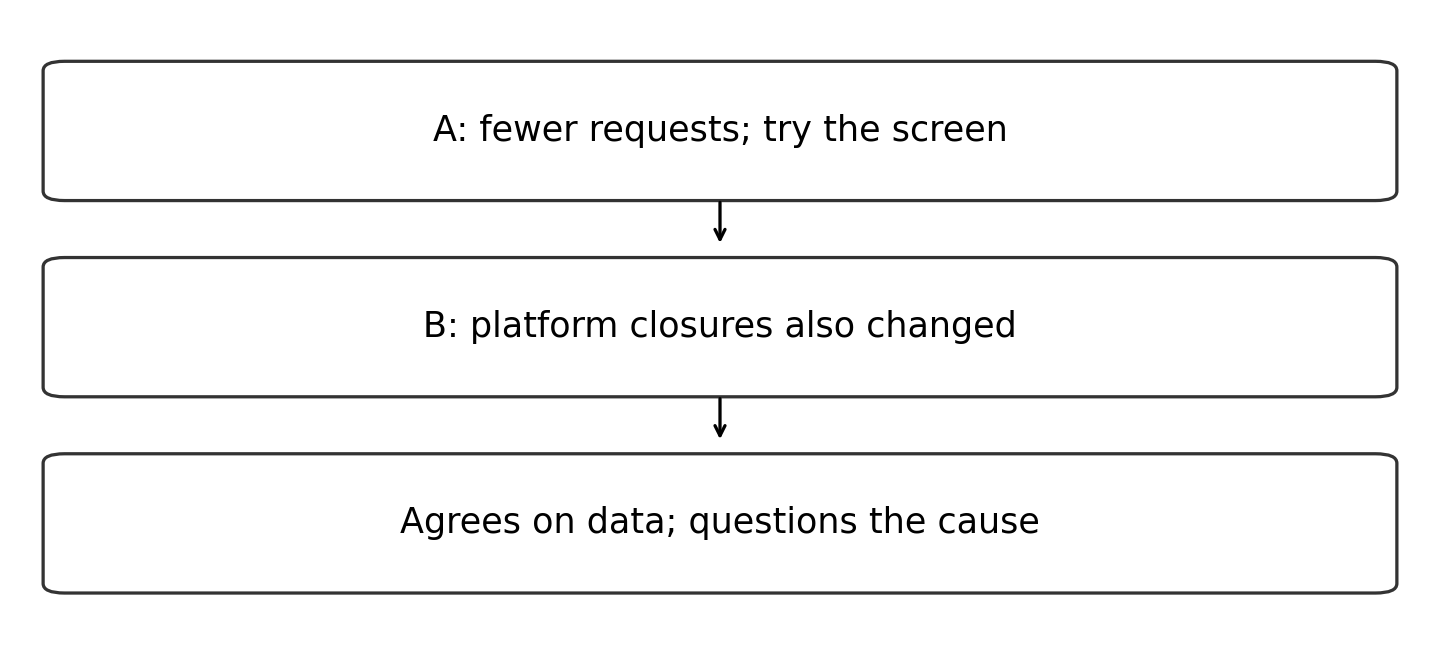
Original Text A: During a two-week trial, a station displayed route information on a large screen. Requests for platform directions fell from 60 in the preceding fortnight to 36. The screen seems a promising way to help travellers find their platforms, and other stations should consider a trial.
Original Text B: Fewer requests were recorded during the screen trial, but several platforms were closed for repairs at the same time. The remaining journeys may have been easier to navigate. Before treating the screen as the explanation, compare similar periods with the same platform arrangement. A further trial is reasonable if it separates these changes.
Independent practice and checked reasoning
Transfer 1
Identify one agreement and the precise disagreement or qualification.
Reasoning: Both accept that recorded requests fell and allow a further trial. B questions attributing the reduction to the screen because platform closures also changed navigation. B does not claim the screen certainly fails.
Transfer 2
How would B most likely respond to “The screen caused a 40% reduction at every station”? Check every part of the claim.
Reasoning: The observed reduction is $(60-36)/60=40\%$ at one station, but B would reject the causal certainty and every-station scope. The simultaneous closures leave an alternative explanation and no observations at other stations are supplied.
Transfer 3
Propose evidence that would address B's concern, and explain why interviewing the screen's designer about its colour would not.
Reasoning: Compare otherwise similar periods or randomised station trials with matched platform arrangements, recording requests and traveller numbers. This addresses confounding and rates. A colour preference interview does not isolate the screen's navigation effect.
Limits and next use
Disagreeing with an interpretation 解释 is different from denying the observation. Keep each author’s evidence and conclusion distinct.
All tasks here are public original practice with authored guidance. They are not official questions or fresh diagnostics. Existing protected tests and mocks remain separate.