Scope and prerequisites
Digital SAT framework; original paper practice is nonadaptive and gives no scaled-score prediction.
- Infer a word’s intended meaning from its sentence and nearby logic
- Use contrast and explanation to determine a missing word
- Choose a word fitting syntax 句法, degree and collocation 词语搭配
Prerequisites: Sentence meaning; contrast and explanation clues.
Explain and choose the method
A familiar word may have several senses. Substitute a simple paraphrase into the sentence and test whether it preserves the relationship. Context, rather than the first dictionary meaning, determines whether check means inspect, restrain or mark a response.
For a blank, decide the needed meaning and polarity before looking at choices. A contrast introduced by but may reverse an expectation; an explanation after because can narrow the intended sense. If the sentence says evidence 证据 is promising yet incomplete, a word meaning cautious or provisional is more plausible than certain.
Check grammatical fit and collocation as well as meaning. A verb must work with its object and complement; an adjective must modify the intended noun. A near synonym can fail if it implies a stronger degree, a different subject or a relationship the passage does not establish.
Avoid treating difficult vocabulary as a contest to choose the most impressive word. Use a neutral paraphrase, eliminate options of the wrong polarity and then compare remaining shades of meaning. Keep a record of words learned in their full phrase, because context and typical combinations help later retrieval.
A word in context 语境中的词义 must fit the relationship, not just a dictionary entry. In “The evidence is thin, so the conclusion remains provisional”, provisional means open to revision. It does not mean temporary employment or physical thinness. Paraphrase before choosing.
Existing worked example: Original sentence: “The committee gave the proposal 提案 qualified support: members approved its aim but requested a smaller trial before expansion.” Here qualified means limited or conditional, not certified or skilled. Original blank: “Because the observations were few, the author described the conclusion as ___ rather than definitive.” Provisional fits the explicit contrast with definitive.
Complete original context
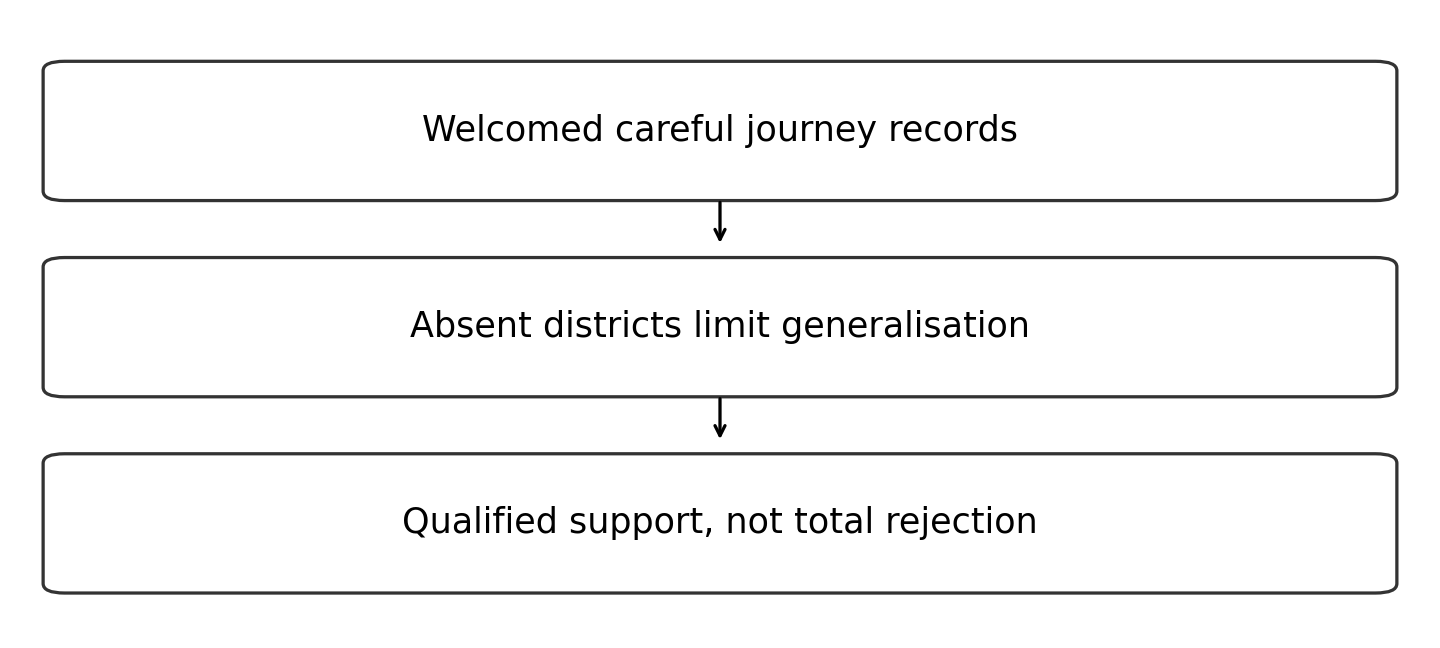
Original passage: The reviewers welcomed the survey's careful record of individual journeys, but they gave its city-wide conclusions only qualified support. The routes had been chosen for convenience, and several districts were absent. One reviewer called the record illuminating: it made previously overlooked travel difficulties easier to understand. Another cautioned that extending the conclusions would require a broader sample. The authors accepted this reservation and proposed a second survey.
Independent practice and checked reasoning
Transfer 1
Explain qualified, illuminating and reservation in this passage. Quote a clue for each.
Reasoning: Qualified means limited or conditional, supported by absent districts and a need for broader sampling. Illuminating means revealing or clarifying, supported by difficulties becoming easier to understand. Reservation means a concern or limitation, supported by caution about extending conclusions; it is not a booked seat.
Transfer 2
Compare “The reviewers dismissed the survey” with “The reviewers endorsed its conclusions without reservation”. Why does neither fit?
Reasoning: Dismissed ignores their welcome for its careful records. Endorsed without reservation erases the sampling concern. The attitude combines appreciation of the records with limited support for broader conclusions.
Transfer 3
Replace illuminating with revealing, dazzling or visible. Which best preserves meaning and why do the others fail here?
Reasoning: Revealing preserves the idea that the record makes difficulties understood. Dazzling introduces brilliance or admiration beyond the stated clarification. Visible describes perceptibility, not the survey's explanatory contribution. This is a contextual meaning 语境义 decision, not a rule that those words are always wrong.
Limits and next use
A recognisable synonym may still carry the wrong strength or grammatical use. Do not ignore the explanation after the colon 冒号.
All tasks here are public original practice with authored guidance. They are not official questions or fresh diagnostics. Existing protected tests and mocks remain separate.