Scope and prerequisites
Digital SAT framework; original paper practice is nonadaptive and gives no scaled-score prediction.
- Interpret slope and intercept of a fitted model in context
- Calculate a residual 残差 and distinguish interpolation from extrapolation 外推
- Choose linear or exponential patterns from equal-step data
Prerequisites: Linear functions; signed subtraction; scatterplot labels.
Explain and choose the method
A scatterplot pairs two quantitative variables, one point per paired observation. A fitted line summarises a trend rather than connecting each point. In a model y=a+bx, b predicts the change in y for one-unit increase in x; its units are y-units per x-unit. The intercept a predicts y when x=0, which may lie outside the data range.
A residual is observed y minus predicted y. Positive means the observation lies above the model; negative means below. Substitute the observed x into the model before subtracting. A large residual marks a poor prediction for that point, not automatically an error in measurement or proof that the trend is absent.
Interpolation predicts inside the observed x-range; extrapolation goes beyond it and needs stronger caution because the relationship may change. Use a model’s contextual domain as well as its algebraic form. A negative predicted travel time, for example, can reveal an unjustified extrapolation rather than a physically possible outcome.
For equal input steps, nearly constant output differences suggest a linear model; nearly constant output ratios suggest an exponential model. Scatter can make either pattern approximate. Association does not identify a cause: both variables may reflect a third factor. A fitted trend is evidence 证据 about prediction, not by itself about intervention.
A residual is observed minus predicted output. A journey model $T=5+2d$ uses minutes for $T$ and kilometres for $d$. $T(4)=5\,\mathrm{min}+(2\,\mathrm{min/km})(4\,\mathrm{km})=13\,\mathrm{min}$. For observed time 16 minutes, $e=T_{obs}-T_{pred}=16\,\mathrm{min}-13\,\mathrm{min}=3\,\mathrm{min}$.
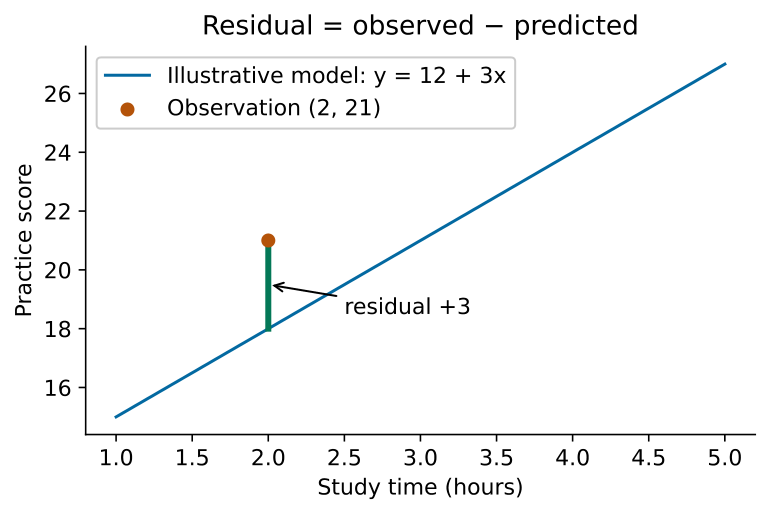
Existing worked example: For study time x hours and predicted practice score y=12+3x, the slope is 3 score points/hour. At x=2 the prediction is 18. If the observed score is 21, residual=21-18=3. With x-values observed from 1 to 5, predicting at x=3 interpolates and x=12 extrapolates. Outputs 5,10,20,40 at equal input steps suggest factor-two exponential growth.
Complete original context
Every transfer question states all data it needs.
Independent practice and checked reasoning
Transfer 1
A fitted delivery model is $T=8+1.5d$ minutes for observed distances 2–10 km. Interpret both parameters. At 6 km the observed time is 15 minutes; find its residual.
Reasoning: The intercept predicts 8 minutes at zero distance; zero lies outside the observed range, so this interpretation is extrapolated. The slope predicts an extra 1.5 minutes per kilometre. $T(6)=8\,\mathrm{min}+(1.5\,\mathrm{min/km})(6\,\mathrm{km})=17\,\mathrm{min}$. Residual $e=15\,\mathrm{min}-17\,\mathrm{min}=-2\,\mathrm{min}$, below the line.
Transfer 2
Predictions are requested at 7 km and 20 km. Classify each, and explain why a fitted slope does not prove distance alone causes all time variation.
Reasoning: Seven is inside 2–10, so interpolation. Twenty is outside, so extrapolation with weaker support. Traffic, loading and other conditions can influence time; a fitted association does not isolate their effects.
Transfer 3
At equally spaced inputs 0,1,2,3, outputs are 6,18,54,162. Choose a simple linear or exponential rule and predict at 4, stating the assumption.
Reasoning: Ratios are all 3, while differences vary. The exponential rule is $y=6(3)^x$. Under continued factor-three growth, $y(4)=6(3)^4=486$. This is a model-based extrapolation, not a guaranteed next observation.
Limits and next use
Keep observed minus predicted in that order. Do not turn a model slope into a causal treatment effect.
All tasks here are public original practice with authored guidance. They are not official questions or fresh diagnostics. Existing protected tests and mocks remain separate.